



'Cover-up' claims from US are all sound and fury







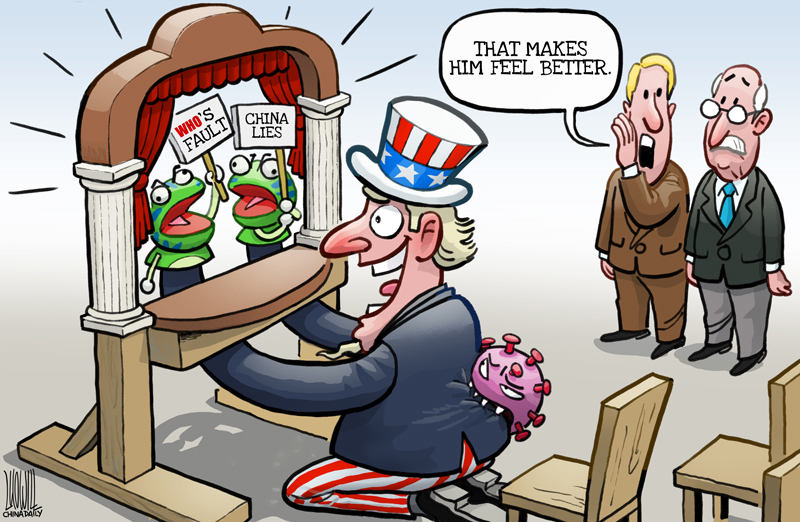
'Cover-up' claims from US are all sound and fury
"There are three kinds of lies: Lies, damned lies, and statistics."
Mark Twain is often credited for this well-worn adage about the power of numbers to deceive. He didn't come up with it, but it sure sounds like something he'd say.
Some in the United States have studied this expression well, given their latest attacks on China. They've made it a little simpler, though: In the absence of statistics, all they have to throw around are lies.
The newest round of absurdities comes courtesy of a government and media struggling to find a scapegoat for their disastrous handling of the COVID-19 pandemic. As China emerges from lockdown after successful containment of the virus — though concern remains over a possible second wave — a furious US populace, with tens of thousands dead and hundreds of thousands infected, is demanding to know why those in charge did not act sooner. Rather than provide an apology or real solutions, some are alleging China deliberately undercounted its infections and deaths in an effort to "cover up" the scale of the outbreak and mislead the world.
This is, of course, an utter falsehood. Ask any of these people to substantiate their claims and they'll come up empty, maybe mumble something about their gut tells them they're right. At most, they will cite poorly sourced reports that should never have been published in the first place. One, which got play in major media outlets, relied on back-of-the-napkin estimates of cremations in Wuhan from anonymous social media accounts. Talk about due diligence! For this theory to even be entertained you have to assume people stop dying from other causes during an epidemic. Do these charlatans honestly believe heart disease is taking a break right now? Is cancer?
Another story, even more ludicrous than the last, contends that millions of mobile phone accounts deactivating during the outbreak indicates an astronomically larger death toll than what's been reported. Again, common sense flies in the face of such outrageous charges. Has it never occurred to the rumor-mongers that when a country of over a billion people is locked down, some of them might choose to rely on home internet? Many migrant workers have multiple SIM cards to take advantage of lower rates when traveling through provinces. These considerations were either ignored or brushed off — all to point the finger at a country that has minimized its people's suffering.
Friday's revision of Wuhan's death toll has thrown fuel on the conspiratorial fire. Already the hyenas in the Western press are salivating, drawing the worst possible conclusions from what would be commended if it happened in any other country. Now that the worst of the outbreak has passed, Wuhan has been able to take a breath and audit its data to ensure an accurate count. One would think this is the very behavior critics want to see. But since they're continuing to take potshots at China anyway, we can guess how genuine their commitment to transparency really is.
The uptick in numbers has several perfectly reasonable explanations. When the virus was at its apex, health systems were stretched to their absolute limits. This was remedied with the swift construction of temporary hospitals, but those Herculean efforts could not save everyone and some sadly passed away at home. Testing infrastructure also took time to catch up to the spread of the epidemic, meaning some who died of the virus were previously uncounted. Any increase in death tolls is cause for heartbreak, of course. But it’s better in the long run to have as precise as possible — and the 1,290 Wuhan revised yesterday is a far cry from the tens of thousands or millions some were twisting themselves into pretzels to make sound plausible.
Putting all that nonsense aside, basic arithmetic calls the whole "cover-up" thesis into question. Though it has a large urbanized population, China's proportional death rate falls well within a reasonable range; China's per-million rate falls below the Republic of Korea's and above Japan's, for instance. Strangely enough, no one is accusing Japan of falsifying its numbers. I'm sure its economic and strategic relationship with the US has nothing to do with that.
What appears to be the determining factor in whether a country can minimize infections and deaths is the level of its outbreak response, and how rapidly that response is implemented. Countries that acted quickly have seen exponential infection growth rates flatline; like a fire without oxygen, a virus with no new hosts is eventually snuffed out. Countries that dragged their feet, on the other hand, are seeing devastating consequences.
With that in mind, let's again review China's methods to see if the country passes muster. Days after sustained human-to-human transmission was confirmed, China enacted an unprecedented outbreak control regime. Among other measures, it included near-universal temperature checks, a leveled system of screening and clearly partitioned levels of quarantine. In particular, the centralized isolation of patients with mild symptoms away from home was singled out by the World Health Organization as the most effective method of curbing the spread of the virus — something the United States has yet to implement on a wide scale.
In China, testing and treatment were made free to all; meanwhile potential carriers in the US, where millions have lost their jobs and for-profit health insurance reigns supreme, are often avoiding the hospital and staying home. This can spread the virus to family members and other close contacts.
That's assuming they're not being made to work, of course. As there are no binding national-level guidelines on outbreak control or essential employment, states and localities have been given a great deal of latitude in how they are handling their epidemics. Some have adopted the necessary protocols to hamper infections. Others have dismissed concerns and voiced their desire to return to "business as usual". We will know soon enough which approach is the right one; some will pay dearly for this little federalist experiment.
There is no "cover-up" to blame for the relatively modest casualty count in China. We know exactly who is responsible: The Chinese people, who took the threat of the virus seriously and sacrificed personal comfort to comply with lockdowns, especially in Wuhan; the healthcare professionals who risked life and limb to battle the disease on the front lines; and the Chinese government, which acted decisively to blunt the contagion's spread.
That success was paid for with blood, and those who lost their lives should be venerated as martyrs in a struggle for the survival of the human race. Implying such a hard-won victory came about by fudging statistics or outright lying dishonors their memories. It's nothing more than a cheap dodge, meant to smother the wholly righteous anger radiating from those demanding answers from their government.
Instead of fabricating conspiracies from thin air, the US should be asking what it can learn from China's experience combating the epidemic. Maybe then it would see how the death rate has been kept so low.
The author is a US writer with China Daily.
The opinions expressed here do not represent the views of China Daily and its website.





