China's contagion response deserves support, experts say







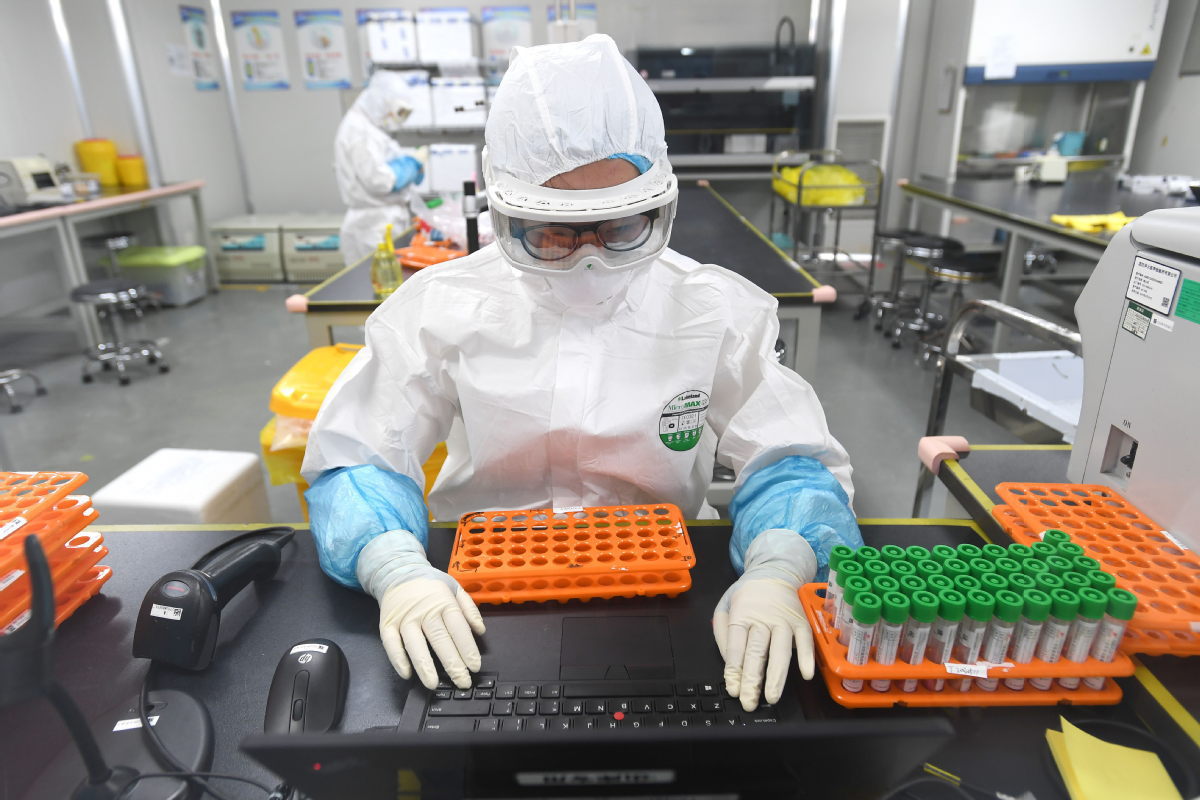
Experts said it is unfair and unreasonable to say that China should have acted earlier and more decisively against the COVID-19 outbreak because it is a brand-new disease that scientists barely understand and existing knowledge is constantly evolving.
China has been taking concrete actions against the outbreak since it emerged based on the understanding of the virus at the time, they added. The nation has also frequently updated the international scientific community on new developments, and these efforts should be recognized, rather than smeared from the vantage point of hindsight.
As the COVID-19 pandemic spreads across the globe, some countries have recently accused China of misinforming the World Health Organization about the severity of outbreak when it began, thus luring the international community into a false sense of security and resulting in their lackluster response.
In response to such accusations, Wang Ting, director-general of the China Research Institute for Science Popularization, said that it takes time and great effort to research a new pathogen's capability, and "such is the pattern for any scientific inquiry that seeks to unravel the mystery of an unknown topic".
"No responsible institution or country should jump to conclusions when discussing the virus' characteristics without sufficient and solid evidence," he said in an interview with China Daily. "China is a country with 1.4 billion people, there are no grounds to blame it for being careful and meticulous when dealing with a new virus nobody could have anticipated."
Jin Qi, director of Pathogen Biology Institute of the Chinese Academy of Medical Sciences, said that individual cases with pneumonia of an unknown origin were reported in Wuhan in late December, but it was not until Jan 8 that scientists were able to initially identify a new coronavirus as the cause of the epidemic, as more cases and studies were needed to discover the link between a new virus and a disease outbreak.
On Jan 3, China began regularly informing the WHO and the United States of the outbreak, and the heads of the two nations' centers for disease control and prevention spoke over the phone about the situation and their cooperation on Jan 8.
On Jan 9, Chinese scientists confirmed the outbreak was caused by a new coronavirus and informed the WHO, which issued online a comprehensive technical guidance package the next day with advice to all countries on how to detect and manage potential cases based on what was known at the time.
On Jan 12, about two weeks after the first case was reported, China shared the genetic sequence of the novel coronavirus with the WHO and the international scientific community.
In early and mid-January, the National Health Commission sent three teams of senior medical experts to Wuhan to research the outbreak. On Jan 20, the third team, led by noted respiratory disease expert Zhong Nanshan, confirmed that it could be transmitted between humans.
On Jan 22, experts from the WHO's China and Western Pacific regional offices, reaffirmed China's findings after a two-day inspection in Wuhan and said more investigation was needed to understand the full extent of its transmission.
Michael Ryan, executive director of the WHO's Health Emergencies Programme, said at a news conference that "there is an understandable confusion that occurs at the beginning of an epidemic".
"So we need to be careful to label misunderstanding versus misinformation; there's a difference. People can misunderstand and they can overreact."
Looking back at the whole chain of events, the local health authorities did publicly announce the appearance of the disease very early, which dispelled the notion that there was a cover-up, said Xue Lan, dean of Schwarzman College and the School of Public Policy and Management at Tsinghua University.
"When the problem was recognized, China's response was very decisive and quick," he said while attending an online panel about fighting COVID-19 organized by the Brookings Institution on April 3. "The challenge is how you can recognize the problem early enough."
Li Taisheng, a professor of infectious diseases at Peking Union Medical College Hospital, said it takes time for scientists to get more knowledge about a new virus, and it was very difficult to predict what would happen next.
"It is always easier to be wise after an event," he said. "But at the beginning of the outbreak, it was not feasible to make a huge decision hastily such as the lockdown of a big city when we had little knowledge of the virus, considering the huge social and economic impact of the decision."
Huang Yu, deputy director of the Department of Medical Genetics at Peking University, said that given the vast amount of scientific literature published globally by China on the epidemic since it began, "it is ludicrous to think the Chinese government is attempting to censor the facts and truths".
"The evidence is all in the journals; just because reporters and politicians don't read them does not mean China hasn't been forthright about the situation and its development," he said. "Some politicians' and media's blatant disregard of science and facts is unhelpful. In this challenging time, people should have more faith in science and the scientific method."
Evolving knowledge
Despite the emergence of the novel coronavirus four months ago, scientists still know surprisingly little about the pathogen, and many previous assumptions have been overturned.
For example, scientists initially believed the disease would mostly affect the elderly, which turned out to be false. Candidates for the intermediate hosts included snakes, pangolins and domestic pets such as cats and dogs, but all the current studies have proved to be inconclusive.
The latest piece of knowledge being contested is the virus' contagiousness. Last month, scientists estimated the R0 value of the novel coronavirus was around 2.2, meaning a single infected person would infect about 2.2 others on average. By comparison, influenza has an R0 of 1.3, and SARS is 3.
But an early access study from the Los Alamos National Laboratory in the US last week said the medium R0 value for the coronavirus could be 5.7-more than double the previous estimate. This puts it on par with polio, smallpox and rubella, which have a R0 range of 5 to 7.
A Beijing biology professor who requested anonymity said if the latest US study is correct, "it is a very startling number, and may very well justify China's swift and sweeping measures in containing the virus".
It took "great political courage "to lock down a city of 11 million on Jan 23, and later the entire Hubei province, when there were around 600 reported cases nationwide right before the Spring Festival holiday-the nation's biggest travel and spending season, he said.
"If we had known the virus is this contagious from the very beginning, we may have quarantined the city earlier. But the reality is we didn't know and we can't foresee the future, we could only act with the information at our disposal at the time."
The assumption that the virus mostly attacks the lungs has also been augmented, as clinical evidence is showing that it can affect or damage other systems such as heart, kidney, liver and reproductive organs, said Mao Yonghui, a senior kidney doctor at Beijing Hospital who served in intensive care units at Tongji Hospital's Zhongfa Xincheng branch in Wuhan.
"Thousands of senior medical experts across different fields poured into Wuhan in early February and worked tirelessly in multidisciplinary teams," she said. "Having this holistic treatment plan is absolutely critical in lowering the death rate for severely ill patients given how the virus can impact so many parts of the body."
Mao said Chinese officials had told her and other doctors to place saving lives as the "paramount priority" and they would give them "maximum support". With these efforts, the fatality rate at her ICU wards was less than 3 percent, when the rate for critically ill patients in other parts of the world could be up to 78 percent.
She added that "if foreign media and politicians question the authenticity of our low casualty figure, they should ask themselves, have they gone to the extent that China did in supporting their doctors and patients?"
Wang Xiaodong contributed to this story.


- Beijing community leads the way in grassroots governance
- HKSAR govt extends thanks to various units for supporting people affected by residential complex fire
- Influencers barred from vulgar, false, or harmful content
- Hangzhou–Quzhou High-Speed Railway begins operations
- China records rise in survival prospects for child and adolescent cancer patients
- Ministry unveils draft revision of the national air quality standards