Regional trade key to pandemic-ravaged world







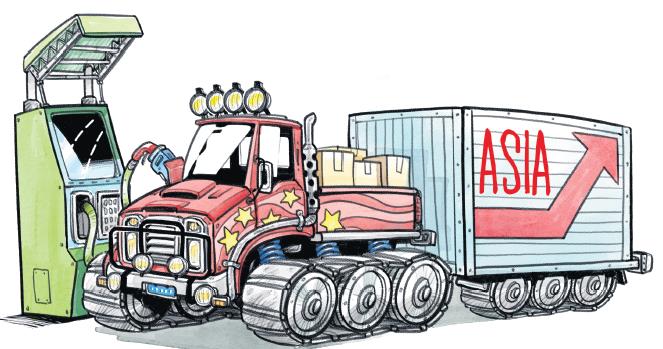
Against the backdrop of the raging COVID-19 pandemic, it is essential to speed up regional trade development strategy in Asia. The main reasons include regionalization that has take on greater importance, a global industrial chain that faces the risk of being curtailed, and the trend of reverse globalization.
First, regionalization has take on greater importance, and to a large degree replaced globalization. Under the influence of economic nationalism and mercantilism, some Western developed economies have rapidly deployed and developed their regional trade strategies.
In 2018, we saw the United States-Mexico-Canada free trade area agreement that replaced the North American Free Trade Agreement reached in 1994; the US-Korea Free Trade Agreement; the Japan-led Comprehensive and Progressive Agreement for Trans-Pacific Partnership, and the European Union and Japan's Economic Partnership Agreement. In 2019, there was also the US-Japan Trade Agreement.
It can be concluded that the more advanced an economy is, the more it intends to use regional trade agreements or RTAs, or upgraded free trade agreements or FTAs, to replace globalized multilateral agreements, with obvious geopolitical features.
Second, there is a risk of curtailing the global industrial chain. RTAs or FTAs have become an important way of cross-regional trade. Some of their important provisions will significantly shorten the industrial chain. For example, the US-Mexico-Canada Agreement stipulates the local production limit of auto parts.
Third, Asian economies are both competitors and partners. The economic level of Asian countries and regions is relatively distinct: there are developed countries such as Japan and South Korea; most of the rest are developing economies. So, their difference in cost and technology determines that there is obviously room for cooperation. At the same time, since most of them are developing economies, there is also some competition among countries with similar costs and technological levels.
However, it should be noted that economies are different from each other in terms of their resources. Even if their cost and technology levels are similar, there is a clear complementary relationship among them, thus a lot of room for cooperation. According to the results prepared by a new International Monetary Fund study, China's importance to the Asian industrial chain is higher than the average level of that to the global industrial chain (see chart alongside). Therefore, further acceleration of Regional Comprehensive Economic Partnership or RCEP is essential for common development in the region.
Finally, the market under the impact of the pandemic exposes itself to the risk of "endogenous reverse globalization". As the contagion continuously exerts negative impact on the economy, different countries and regions have adopted policies to hedge risks. Even if the outbreak is to basically end, the weak demand will continue for a certain period of time, due to the impact of the income decline in early days. It means that trade itself will shrink accordingly, leading to the risk of "endogenous reverse globalization".
To lower such a risk in the market, it is necessary to use RTAs to facilitate business activities in the region and to release the potential for demand at different levels, which depends on different consumers' per capita income in the region. Therefore, the establishment of a larger free trade area will help the economic development in the post-pandemic era and reduce the economic losses caused by the disease.
The China-ASEAN Free Trade Area was established in Asia in 2010. It is a free trade area with the largest population established entirely by developing countries. On the basis of the 10 + 1 framework, the RCEP among 10 + 6 (refers to 10 countries of ASEAN and six other countries in the Asia-Pacific region) will become a higher level of free trade regional cooperation agreement following World Trade Organization rules.
Once the RCEP is inked, the total economic volume of the region will reach a level that is comparable to EU28 (or the European Union comprising a group of 28 countries). The RCEP, together with the United States-Mexico-Canada Agreement and the EU28, will be called the world's three largest trade areas. It is of great significance to the economic integration in the Asian region.
In the meantime, China, Japan and South Korea have integrated their industrial chain to quite a high degree, which can be drawn from their trade relationship. Japan and South Korea, both advanced economies, have advanced technologies and products in many fields. It has positive significance for China to enhance its own technology and trade. The China-Japan-South Korea free trade area and the RCEP are critical for China to play its role in Asian trade.
Each economy's complete industrial chain will be constrained by its resource, technology and cost, while the trend of globalization will be reversed. In this context, regionalization of trade is a desirable choice that emphasizes cost and efficiency. I expect that the China-Japan-South Korea FTA and the RCEP can be signed as early as possible this year.
Amid financial turmoil brought by the pandemic, it should have been an opportunity for the world to cooperate in surmounting the difficulties. A good example is that in late March, leaders of the Group of 20 major economies vowed to pump over $5 trillion into the global economy to limit job and income losses from the coronavirus.
But in recent months, there have been a lot of developments that can reverse globalization, such as the oil price war, groundless accusations about the origin of the virus and the scramble for scarce resources worldwide.
Crude oil prices have plunged since the beginning of this year. The average price is at its lowest point in more than a decade. The intricate geopolitical relations among the three international giants in crude oil production-OPEC's representative Saudi Arabia, Russia and the US-make it difficult for them to reach a long-term agreement in the oil market. Since the outbreak of the epidemic, even a temporary agreement has not been reached. The volatile crude oil market is not conducive to economic globalization.
Measures taken by many economies, like the temporary lockdowns to prevent the rapid spread of the novel coronavirus, have already restricted the global flow of people and resources. They should have helped each other to overcome difficulties, but instead some advanced economies imposed curbs on medical supply exports.
They neglect the fact that a large number of low-income and under-developed economies in the world have very scarce medical resources, and have been waiting for international assistance.
It has been noticed often that some of the world's most important advanced economies tend to protect themselves when facing a crisis, which shows that they lack a sense of international responsibility.
These behaviors pose severe challenges to globalization in the future, but won't be able to stop the process altogether. In the past few decades, most economies have witnessed and enjoyed better labor division and welfare growth brought about by globalization, and they thereby will likely make rational choices.
Wang Jinbin is a researcher at the RUC's National Academy of Development and Strategy, and the executive deputy secretary of the Party committee of the School of Economics at the Renmin University of China in Beijing.
- Shanghai implements policies to boost business, foreign investment
- China's weekly export container shipping index dips
- 'World's Supermarket' in Yiwu springs back to post-epidemic life
- Digital economy growth gives push to virus fight
- Govt revising foreign investment catalogue to boost processing trade