



Make climate part of the anti-virus fight







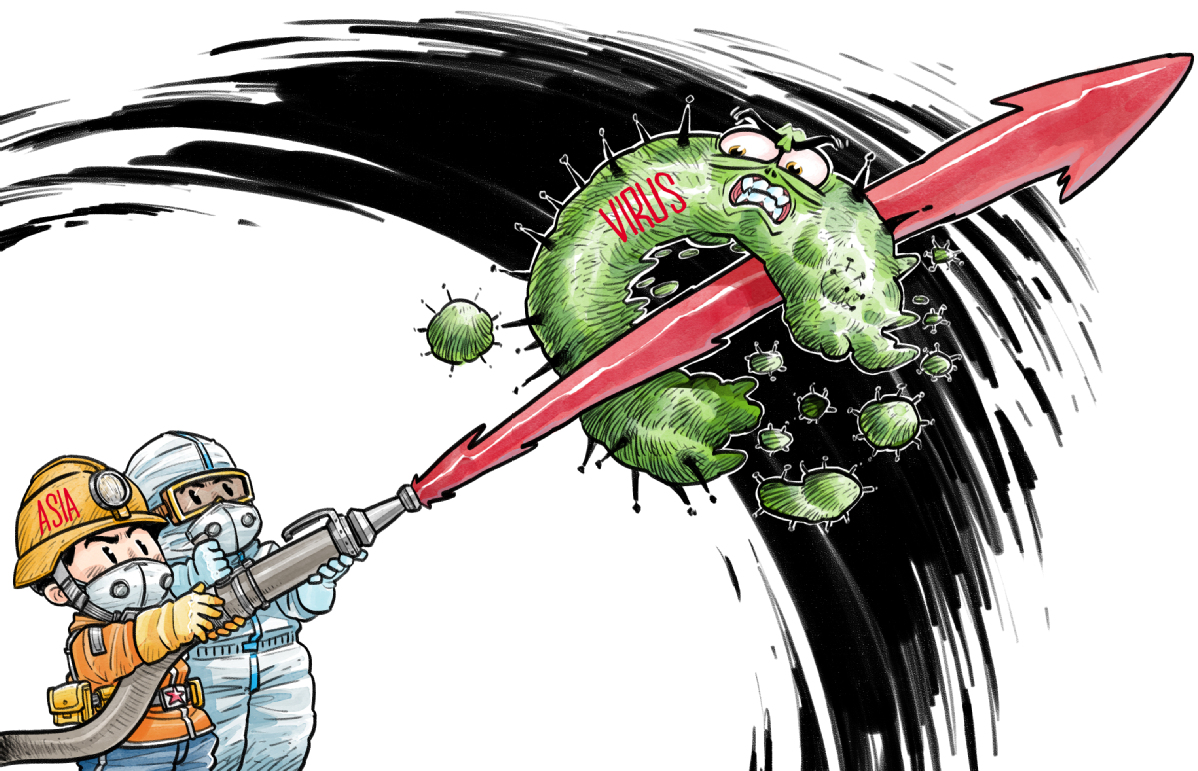
The unprecedented public health emergency triggered by the novel coronavirus pandemic and its multi-faceted impact on people's lives around the world is taking a heavy toll on Asia and the Pacific.
Countries in the Asia-Pacific region are striving to mitigate the massive socioeconomic impact of the pandemic, which is also expected to affect the region's economic health. In its annual Economic and Social Survey of Asia and the Pacific 2020 released on April 8, the United Nations Economic and Social Commission for Asia and the Pacific expects growth in Asia-Pacific developing economies to slow down significantly this year.
Bold investments to sustain the region's physical and economic well-being are imperative. The survey advises policymakers to protect the economic health of the region by taking measures that support affected businesses and households and prevent economic contagion. To tackle the pandemic in developing Asia-Pacific countries, the survey also calls for an estimated increase in health emergency spending by $880 million per year through to 2030.
Fiscal support will be crucial in enhancing health responders' ability to monitor the spread of the pandemic and caring for infected people. ESCAP is also calling on Asia-Pacific countries to consider setting up a regional health emergency preparedness fund.
The pandemic should also make us rethink our economic growth path that has come at a heavy cost to people and the planet. According to the latest ESCAP assessment on implementing the 2030 Agenda for Sustainable Development, the Asia-Pacific region is not on track to achieve any of the 17 Sustainable Development Goals by 2030, with regression on several environmental goals.
This stands in stark contrast to the region's impressive gains in material prosperity, which have been powered by intensive resource use. We are currently paying the price amid a public health emergency in a region with 97 of the 100 most air-polluted cities in the world and five of the 10 countries most vulnerable to climate change. Economic policymaking is understandably focused on maximizing growth to reduce poverty and create jobs. Yet we need to question this when the methods of growth undermine its sustainability over the long term.
The 2020 survey proposes a transition toward a growth path that ensures we bequeath a healthy planet to future generations, and calls for a shift in the paradigm of production and consumption, which is at the core of all economic activities.
To bring about this fundamental shift in the way we produce and consume, we need to adopt the motto of "no more business as usual" for all stakeholders in planetary well-being, namely governments, businesses and consumers. Policymakers should not lose sight of a looming climate crisis, but instead design economic stimulus packages with social inclusion and environmental sustainability built into every decision.
The survey identifies challenges and constraints to making this switch for each group of stakeholders. The good news is that it is possible to meet these challenges and align the goals of all stakeholders with the 2030 Agenda for Sustainable Development.
In particular, the survey urges governments in the region to embed sustainability in policymaking and implementation, transition out of fossil fuel dependency, and support the greening of finance. The region continues to provide $240 billion worth of annual subsidies to fossil fuels while investments in renewables remain at $150 billion.
Businesses can integrate sustainability by factoring in the environmental, social and governance aspects in investment analysis and decisions. Carbon pricing will be a key tool to reduce emissions and mitigate climate-related risks. And the region is already a leader in adopting emerging sustainable business paradigms of the shared economy and circular economy.
All of us, as consumers, must understand the importance of switching to sustainable lifestyles. This will begin with increasing awareness of the impact of consumer choices on people and the planet. Governments need to play a vital role in encouraging consumer choices through positive reinforcements, small suggestions and eco-labelling of products.
Integrating sustainability also requires international collaboration, given the interconnected world we live in. Asia-Pacific governments need to coordinate their climate action, particularly the development of climate-related standards and policies. Having achieved so much, yet also at the risk of losing so much, the Asia-Pacific region stands at a pivotal moment in its development journey. The next phase of its economic transformation should be more sustainable, with cleaner production and less material-intensive lifestyles.
With headwinds to the region's development journey strengthened by the pandemic, let us heed the United Nations secretary general's call to mobilize for a decade of action to build a sustainable and resilient future.
The author is the United Nations undersecretary-general and executive secretary of ESCAP. The views don't necessarily reflect those of China Daily.





