


Scientists discover smallest dinosaur of all time







An international team of scientists recently discovered the skull of a tiny bird preserved in 100 million-year-old Myanmar amber dating to the Cretaceous period, according to a paper newly published in renowned scientific journal Nature.
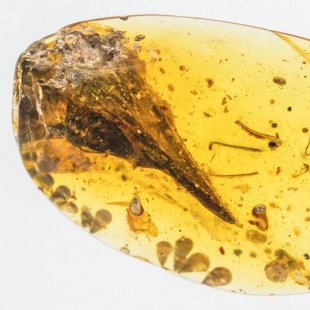
The 14-millimeter-long skull is smaller than that of a bee hummingbird, the smallest living bird, making the new species, Oculudentavis khaungraae, the smallest bird – and thus dinosaur – ever found.
When Xing Lida, a paleontologist at the China University of Geosciences, who led the research, first saw the amber in 2016, he was amazed.
"It's awesome. It's like a tiny arrow with a long beak and big eyes. Too strange. Only birds have such characteristics," he said.
"But it had too many teeth, much more than the common early Cretaceous birds," he said.
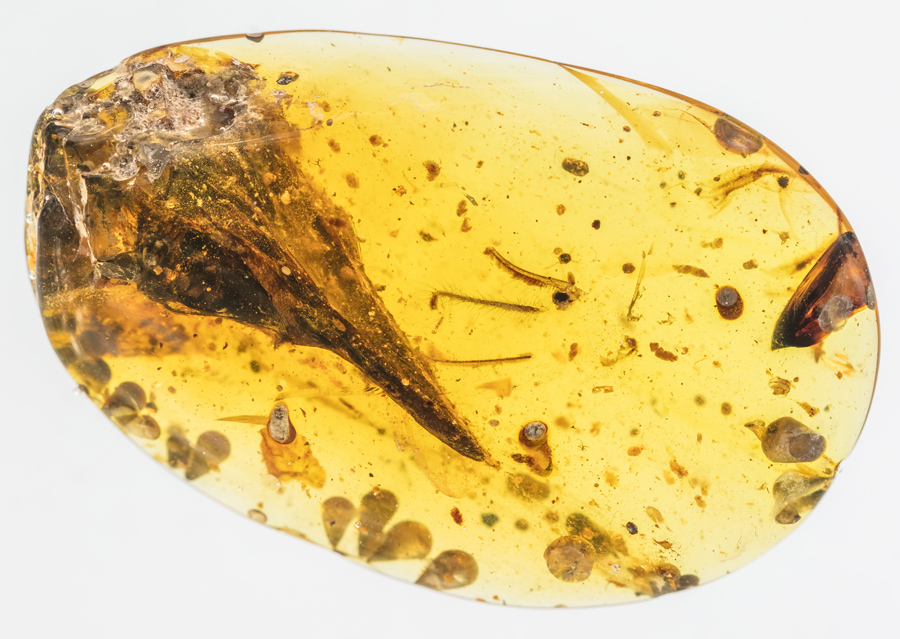
The well-preserved fossil skull has rows of nearly 100 teeth that extend all the way under its big eyes that are supported by scleral rings (eye bones) of a unique structure. The unusually high number of teeth and the unique shape of the eye make it difficult for paleontologists to classify the specimen, nicknamed Teenie Weenie.
Scientists speculate that about 100 million years ago this bird-like animal lived in the tropical humid Hukawng Valley in northern Myanmar, where the amber was mined, and was unfortunately trapped by globs of resin that dropped from trees, leaving it exquisitely preserved in the amber through millions of years.
The most interesting thing about the specimen is its unusually small size, Xing said.
Paleontologists note that animals that become very small have to deal with new problems, like how to adjust all sensory organs in a very small head or how to maintain body heat. They call this process miniaturization, which commonly occurs in isolated environments like islands. During miniaturization, animals normally have lost teeth and enlarged eyes.
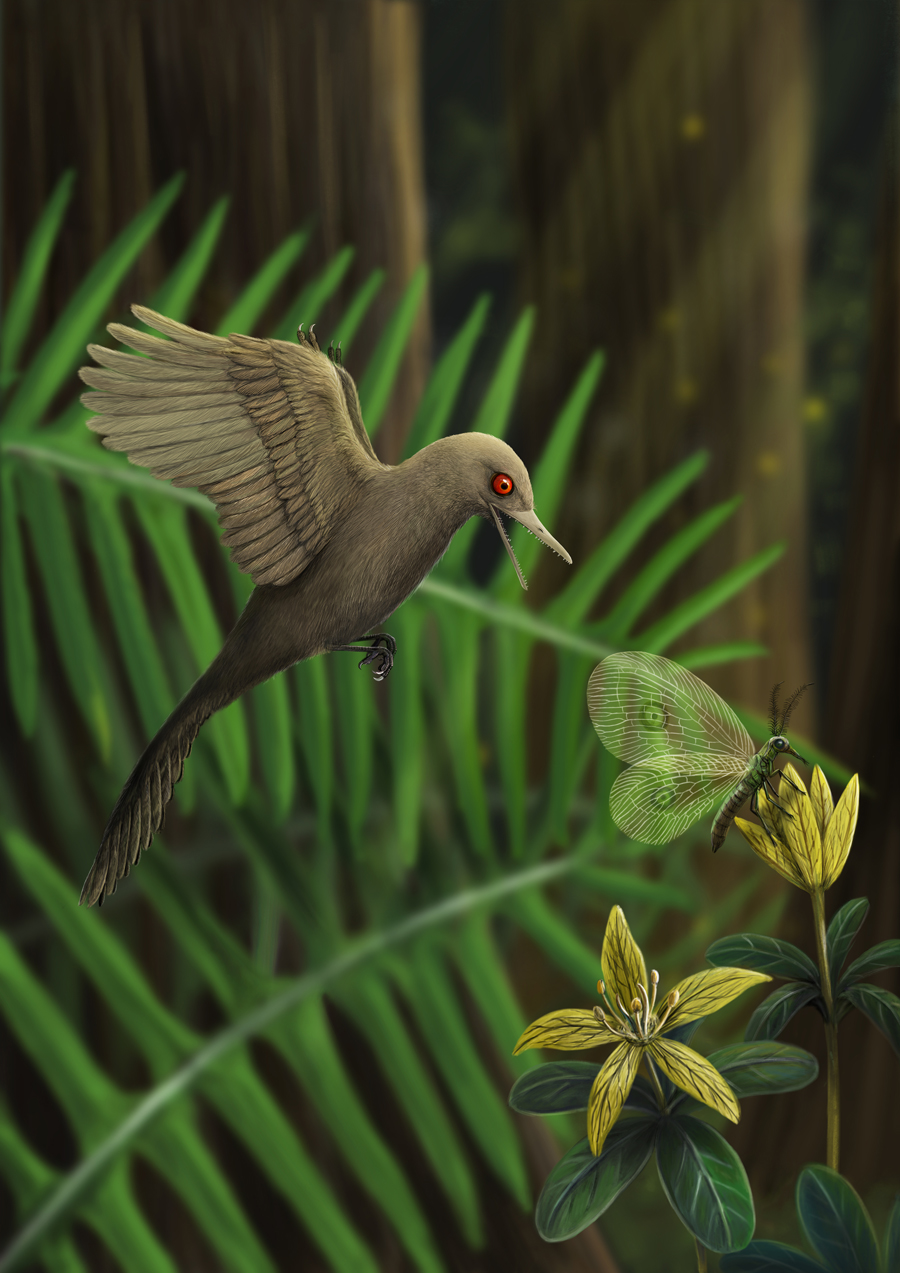
Despite its small size, the specimen, Oculudentavis, has more teeth than any other fossilized bird. Its tooth row is also longer than that of other birds, extending all the way under the eye. The large number of teeth indicates that Oculudentavis was a predator, the paper said.
"Judging from its size, it might prey mainly on insects," Xing said.
Another odd thing is its eye, which is 4 mm in diameter. Birds are known to have a ring of bones that help support the eye. In most birds, the bones in the ring are simple and fairly square, but in Oculudentavis they are spoon-shaped, a morphology previously found only in some living lizards, which is one of the most confusing features paleontologists find in this specimen, the paper said.
The eye bones would have formed a cone, like those in owls, suggesting keen visual abilities. However, unlike owls, whose eyes face forward, Oculudentavis's eyes would have faced sideways, the paper said. The jugal, or cheekbone, is bowed in such a way that suggests Oculudentavis's eyes would have bulged out of its head sideways.
No living animal utilizes such a type of visual system so it is hard to understand how the eyes of Oculudentavis may have functioned. However, the small aperture of the eye bones (the inner diameter of the ring) indicates that Oculudentavis was active during the day.
Due to its unique structure of eye and tooth, paleontologists regard it as a new species and give it the name Oculudentavis, or eye-tooth-bird, "a dry scientific name referring to the teeth that extend under the eye", said Jingmai K O'Connor with Institute of Vertebrate Paleontology and Paleoanthropology of the Chinese Academy of Sciences, lead paleontologist on the research.
Because the fossil consists of only a skull, it is still unclear how to relate it with other birds.
"We think it's a bird. The skull has a shape that only occurs in birds and some dinosaurs. However, there are no specific skull morphological characters that define birds, therefore it could be a dinosaur or even something else," O'Connor said.
Xing added, "In fact, it has some characteristics that do not belong to birds or even dinosaurs. At present we think of it as a bird or a dinosaur, which is the most likely conclusion based on the characteristics of the skull."
"To us, the paleontologists, birds are dinosaurs. This specimen may represent the lowest limit of body size that dinosaurs could reach during the dinosaur age," he said.
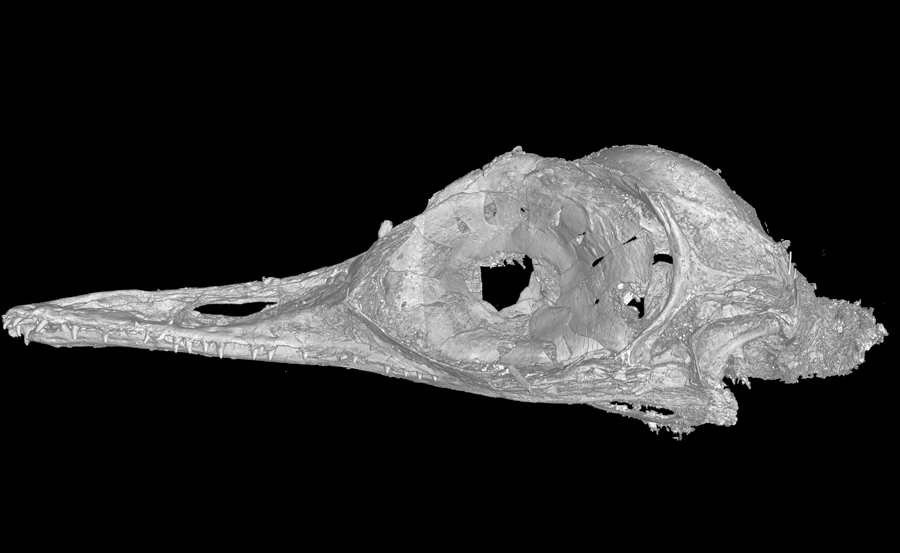
Analyses that explore the relationship between Oculudentavis and other fossil birds suggest that the tiny bird is very primitive, placed between Archaeopteryx, the oldest and most primitive bird, and Jeholornis, a long boney-tailed bird from the Early Cretaceous of China. As a result, like these two groups, Oculudentavis was very likely to have a long tail, like that in non-avian dinosaurs.
The full name of the bird is Oculudentavis khaungraae in homage to the collector who found it, Khaung Ra. Now the amber is kept in a private museum.
One of the biggest advantages of amber lies in its high quality preservation of the fine details in the skull, such as the bony rings that support the eyes, and soft tissue features that have not been preserved in other specimens, such as small bumps on the roof of the mouth that aided in gripping prey, said Ryan C McKellar, curator of Invertebrate Paleontology at the Royal Saskatchewan Museum in Regina, Canada, in an email to China Daily. McKellar helped with the interpretation of how the specimen was preserved in amber in the research.
"Amber gives us almost the only opportunity, to learn about tiny vertebrates from the dinosaur age. We were lucky to find non-avian dinosaurs and birds in these tiny vertebrates' records. Oculusdentavis is by far the smallest and most important specimen," Xing said.
McKellar said, "The specimen is important because it represents a size class that we have probably been overlooking in other fossil deposits, simply because the animals are too small to preserve as identifiable fossils."