



COVID-19 means the world economy may be in for a long slog







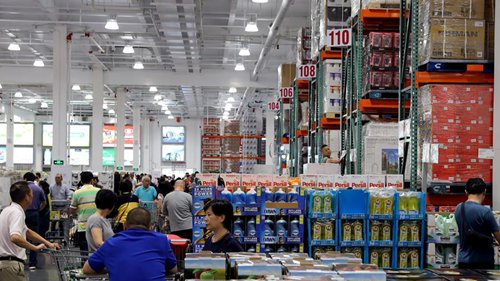
First, COVID-19 triggered fear and panic among consumers in some countries. Now the financial markets seem just as rattled.
As a result, experts say chances of a global recession in 2020 are increasing.
Governments, investors and populations have been thrown into a state of confusion and uncertainty by the accelerating cases of the novel coronavirus, which broke out in China and spread around the world. More than 3,600 globally have been killed by COVID-19, the disease caused by the virus.
As markets gyrate wildly, no one seems to have a clue as to what route the virus will take. The global economy will certainly take a hit but the question is how hard.
"Coronavirus may be more destructive than the Lehman crisis," reads the scary headline above an article on Tuesday by Ambrose Evans-Pritchard, the international business editor of London's Daily Telegraph, referencing the collapse of the giant U.S. bank that helped cause the 2008 financial crisis that some said was the worst in history.
"The outbreak has triggered a collision of unstable debt and an oil price crash," he wrote. "Recession is imminent."
"Mr. Market is basically saying that we're headed for permanent recession," was the stark assessment of Nobel Prize-winning economist Paul Krugman in a tweet on Monday as U.S. Treasuries entered a new round of their historically low yields.
And this happened even after the Federal Reserve Bank, on March 3, announced an emergency interest rate cut of half a percentage point, the first of its kind since 2008 crisis.
Diverse strategies needed
Rate cuts have been used as the chief remedy by central banks in recessionary times but they are already so low in America and Europe that policymakers have less ammunition this time around. Governments will have to ramp up their efforts to help firms with their costs, as China has done, and to protect workers by minimizing layoffs and maintaining stable incomes.
The coronavirus has kept investors nervous since January when global supply chains were initially disrupted as economic powerhouse China began its war against the fast-spreading infection.
Stress levels were elevated by an oil price fight between Saudi Arabia and Russia after OPEC talks ended in failure last week amid attempts to support the oil market as the virus led to a drop in global demand.
Saudi Arabia announced it would raise output after Russia, which is not a member of OPEC but works closely with the cartel, rejected the additional production cut. The conflict sent oil prices crashing to a four-year low on Monday in a signal that coronavirus can cause pain in expected ways.
All this as life in China is gradually returning to a semblance of normality after a path-breaking response to the virus that seems to have contained it and gave the world what the chief of the World Health Organization called a "window of opportunity" to prepare for the possible global spread of the epidemic.
The evidence is mounting that some countries may not have used the limited time as wisely as they could have now that coronavirus is arriving on their doorsteps.
In the United States, investors have become increasingly worried about a number of factors, including what some have called an uneven government response, confusion about the number of cases in the country and concerns that fear of contracting the virus or government-imposed limits on movement will hit consumer spending and damage the economy.
Cascade of recessions
A lot of attention is centered on Italy, which has the largest number of virus infections outside Asia and is taking cues from China's mass-quarantine containment model.
The European nation is the world's eighth-largest economy but was already in a weakened state that will get worse. It is not alone.
"We're going to have recessions in many countries," Mohamed El-Erian, chief economic adviser of Allianz, a European multinational financial services company headquartered in Munich, Germany, told CNN. "That includes Germany, Italy, Singapore, Japan and that list is going to get longer; (South) Korea. "The United States is still a 50-50 situation, but if the market disruptions continue and the coronavirus fears amplify, then, unfortunately, we will."
El-Erian said the state of affairs was exacerbated by the confluence of a simultaneous "destruction" in demand and supply, weaker economic fundamentals, and a drop in market confidence in central banks.
In effect, even if the recession doesn't turn out to be truly global, it will certainly feel like it.
'Long-term effects'
Supply chains are struggling and factories remain well below full pelt, the appetite for travel, for example, has dampened precipitously, and trade is shrinking.
UNCTAD, the United Nations trade agency, said on Monday that the coronavirus outbreak could cost the global economy up to two trillion U.S. dollars this year by depressing annual growth to below 2.5 percent, the recessionary threshold for the world economy.
"Governments need to spend at this point in time to prevent the kind of meltdown that could be even more damaging than the one that is likely to take place over the course of the year," UNCTAD's director of globalization and development strategies Richard Kozul-Wright told reporters.
In his article, Ambrose Evans-Pritchard said a global recession was imminent and inescapable, but not everyone is so sure.
Goldman Sachs' chief economist Jan Hatzius says one might just be avoided. "We wouldn't have to see that much more weakness, whether it's out of China and then the spillovers associated with that, or maybe the pullback in consumer activity, to turn it into a recession. Our best guess is it stops just short of that," he said.
Whatever happens, we seem to be in for a slog.





