



China key to global supply chain, economic growth







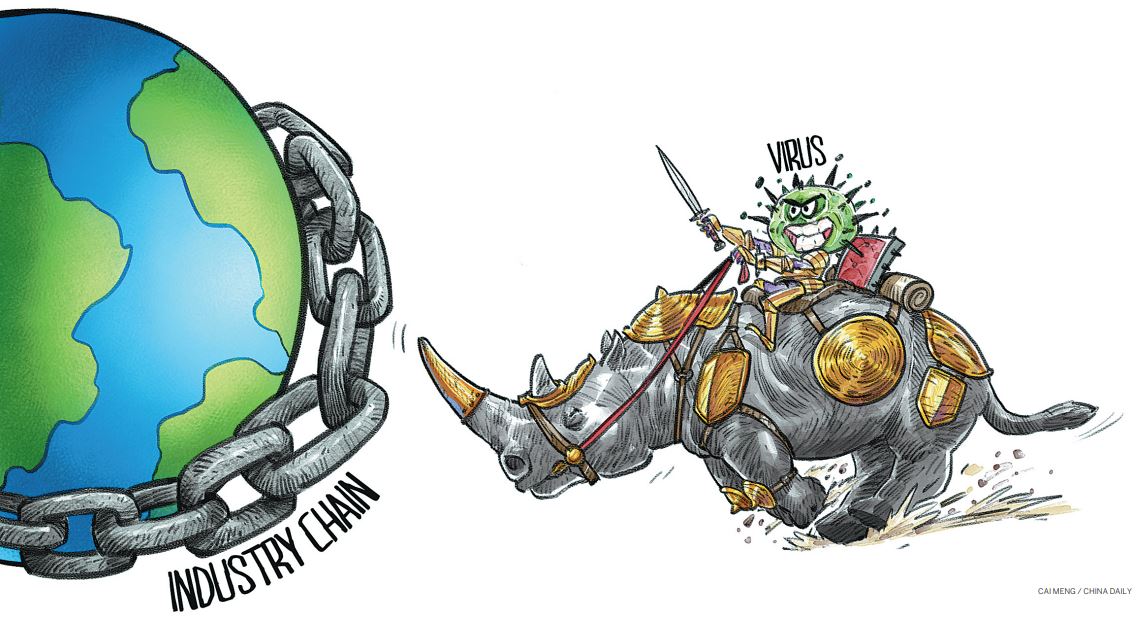
The evolution and duration of the COVID-19 epidemic will determine the stage at which its impact on the global supply chain is. If the impact is determined to be at the fourth stage, then the epidemic will escalate into a "gray rhino" that will likely hurt the global economy. (I'll discuss the four stages in a bit.)
Gray rhino refers to a crisis that develops slowly and is usually ignored until it is too late. Examples include accumulating financial risks from rising debt levels, wild fluctuations in the exchange rates of major currencies, increasing tensions between major economies and rising frictions in regional hot spots.
China's industrial added value accounted for only 6.8 percent of the world's total in 2003, and surged to 23.9 percent in 2017. The country also became the largest trading partner of more than 120 countries and regions in 2018, according to the World Bank's World Development Indicators.
China's influence on the global economy is far greater than its own weight. More importantly, such influence is also reflected in China's presence at the core of the global supply chain. Over the past decade, China has become the center of the global supply chain network, with import and export of intermediate products accounting for a relatively high proportion.
It can be observed from data of the World Integrated Trade Solutions, jointly released by the World Bank and the United Nations Conference on Trade and Development, that nearly 200 economies across the world import goods from China, with intermediate products accounting for an average of 21.7 percent of all imports.
Intermediate goods-a key factor
Unlike final products, other economies import intermediate goods from China and use them in their own production process. Any interruption in intermediate goods trade may affect the continuity of the entire manufacturing process and result in greater financial losses.
Based on an Oxford Economics forecast, the impact of the epidemic will cut global economic growth by 0.2 percentage point to 2.3 percent this year. This will be the slowest annual growth rate since the 2008 Global Financial Crisis.
However, this forecast mainly considers the global impact of China's economic slowdown. The global economy will face a more severe test if the impact of the epidemic on the global supply chain is also factored in. In fact, this challenge has already impacted China's domestic supply chain network.
Economic and supply chain globalization has highlighted that the impact of the epidemic can be more destructive within a region. Global economic policymakers should take note of this reality and strengthen international cooperation to jointly address the challenges being posed by the epidemic to the global supply chain.
The four stages
In the first stage, the outbreak affected China's domestic supply chain network. The impact of the epidemic has disrupted domestic production order to a certain extent. It has delayed work resumption and affected logistics, thus leading to insufficient industrial material and items that are needed for epidemic prevention and control.
These factors have disturbed production at manufacturing companies, employment, inventory numbers, transportation and market orders, especially in Hubei province, the epicenter of the novel coronavirus outbreak where the impact is even more severe.
In the second stage, the epidemic affected China's export of intermediate products to other countries, resulting in disruption of production processes in partner economies. However, at this stage, due to the buffering of finished goods inventory and transportation time between Chinese and foreign companies, it did not have a heavy impact on China's imports from other countries in the short term.
In the third stage, which appears to loom at the time of writing, a broken global supply chain can affect China through the feedback of import channels. If some foreign companies stop production or run out of inventory, the import condition of intermediate and final products in China could also face the risk of production suspension.
In the fourth stage, or the worst-case scenario, the existing supply chain could get destroyed by the outbreak, and a new global supply chain may be formed by other parties, without the direct participation of Chinese companies.
United global response
However, it is very difficult to create such a new global supply chain, because China's position in the existing global supply chain is fairly important. Besides, companies in other countries cannot completely replace their Chinese counterparts within a short period. Therefore, uncertainty in the global economy will likely rise sharply in the event of the current crisis reaching the fourth stage.
In the weeks to come, if the impact of the epidemic on the global supply chain is determined to have reached the fourth stage, the epidemic will likely further escalate into a gray rhino that could seriously hurt the global economy.
Under such circumstances, a united global response to the epidemic is critical for maintaining the stability of the global supply chain. China's actions like organizing orderly work resumption with sufficient protective material supplies will be helpful in putting the world's economic growth on a firmer footing.
The China Machinery Industry Federation in Beijing has predicted that the production of China's machinery manufacturers will be fully recovered in the second quarter of this year. Many of its member companies have already begun to produce equipment and vehicles such as negative pressure ambulances, disinfection robots and exhaust fans as part of the country's drive to fight the novel coronavirus outbreak.
The current impact of the epidemic on the global supply chain is still in the early phases of the second stage. The decline in intermediate parts and components provided by China to other economies has affected manufacturing businesses in South Korea, Japan and southern Europe. Such a trend may further expand to other European countries, as well as the United States.
Based on the current situation, the epidemic may affect some Chinese companies' export orders and their production pace this month. At the same time, the risks of industrial transfer still exist, but they are controllable.
Owing to the negative influence caused by the epidemic, the government should also be aware that the work resumption at some Chinese companies has encountered various practical problems and the follow-up impact remains unknown.
After all, one thing is certain: the world is well connected today and all the nations have to face the difficult times together in a spirit of unity and fraternity, and try to resolve any differences amicably.
Xu Qiyuan is the director of the Economic Development Division of the Institute of World Economics and Politics, which is part of the Chinese Academy of Social Sciences in Beijing.




















