



Why Italy should learn from China in fighting COVID-19







Editor's note: Matteo Giovannini is a finance professional at the Industrial and Commercial Bank of China in Beijing and a member of the China Task Force at the Italian Ministry of Economic Development. The article reflects the author's views, and not necessarily those of CGTN.
The COVID-19, caused by the outbreak of respiratory illness firstly detected in Wuhan, has been hitting China for over a month forcing citizens to change their lifestyle and having important repercussions on the country's economic system.
What was initially considered a phenomenon circumscribed within China has rapidly become a global issue, enough to force the World Health Organization to declare the coronavirus a global health emergency with cases of infections confirmed in several other countries and in different continents.
The countries most severely hit by the virus have been those characterized by either a geographical proximity to China or by the popularity as a tourism destination for Chinese tourists or by being important trading partner of China. In this context, Japan, South Korea, Singapore and Iran have been by far the most reported cases of countries that have experienced a skyrocketing number of infections.
By the end of February it has been surprisingly disclosed by media an unexpected and dramatic outbreak in Italy, where the number of cases rapidly multiplied from 200 to over 600 in less than a week and reaching over 1,100 as of Sunday. Probably the most worrying aspect is that the virus has spread in the north of Italy covering three regions that combined contribute for about 40 percent of Italian GDP with possible serious consequences in terms of national growth for this year.
When the virus was officially confirmed within Italy's borders, the Italian government took a series of drastic and late measures to handle the growing number of confirmed cases, from isolating the areas where the virus was initially spotted to locking down the worst-impacted town, Codogno in the Lombardy region, to prohibiting the holding of public events in the country's northern part.
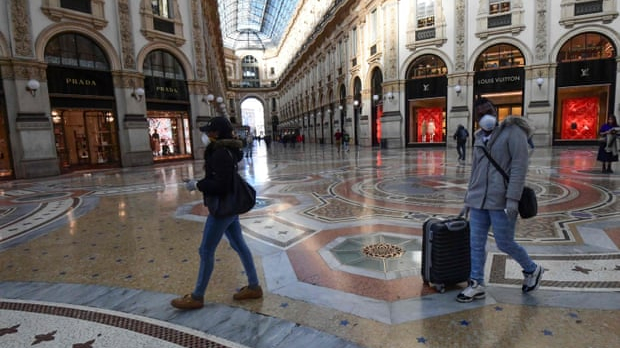
Events such as the Milan Fashion Week was held closing the access to the public and the same has been happening to TV shows recorded in empty studios. Schools and universities have been declared closed for at least a couple of weeks, churches have suspended religious celebrations, while museums and cinemas have banned the entrance to the public. In addition, one of the most famous carnivals around the world, the Venice Carnival, have been canceled with important consequences on tourism, as well as the shooting of the new Mission Impossible movie that was planned in the same city.
This series of decisions has done nothing but increase the level of tension and panic in the citizens and has even raised in someone the suspicion of the inadequacy of the Italian political class to manage an external risk of this proportions.
This situation contrasts strongly with the past when Italy demonstrated a rich experience combating epidemics starting from the Middle Ages when the Black Plague, one of the most devastating pandemics in human history, hit Europe in the fourteenth century killing millions of people.
Nevertheless, the Italian government has demonstrated it's unprepared to manage the uncertainty and decisions such as the suspension of direct flights to and from the Chinese mainland, as well as Hong Kong, Macao and Taiwan regions, have been highly criticized because it does not solve the problem and in reality increases the risk of contagion due to the difficulty of tracking the route of people who stop over in other airports before landing in Italy.
Moreover, decision makers have underestimated the importance of strict quarantine in order to prevent the spread of the virus in entire regions by simply suggesting people to self-quarantine based on a mutual trust. The case of an entire family affected by the virus in the north of Italy that secretly traveled to the south of Italy has created panic and anger within the country.
The most bizarre aspect is that the word quarantine comes from the seventeenth century when in Venice all ships coming from other countries were required to be isolated for a period of 40 days before passengers and crew could go ashore during the Black Death plague epidemic. It seems that Italy hasn't learned yet from its past.
China should represent a good example and a benchmark for Italy on how to tackle an emergency like the COVID-19. The ability of China to mobilize huge resources, to centralize decisions at the core and to tightly control the behavior of citizens are paying off in terms of a slowdown in the number of newly infected people in these days.
China has demonstrated a mastery in leveraging technology to prevent the contagion and keeping a constant, reliable and direct communication channel with citizens. Today China is reacting well to the COVID-19 because people realize that there is a clear guidance from the top and everyone is committed to take precautions by respecting the instructions of the authorities with a clear positive domino effect.
Italy should seriously take this emergency as an opportunity to rethink central governance during a time of emergency, instead of guaranteeing federalism and independence of decision to the regions. A centralized governance has demonstrated to be the most efficient way of decision making that inspires a genuine cooperation and solidarity from every part of the country and avoids self-interest behaviors that could put everyone at risk.





