



After the virus, boosting the real economy







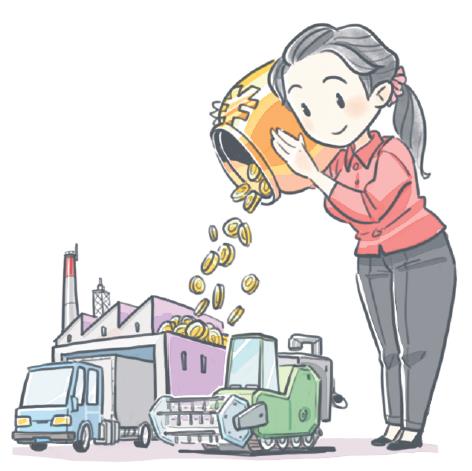
COVID-19 has been tough on many companies and workers in China's real economy. After losing a month's revenue or more, many smaller companies and factories simply don't have the cash to get going again.
In addition, complex international supply chains depend on financial connections just as much as they do on good transport-but many firms now fear to ship products because they don't know whether their trading partner is solvent.
The Chinese government is implementing specially targeted assistance for highly impacted businesses. This, combined with general macroeconomic stimulus, will be essential to unblocking virus-related bottlenecks in the economy.
In a Feb 23 speech to a Beijing meeting on the prevention and control of the novel coronavirus, President Xi Jinping said COVID-19, the disease caused by the novel coronavirus, will inevitably deal a relatively big blow to China's economic and social development. However, at such a time, it is even more important to view China's development in a comprehensive, dialectical and long-term perspective and firm up confidence.
In general, the fundamentals of China's long-term sound economic growth remain unchanged, Xi said.
He stressed strengthening the regulation role of macroeconomic policies, calling for more positivity in the country's proactive fiscal policy and the rollout of more targeted interim policies in cutting taxes and fees to help micro, small and medium-sized firms tide over difficulties.
The February edition of the CKGSB Business Conditions Index, based on surveys by the Cheung Kong Graduate School of Business in Beijing, shows that both consumer prices and producer prices have fallen in February. This type of deflation is exactly the classic situation for which economists almost universally agree that large-scale monetary and fiscal stimulus is appropriate.
The People's Bank of China, the central bank, has already announced major general stimulus, the target interest rate has been reduced to 4.05 percent, 1.7 trillion yuan ($242.5 billion) of broad base money (M2) has been released and more than 3 trillion yuan of new loans were made in January alone.
To more directly support small and medium-sized companies hurt by the virus, the PBOC is allowing banks to issue special purpose bonds to raise funds for them. In addition, businesses are being allowed to defer payment of social employment taxes and many businesses are receiving reduced rent or being allowed to delay payment. Banking regulators also announced that companies affected by the virus may be allowed to make late payments on loans.
One of the strengths of China's financial system is that the government can control stimulus programs and bank loans to target them to key sectors of the real economy. It is crucial that post-epidemic stimulus funds be prevented from flowing into unproductive increases in the prices of assets such as real estate or stocks.
Private companies, which are mostly SMEs, account for 60 percent of the Chinese economy and 80 percent of jobs, so it is crucial to get them back up and running.
A February survey of SMEs by Peking University and Tsinghua University showed that one-third of the companies had enough cash to cover obligations for one month or less. Another third could survive for up to two months. Only about 18 percent said they could last three months without revenues.
In any country, small companies typically have very small profit margins and poor access to capital. Businessmen expect good months and bad months when sales may be up or down 10 percent or so. It would be unreasonable and impossible to prepare for a month or more with zero sales, while many expenses continue. The only hope for many of these companies will be government support.
There will be some natural stimulus from pent-up demand. Almost no cars or apartments have been sold over the past month, so presumably the people who would otherwise have bought them will do so after the crisis is over. But, without readily available cash, even businesses with high potential demand may not be able to meet their obligations, pay their workers, and resume operations.
In many service industries-especially restaurants and tourism-the sales lost during the crisis will never be recovered. Without easily available concessionary loans, many businesses in these sectors will go out of business. Services now amount to 54 percent of the Chinese economy, so it is critical that these businesses survive.
Ordinarily, macroeconomic stimulus is designed to deal with financial shocks. In a normal recession, additional government spending or reduced interest rates will increase demand, thus providing additional sales for business. In this case, a widespread stimulus plan to create additional demand can smooth out the business cycle.
In more extreme cases, such as the 2008-09 global financial crisis, stimulus is targeted to provide government or central bank assurance to make financial transactions possible. In that crisis, banks were afraid to deal with other banks or financial institutions because there was no way to know which companies were solvent. Without a working financial system, the real economy was near collapse.
In the United States, targeted bailouts prevented bank collapse and more general government spending and interest rate cuts stimulated general demand. In China, government spending on infrastructure was increased to compensate for the declining demand from US consumers.
Even the Great Depression of the 1930s was largely caused by financial system problems though these had devastating impacts on the real economy. Through a combination of large monetary stimulus, largely a revaluation of the dollar compared to gold and some targeted government spending, the administration of president Franklin Roosevelt was eventually able to largely restore the economy before the start of World War II.
The economic problems caused by COVID-19 are very unusual in that they are driven by supply-side issues, rather than problems in financial markets or demand shortages. General stimulus that puts additional money into the general economy will be needed. But the focus should be on highly targeted government programs to save small and medium-sized companies, help the service economy to get going again, and resolve bottlenecks in supply chains.
It must have been heart-breaking for China's leaders to take the tough decision to quarantine Hubei province and to restrict activities throughout the country. But, without these measures, the novel coronavirus certainly would now be wreaking havoc throughout the world.
Recent reports of the virus spreading to South Korea, Italy, and Iran may indicate that the world-wide economy will be strongly affected. US stock market indexes immediately fell around 10 percent on that news last week. We don't yet know the extent of the economic damage around the world. International cooperation, including coordinated monetary stimulus from the world's central banks, should be ramped up to take advantage of the opportunity China's policies have provided.
As the World Health Organization has stressed, China's extremely strong healthcare measures have given the world a window of opportunity to contain the virus. Similarly, China's economic stimulus and targeted measures are giving the world economy an opportunity to recover.




















