



China's financial markets pass another stress test







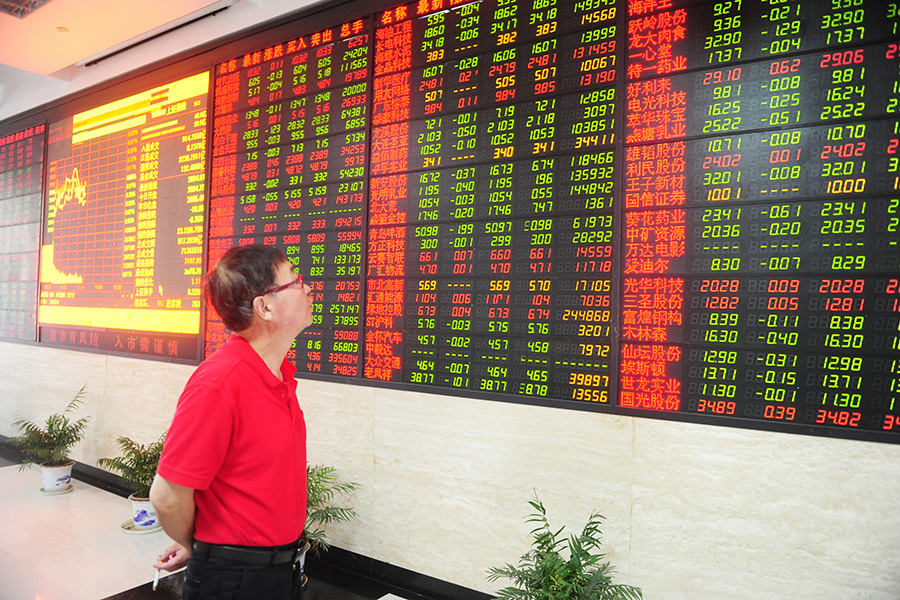
The novel coronavirus has changed the optimism on China's economy seen at the beginning of this year into nervousness now. The whole country is mobilized to fight the COVID-19 epidemic, and China's financial markets are not exempted. Stock, bond, foreign exchange or FX, and commodity markets all re-opened on Feb 3, which showed confidence in the leadership and enabled those who need liquidity to sell their positions for cash.
In particular, as bond and FX are over-the-counter markets that require market-making, the trading volume of both markets recovered only slowly. This was true even during the second week after the Chinese New Year holiday, as many traders are still in quarantine at home or are required to do remote work. Based in Beijing, I fully understand the difficulty in finding balance between the reboot of economy and the fight against the virus.
However, a lower volume does not mean a quiet market. For China rates, a strong risk-off sentiment combined with a concern about the economic impact pushed 10-year China government bond yield from 3.10 percent down to 2.80 percent, a level last seen in 2016. Even the escalation of the trade tension between China and the United States did not lead to such a big move.
However, the Chinese yuan in the FX markets largely remained stable, with the dollar-yuan rate fluctuating around 7.0, which is far from the 7.2 peak reached last year. Investors maintained a clear mind without any panic, as the number 7.0 is no longer magic: the People's Bank of China, the central bank, had successfully made the market to go through this level last year. In renminbi FX options market, the implied volatility has stayed at a level similar to that in November 2019, far below the level in August 2019 when the dollar-yuan rate broke 7.0. This shows that investors are not convinced to buy insurance at a high price to protect themselves from large movements.
Such a stability in RMB FX shows that the market is very satisfied with the recent reforms in RMB FX. Both buyers and sellers of RMB have many arguments to support their view, and the market is overall balanced. It also shows that RMB itself is no longer a weak currency that depreciates significantly when a large negative shock hits the country. In contrast, RMB is traded as a hard currency that is driven by balanced demand and supply.
Plus, the deep integration of China into the world economy also supports RMB FX. China is not only an exporter but an important buyer of energy and services. The COVID-19 outbreak sent the oil price down by more than 20 percent, which implies less overall spending on crude oil import due to both a lower price and a weaker demand. Plus, Chinese travelers largely canceled their overseas trips, so the demand for foreign currencies is also weaker due to weaker tourism spending.
In fact, the above two points are often mentioned by investors as reasons to go long on RMB rather than short it.
The stability of RMB FX also implies that for global investors, the impact of the virus will be limited and temporary, so there is no reason to have a run on RMB FX or any concern about capital controls. Investors are comforted by the responsiveness of the Chinese authorities, companies and individuals. Many industries, including energy and commodity production, are largely intact, and the recovery of production tends to be very rapid for manufacturing and exporting industries.
Plus, given the China-US phase-1 trade deal and global risk-on sentiment, the external environment is positive for China. Economic indicators in many countries have been recovering recently, and global trade has been re-energized. Therefore, Chinese manufacturers may generate higher revenue as long as they can return to full function. After three rate cuts by the Federal Reserve and a reflation of its balance sheet, the abundant and cheap global funding is also helpful for China's credit and liquidity condition.
In addition, the domestic monetary policy reacted swiftly, with the central bank cutting 10 basis points on its reverse repurchase operation on Feb 3. Such a stance is very different from the experience of 2019, when the central bank remained reserved until a clear signal of the China-US phase-1 trade deal in November, despite both economic and financial pressures. In retrospect, the slightly hawkish stance secured more policy room for this year.
Such a 10-bp cut may be the beginning of a series of small rate cuts in 2020, in our view. On Thursday, China's central bank cut the (one-year) loan prime rate or LPR, the new benchmark for commercial bank loans to the corporates and households, by 0.1 percentage point to 4.05 percent. LPR may decline significantly this year, so as to support the economy and attract more borrowers to convert their outstanding old benchmark-based loans into LPR-based loans.
For the rest of this year, we expect that China will return to its growth potential, with new focus areas. The shock of the virus has been a stress test for China's financial system, which it appears to have passed with an outstanding performance so far.
The focus of policymakers is on supporting economy rather than preserving financial stability, which is a big leap from 2015-16 when China experienced several crashes in the stock market and challenges in the FX market. This resilience will attract more overseas investors to participate in China's financial markets, not only bond and FX but equity and commodity.
The writer heads foreign exchange and local market strategy for global markets China, BNP Paribas.




















