



Mom & baby products see steady growth
Rising needs of young parents pursuing high-quality lifestyles boost the sector







China's maternal and infant market is expected to see steady growth over the next decade, with online buying playing a vital role in bolstering consumption, due to rising demand from young parents pursuing high-quality lifestyles amid the consumption upgrade.
The implementation of the comprehensive second-child policy starting from late 2015, which allows all couples to have up to two children, has led to a steady growth in population, experts said.
According to the National Bureau of Statistics, there were 14.65 million babies born in 2019. The increase in population has brought about an increase in the demand for maternal and infant products, stimulating the development of the related market.
A report from Chinese research firm CBN Data and Tmall Baby showed that the online maternal and infant market has maintained growth in the past three years, which is mainly attributed to the post-1995 generation getting married and having babies.
However, the post-1980 and post-1990 generations still dominate the online maternal and infant goods sector, with baby clothes and diapers being the most important categories of online consumption.
It is noteworthy that the consumption growth from third-to fifth-tier cities is higher than that from first-and second-tier cities, showing huge potential. The per consumer transactions of maternity dresses, toys and baby strollers are improving significantly.
"The size of China's mom and baby products market continues to grow, in part because of the implementation of the second-child policy. Although the future of the market has significant opportunity, there are many challenges," said Brady Ni, vice-president of market research firm Nielsen China.
"With the rise of New Retail, or the integration of online and offline sales platforms, it is foreseeable that retail competition will grow in intensity. In the face of increasingly discerning consumers, brands must stand out from the complex competitive environment by improving product quality, creating a pristine reputation, and building brand awareness," Ni added.
Chinese online retailers are looking to cash in on the consumer craze for mother and infant goods, launching tailor-made commodities and cooperating with various overseas brands to cater to their diversified and personalized demands.
E-commerce giant JD is banking on the consumer-to-manufacturer or C2M sector to expand its presence in the maternal and baby products market.
The model leverages online retailers' big data and customer analysis capabilities to optimize a brand's products specifically to meet the unique demands of the Chinese market.
JD has cooperated with a baby diaper brand to seek insights from consumers. Using data analysis of online searches and comments, JD found that users often search specific keywords like "diaper rash", and look for diapers that feature better skin care function.
Based on the big data and consumer preference, the partners have jointly developed a new diaper product that targets babies' sensitive skin.
The Beijing-based tech heavyweight has become one of the largest retailers for many world-famous brands such as Wyeth, Kao, Unicharm, Frisco, Nestle, Danone and Pigeon. More than 50 mother and baby brands saw their revenue surpass 100 million yuan ($14.3 million) in 2018.
Liu Lizhen, general manger of the maternal and infant products sales department at JD, said they are banking on the C2M sector and launching high-quality products to meet diversified and personalized needs of consumers, on the basis of in-depth analysis of user data.
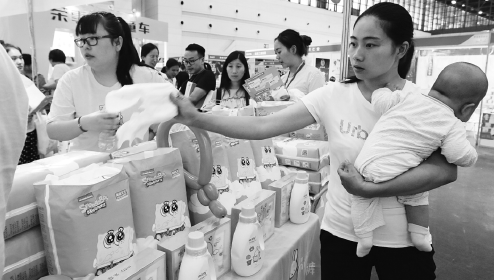
Moreover, statistics from JD showed the sales of imported milk powder increased 40 percent year-on-year in 2019, while that of baby mouth cleaning products surged 80 percent compared with the previous year. In 2019, sales of educational toys sold on JD skyrocketed 225 percent year-on-year.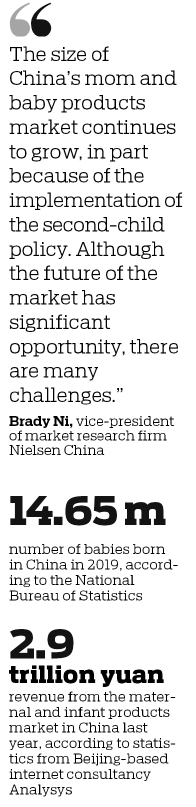
According to statistics from Beijing-based internet consultancy Analysys, revenue from the maternal and infant market in China reached 2.9 trillion yuan last year, and the figure is expected to reach 3 trillion yuan in 2020. The whole industry will maintain a 20-to 30-percent annual growth rate in the next 10 years.
Mia, an online retailer specializing in items for infants, toddlers, and mothers, is ramping up efforts to build up the supply chain of maternal and baby commodities and establish its self-owned brands such as Mompick.
Liu Nan, founder and chief executive officer of Mia, said the newborns are mainly coming from third-to fifth-tier cities across the nation, and the consumption potential in lower-tier cities has already been stimulated.
Statistics from Mia showed its users from first-and second-tier cities are more willing to spend on comfortable underwear, snacks and intelligent home appliances. However, users living in third-to fifth-tier cities tend to buy women's apparel, latex pillows, juice extractors and other homegrown products.
"We should carry out meticulous operations, and make better decisions for families based on our users' needs," Liu added.
Founded in 2011, Mia had served more than 50 million registered users aged from 24 to 40 by the end of 2018. It is dedicated to helping middle-and high-income families access the best mother and baby products, such as diapers, baby formula, toys and garments for babies and toddlers from abroad.
Babytree, which runs China's largest online parenting site, has announced strategic cooperation with Japanese TV station Tokyo MX to form a joint venture in Japan, sourcing quality Japanese consumer goods for mothers and their families in China.
"We are looking forward to cooperating with various brands from Japan to expand the consumption market in China and jointly upgrade its cross-border consumption services," said Lou Lili, president of Babytree.
Liu Shihong, vice-president and general manager of e-commerce business of Babytree, said the big data insight deriving from users' true opinions of products will further help brands to quickly understand users' acceptance level, which is a process of users' reverse selection, helping the company distinguish whether the product is good enough to impress Chinese mothers.
Babytree will jointly develop professional and interesting intellectual property like content with Tokyo MX, combining the concepts, usage and functions of high-quality commodities with the current pan-entertainment visual content that is most popular among young Chinese families, Liu added.
The company also customizes stock keeping units for young Chinese family consumers to promote sales.
In 2018, Babytree reached a strategic cooperation deal with Alibaba on e-commerce to further upgrade its household consumption services. Its average monthly active users reached 156.3 million in the first half of 2019, with an increase of 21.6 percent compared with a year ago.
Cao Lei, director of the China E-Commerce Research Center, said: "The explosive growth of the maternal and child industry in recent years has prompted many online retailers to enter the market."
Cao noted that the purchasing power of residents in third-and fourth-tier cities is increasing, with the integration of online and offline channels continuing to grow. Moreover, the maternal and infant market has extended to the early-education and healthcare sectors, creating more consumption scenarios, he added.
"Along with the consumption upgrade and the change of household consumption concept, more efforts are needed to improve products' quality and related services," said Chen Yu, an analyst from Analysys.


Today's Top News
- United front work urged to pool strength
- Beijing refutes US nuclear test accusations
- Xi sends festive greetings to all service personnel
- Stability, vitality and creativity appeal to all: China Daily editorial
- Xi attends Chinese New Year gathering with non-CPC personages
- Xi extends Spring Festival greetings to service personnel







