



Science keeps improving global health







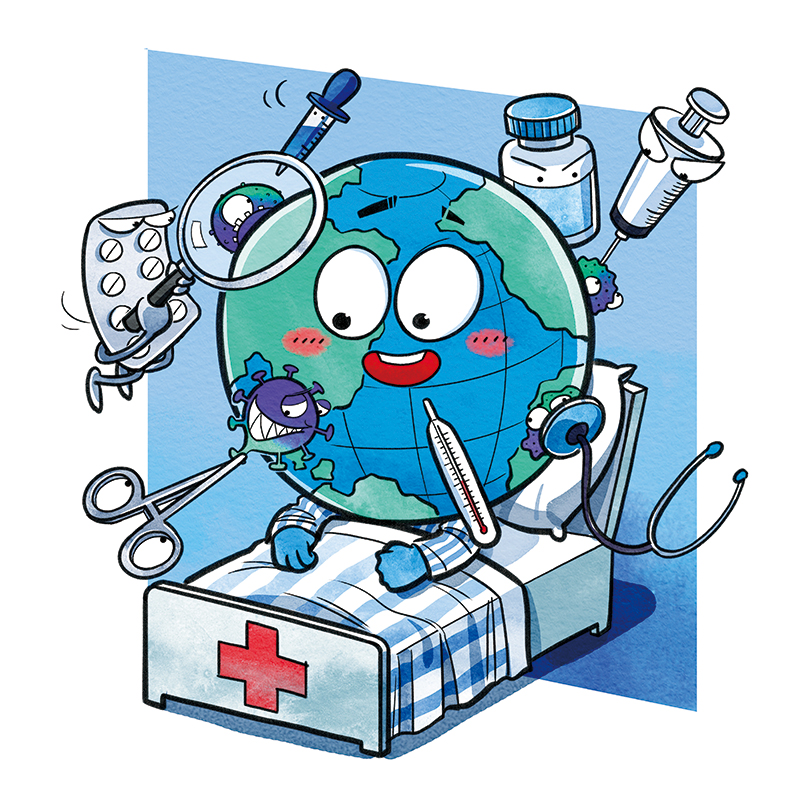
Measles went "viral" in 2018, infecting nearly 10 million people worldwide and claiming 142,000 lives. Poor vaccination coverage and large pockets of unvaccinated children resulted in devastating outbreaks in many parts of the world, including in countries that had high vaccination rates or had previously eliminated the disease. Last year, the United States reported its highest number of cases in 25 years, while four European countries-Albania, the Czech Republic, Greece, and the United Kingdom-lost their measles-free status following protracted outbreaks.
Moreover, two studies demonstrated how a measles infection reduces the levels of pre-existing antibodies against other pathogens like flu or pneumonia. So, children who recover from measles become more vulnerable to other infectious diseases.
Fortunately, measles was not the only big global health story of 2019. The year also witnessed the discoveries of new viruses, vaccines, and treatments that again proved the value of science.
Virus research made significant strides last year. For starters, scientists in Japan discovered the Medusavirus, so named because it can turn amoebae into stone-like cysts. Its genome is among the largest and most complex viral genomes ever found. Separately, researchers identified a new tick-borne illness-the Alongshan virus-in a group of patients in Inner Mongolia. For the first time, an insect RNA(ribonucleic acid) virus, the Providence virus, was found to have the ability to infect plants and mammalian cells-suggesting that plants could act as reservoirs of human viruses. Meanwhile, the Spanish authorities reported the first case of dengue attributed to sexual transmission in an area without vector mosquitoes.
In addition, a mysterious polio-like disease known as acute flaccid myelitis, or AFM, has emerged in the US in recent years, with the Centers for Disease Control and Prevention reporting over 600 cases since 2014. Immunological studies published last year linked this new disease to two enteroviruses. Researchers also associated a common human herpes virus (HHV-6) and the Epstein-Barr virus with multiple sclerosis, linked adenovirus C with type I diabetes, and found that a human papillomavirus infection increases the risk of breast cancer. Another study found that the brains of Alzheimer's patients had higher levels of the HHV-6 and HHV-7 viruses than healthy brains, while levels of viral RNA tracked the severity of clinical symptoms. More research is needed to discover exactly what roles, if any, these viruses play in the progression of these diseases.
Vaccines also advanced in 2019. For starters, the European Medicines Agency and the US Food and Drug Administration approved Ervebo, the first Ebola vaccine. Trials had shown the vaccine to be 100 percent effective in preventing transmission of the disease to people in close contact with those infected. Another Ebola vaccine, manufactured by Johnson& Johnson, was also tested during 2019 in the Democratic Republic of the Congo, where the second-largest outbreak of the disease began in August 2018.
Meanwhile, the Typhoid Vaccine Acceleration Consortium completed a large field study in Nepal which showed that the typhoid conjugate vaccine is safe, immunogenic and effective. It could significantly reduce typhoid infection among high-risk groups. In addition, the World Health Organization prequalified a more affordable pneumococcal conjugate vaccine that could help to widen protection against a leading cause of deadly childhood pneumonia.
Finally, new and improved treatments provided some of the best global health news of the year. In particular, the final results of a study called Pamoja Tulinde Maisha (Together Save Lives) in the DRC showed that two experimental Ebola treatments based on monoclonal antibodies were nearly twice as effective as the standard treatment. When patients received the new treatments shortly after the onset of symptoms, deaths decreased by almost 90 percent. For the first time, therefore, Ebola ceased to be a death sentence.
Moreover, gene therapy staged a comeback in 2019, mainly featuring adeno-associated viral (AAV) vectors, and lentiviral vectors derived from the human immunodeficiency virus (HIV). Early last year, doctors in the US used lentiviral gene therapy to cure children afflicted with severe immunodeficiency. And the previous December, a phase 1/2 human-based clinical trial of another lentiviral gene therapy stopped painful episodes of sickle cell disease, and relieved nearly 80 percent of patients of the need for therapeutic blood transfusions.
Also last year, the FDA approved the AAV-based Zolgensma gene therapy for spinal muscular atrophy. Other AAV-based experimental therapies, including one for temporal lobe epilepsy and another for Duchenne muscular dystrophy, were tested on animals with promising results.
The discovery of many new viruses, vaccines and treatments in 2019 was the result of investments in global surveillance, cross-sector partnerships, and scientific advances. But much more needs to be done. For example, we are only beginning to understand the impact of climate change on the emergence of infectious diseases and on the social and environmental determinants of health.
Science may have been successful last year, but it still needs support. This should include more high-quality education in the STEM disciplines (science, technology, engineering, and mathematics), increased funding of global research collaborations, and continued government support for innovation and research and development. At a time when misinformation is calling into question the validity of facts, the world also needs better science communication-including higher-quality science reporting by the mass media.
This year started with a mysterious outbreak in Wuhan, China, involving individuals who have contracted a novel coronavirus. The coming weeks or months will, one hopes, bring answers to some key questions, including how the virus is acquired, whether those who have died or are critically ill have other medical conditions that explain the severity of their illness, and many others. Science helped the world with the H1N1, SARS, and Ebola pandemic, and science will once again help the world overcome this new threat.
The world is on the cusp of further, previously unimaginable medical discoveries and innovations. By supporting science and highlighting its positive impact, we can make 2020 an even better year for global health.
The author is medical director at Takeda, a global research and development-driven pharmaceutical company.
Project Syndicate
The views don't necessarily represent those of China Daily.





