China and EU lead charge for climate policy







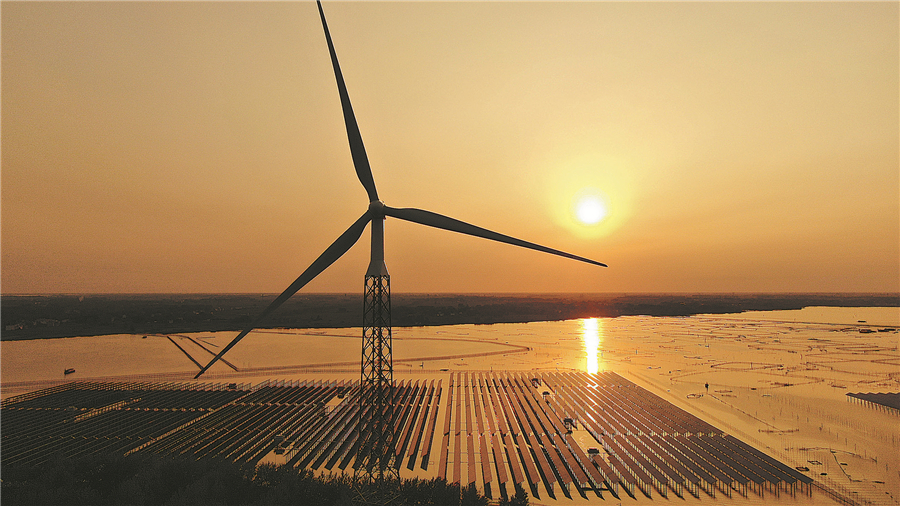
In recent years, Chinese CO2 levels have flattened for sustained periods, creating what Stern calls a "bumpy plateau" for carbon emissions.
Hu Angang, director of the Center for China Study, or CCS, which is a think tank connected with Tsinghua University and the Chinese Academy of Sciences, says that China laid much of the groundwork for this plateau in the drafting of the 13th Five-Year Plan (2016-20).
"We project that the total volume of carbon emissions shall decrease during the period of the 14th Five-Year Plan, which should also greatly affect global emissions," Hu told China Daily.
Hu expects that this next Five-Year Plan will once again have a strong commitment to emissions reduction and clean energy, a prediction supported by the nation's leadership. A report delivered by President Xi Jinping during the 19th National Congress of the CPC in 2017 mentioned "climate change" three times, "low-carbon" four times, "green" 27 times, and "environment" 43 times.
Precisely how China will go about controlling emissions over the next five years will only be revealed when the 14th Five-Year Plan is published, and divergent strategies are currently being analyzed.
In the lead up to the Paris Agreement, Premier Li Keqiang said China was committed to peaking its CO2 emissions by 2030. A 2019 study published in Nature, led by researchers from Nanjing University and Harvard University, found that China may be on course to meet that target by as early as 2025.
But a report released by Chinese think tank the National Center for Climate Change Strategy and International Cooperation, or NCSC, warned that on its current trajectory, China could risk missing its emissions target, with CO2 emissions potentially rising from 11 gigatons this year to 14.3 gigatons in 2030. The NCSC also said that, under current policies, China could narrowly miss its commitment to produce 20 percent of its energy through nonfossil fuels by 2030.
The NCSC said the government should consider committing to a cap on CO2 emissions in the 14th Five-Year Plan, limiting CO2 emissions to 10.6 gigatons by 2025. The 13th Five-Year Plan set targets for total energy consumption, though these limits do not take into account the carbonintensity of sources of energy, so an emissions cap would be a noteworthy development.
The CCS proposes writing a unified national carbon tax into the plan, and it too recommends exploring limits on carbon volume.
"As a university think tank, we have been intensively involved in the first steps of providing background research and decision-making consultation for the designation of Five-Year Plans," Hu said. "In terms of the 14th Five-Year Plan, one of the major challenges faced in China is climate change, because China itself is a big victim of frequent natural disasters and abnormal conditions induced by climate change.
"Our suggestion," Hu added, "is that, apart from the obligatory reduction both in total volume and intensity of energy consumption-which was proposed in the 13th Five-Year Plan-the 14th Five-Year Plan should propose the same for carbon emissions, reduction in both volume and intensity."
Looking beyond China's borders, Stern said he hopes for measures which encourage green development in countries within the Belt and Road Initiative, which is a China-proposed economic and infrastructure development plan. Stern said that if the multitude of developing nations along the BRI continue with coal-driven industrial development, it would make the 2-degree target an impossibility.