



Market fundamentals in focus on opening-up







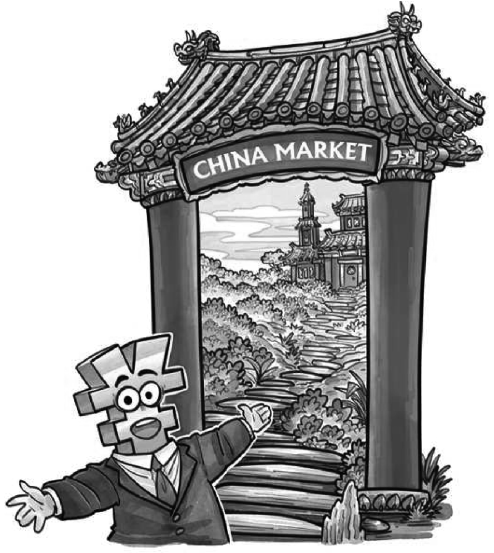
It makes sense that foreign banks, money managers and other financial firms are eager to do business in China's domestic markets. In October 2019, the Credit Suisse Global Wealth Report calculated that 100 million Chinese are now in the top 10 percent of global wealth, compared to 99 million Americans.
China also has 4.4 million dollar-millionaires, second largest in the world. Despite increasing consumption in recent years, China still saves about 40 percent of GDP.Chinese households are sitting on about 90 trillion yuan ($13.1 trillion) of investable assets.
Deloitte estimates that China's potential "addressable" retail financial wealth, even ignoring future GDP growth, amounts to more than $30 trillion. Foreign financial companies see great opportunities in managing even a small part of this money.
But what is in it for China?
The Chinese government decided to open up its domestic financial markets in order to: 1) help create more institutional ways for Chinese citizens to save money; 2) create more risk mitigation tools; 3) supply more funds to the private sector; and 4) focus investors on real-economy fundamentals rather than speculation.
In the past, investing in Chinese stock markets was seen by many investors as basically a kind of gambling. Even worse, many investors believed that there may be an implicit government guarantee that the markets would not be allowed to fall or that indebted companies would not be allowed to fail.
As part of the phase one trade deal with the United States, China stated that it would increase market access for international finance firms and impose stricter rules around intellectual property and currency movements. It should be noted that these measures fulfill US requests, but they are clearly in China's interest and are already well underway as part of China's broader process of reform and opening-up.
A key factor in China's financial reform is increasing the role of professional institutional investors-insurance companies, mutual funds, pension funds-who will invest on the basis of fundamental analysis. That is, they will determine whether to invest by using publicly available information from the invested companies to assess the prospects for future profits and growth.
This is tied in with recent regulatory changes designed to force Chinese companies to increase their disclosure, to increase the penalties for misrepresentation or nondisclosure, and to convince investors that they need to do their own analysis and not rely on assumptions that there is a government guarantee of the value of any particular stock or bond.
These reforms will increase the stability and predictability of the Chinese markets and raise the level of investment into them. It will also help savers by giving them a larger variety of savings venues and by increasing the transparency and stability of their available investments.
The foreign financial firms coming into the domestic market will also increase competition and create new financial products for customers. Liu Min, China Market Analyst for European brokerage house FXTM, said: "The opening-up has introduced new competition in China's financial market which has propagated the optimization of resource allocation and benefited China's investment environment … (This) will put some internal pressure on the domestic financial system and accelerate the reform of the domestic financial services sector by strengthening the pace of financial innovation, products optimization and service updating."
On Jan 1, foreign insurers were allowed to set up 100 percent-owned units offering life insurance. Since life insurance is often a way of saving and because insurance companies are large institutional investors in both the stock and bond markets, foreign expertise in this market could help increase the importance of analysis of fundamentals of the underlying value of companies in the Chinese markets.
Also, on Jan 1, overseas firms were allowed to set up their own futures trading entities. Assuming that the futures and derivatives markets are strongly regulated, this offers the potential to create new tools for firms to limit financial risks. For example, a company could invest strongly in renewable energy, but might buy a futures contract to give them some protection against a fall in electricity prices.
Beginning in April, foreigners can apply to set up 100 percent-owned mutual funds. Again, increasing the role of large institutional investors will stabilize the Chinese stock and debt markets and strengthen the role of fundamental analysis of the value of the invested companies.
Finally, beginning Dec 1, global investment banks will be able to carry out domestic banking business in China, without needing a Chinese joint-venture partner. This will force China's huge number of smaller investment banks to consolidate and become more competitive-with the goal of eventually creating Chinese investment banks that are internationally competitive with the US and UK giants.
It will take some time for foreign companies to find a viable business model in this market. Liu of FXTM said: "Foreign financial firms will likely go through a trial period to test the waters and get familiar with China's market. As such we do not believe that a significantly higher amount of capital will be made available to the private sector in the early stage… At present, the most common and likely business model for foreign financial firms and foreign capital will still be share-holdings. However, we believe that once foreign players become more familiar with the Chinese market, they might explore more options."
With so much domestic savings, China does not really need foreign money. Even with the recent influx of overseas investment because of the inclusion of A shares in the MSCI indexes, the actual amount of money is a tiny portion of the total market capitalization. However, foreign inflows are a signal of confidence in the Chinese markets. Plus, the investments made by foreign companies doing fundamental analysis is an indicator of valuable companies.
China's reforms in its financial services markets will increase the methods that average savers can use to save for retirement, education, emergencies, or major purchases. Until recently, many put most of their money into low-return bank accounts.
And, one reason housing prices are high is that apartments were seen as one of the most secure investments. Many investors also speculated on high-return wealth management products, without fully understanding the risks involved.
The growth of pension funds, mutual funds, and various insurance products will give savers better ways to make fundamentals-based investments and avoid uninformed speculation.
The opening of the financial services markets is part of a larger policy of opening-up. For example, foreign ownership restrictions on building commercial vehicles will be removed this year, followed by liberalization of the rules on passenger cars by 2022, to be followed by removal of all restrictions in the automobile market in the next few years.
And, starting May 1, foreign companies will be allowed to apply for licenses to conduct oil and gas exploration and production. Last year, the Chinese government implemented a "negative list" system that allows foreign investment in any sector not explicitly prohibited. And, the new foreign investment law allows 100 percent foreign ownership in most areas and treats foreign firms as legally the same as domestic firms.
Because of China's financial services market opening up, 2020 will be remembered as a year of financial reform, at least on a par with the famous London "big bang" of 1986.
There are some dangers in opening up financial markets. After all, risky investments by the large US and UK banks were largely responsible for the global financial crisis of 2008. But, combining opening-up with a strong regulatory environment can mitigate the risks.
Emphasizing disclosure and fundamental analysis will lead to the development of a financial system built around institutional investors that can properly reward savers while directing investment toward the most productive companies.


Today's Top News
- Stability, vitality and creativity appeal to all: China Daily editorial
- Xi attends Chinese New Year gathering with non-CPC personages
- Xi extends Spring Festival greetings to service personnel
- Nigeria and China at 55: a partnership for a new era
- 'Shopping in China' a broader economic repositioning
- China successfully conducts key flight test for manned lunar mission







