



First the bushfires, then extinction







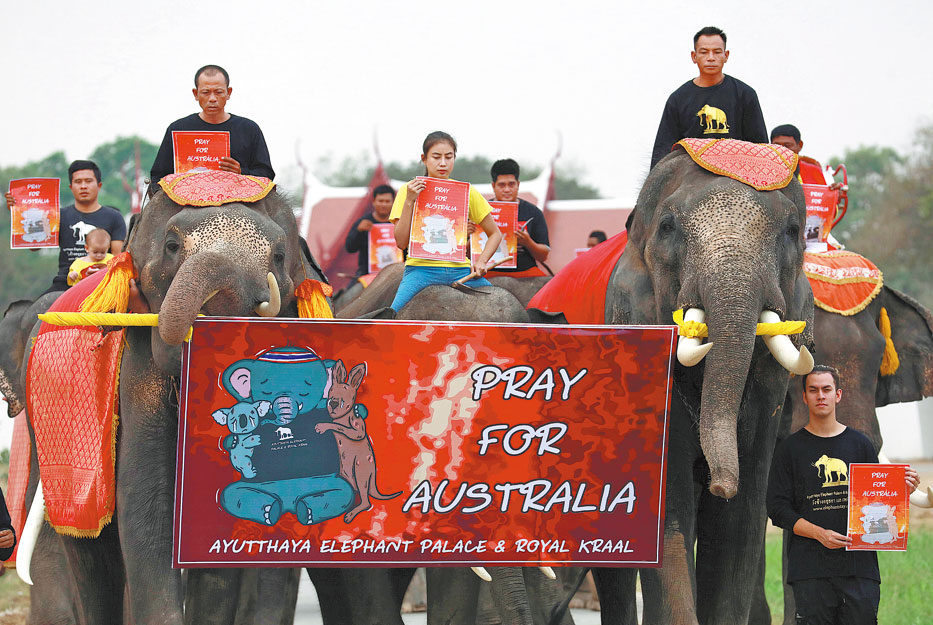
Infernos across Australia leave fears that many species have been wiped out
As bushfires continue to burn in many parts of Australia, ecologists are starting to count the cost to the country's unique wildlife, with fears that many species may now be extinct.
Some reports have put the number of animals, birds and reptiles killed by the fires at half a billion or more.
"The numbers are fairly hard to determine, because nothing like this has happened before, especially across this scale," said University of New England entomologist Nigel Andrew, a former president of the Ecological Society of Australia.
He said fires previously "have been patchy in their distribution-they haven't been taking out entire landscapes".
Jim Radford, principal research fellow at the Research Centre for Future Landscapes at La Trobe University in Melbourne, agrees.
"The simple answer is no one knows," he said. "This is an area of biodiversity research which is grossly underfunded."
Professor Chris Dickman, a fellow of the Australian Academy of Science, has estimated that half a billion animals have perished in the state of New South Wales, or NSW, alone since the fires started in September.
Dickman based his figure on a 2007 report that he co-authored for the World Wild Fund for Nature on the impacts of land clearing on Australian wildlife in New South Wales.
"To calculate the impact of land clearing on the state's wildlife, we obtained estimates of mammal population density in NSW and then multiplied the density estimates by the areas of vegetation approved to be cleared," he said. "Estimates were conservative."
Dickman said he used the same formula to come up with half a billion animals affected by the current fires in Australia's most populous state.
"Many of the affected animals are likely to have been killed directly by the fires, with others succumbing later due to the depletion of food and shelter resources" and by predators such as feral cats and red foxes, he said.
The current bushfires have destroyed almost half of South Australia's 4,400-square-kilometer Kangaroo Island Wildlife Park-normally a place of refuge for dozens of threatened plant and animal species.
Wildlife experts estimate that 25,000 koalas-h(huán)alf the island's koala population-h(huán)ave perished in the blazes.
As flare-ups continued, the fate of the island's echidna, kangaroo and bandicoot populations, as well as the rare dunnarts and glossy black cockatoos, remained unknown.
Kangaroo Island Wildlife Park said it has taken in hundreds of starving and injured koalas, including many young koalas left orphaned by the fires.
Scientists say rare and unique flora and fauna in Western Australia's Stirling Ranges, 400 kilometers southeast of Perth, may never recover after fires tore through 40,000 hectares of land, much of it designated national park.
The story is much the same for the entire country.
Associate Professor Matthew Hayward, of the School of Environmental and Life Sciences at the University of Newcastle in New South Wales, said: "The parma wallaby and red-legged pademelon are just a couple of the threatened species that have had the majority of their distribution destroyed in the fires."
Once a fire goes through an area, animals that did survive need to be able to find enough food, and this is suddenly much harder.
"There is unlikely to be much food in these areas until rains come and the vegetation responds. This drought-fire-drought trifecta means the impacts on biodiversity treble," Hayward said.
For generations
Joe Fontaine, a lecturer specializing in fire science and ecology within the environmental and conservation sciences field at Murdoch University in Perth, said: "The reverberations of these epic bushfires will be felt for generations.
"Tree mortality and seedling survival, as well as food and shelter for our animals, are all threatened by harsher conditions.
"We also face a fierier future, and a real risk of more drought-heat-fire interplay further threatening our iconic landscapes. Effective policy and thinking will need to incorporate these realities going forward."
Professor Bob Hill, director of the Environment Institute at the University of Adelaide, said: "The fires around Australia are tragic at many levels, and the cost in human life and of animals, both domestic and native, is appalling."
Perhaps less well understood is the potential cost in terms of future vegetation, he said.
"Australian plants in many vegetation types have evolved in response to a high-fire regime over tens of millions of years, and they are well known for their capacity to regenerate, either from seed or vegetatively, after major fires," he said.
"However, the risk is that we are now seeing fires that are so intense that they are reaching temperatures where these adaptations are no longer effective-and if this continues we will begin to see plant species losses from burned sites as their regeneration processes fail. Over time, this has the potential to be catastrophic."
Australia supports a rich and impressive diversity of mammals, with over 300 native species. The continent is uniquely dominated by marsupials and is the only great land mass to contain three major groups of living mammals: marsupials, monotremes (egg-laying platypus and echidna) and placentals.
Some 244 species, or 81 percent of this distinctive fauna, are found only in Australia.
Thirty-four species and subspecies of native mammals have become extinct in Australia over the past 200 years, the highest rate of loss for any region in the world.










