



Reform of tax system may boost FDI







The process of paying taxes is one of the aspects measured by the World Bank to compile its annual ease of "doing business" rankings. China has continually improved its standing insofar as the "paying taxes" score is concerned, on the back of the government's tax and fee cuts campaign.
This is revealed in Paying Taxes 2020, a sub report of the World Bank's Doing Business 2020 that evaluates four factors of each economy's tax environment: the number of payments; time; total tax and contribution rate for a firm to comply with all tax regulations; and the post-filing processes.
The time required to complete the process of paying corporate taxes and comply with tax obligations in China reduced to 138 hours, according to the new report, compared with 142 hours a year earlier.
The total tax and contribution rate for a firm declined to 59.2 percent. Although it was a relatively high level compared with some advanced economies, it has improved from the previous year's 64 percent.
"In the past two years, China has been in the world-leading position in terms of tax payments, time, and corporate income tax correction and declaration, with tax payment indicators ranking in the top three of the BRICS (Brazil, Russia, India, China and South Africa) group," said Peter Ng, the mainland and Hong Kong tax leader of PwC.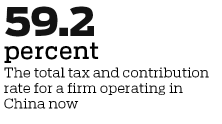
"The World Bank also gave positive comments on China's achievements in optimizing and upgrading its electronic tax declaration and payment system," he said.
China implemented a proactive fiscal policy, with tax cuts and rate reductions as the most important measures since 2018. Specific policies included deepening the reform of value-added tax (VAT); adding special additional deductions of personal income tax; further expanding the scope of small enterprises that enjoy preferential corporate income tax; and policies to promote the development of innovative and high-tech startups.
"Many of the above reform measures have been reflected in the Paying Taxes 2020 report, which has been recognized by the World Bank. China's total tax and contribution rate index has been significantly reduced," said the PwC partner.
The World Bank research report showed that the complexity of tax systems is a major determinant of foreign direct investment or FDI. Economists found that the number of payments and time to comply with tax obligations has significant negative effects on FDI flows.
During the past years, China has accelerated tax reforms to make the paying tax process easer, faster and more accurate. According to Doing Business 2006, for example, businesses in Shanghai spent 832 hours per year on average back then to prepare, file, and pay taxes, and they had to make 37 payments. By the time Doing Business 2020 was published, these metrics have been reduced to just 138 hours per year and seven payments, according to the World Bank.
"Modern technologies pose a number of complex questions for tax policy," said Rita Ramalho, senior manager of the World Bank's Global Indicators Group. For the ninth year in a row, the most common feature of reforms in paying taxes is the implementation or enhancement of electronic filing and payment systems.
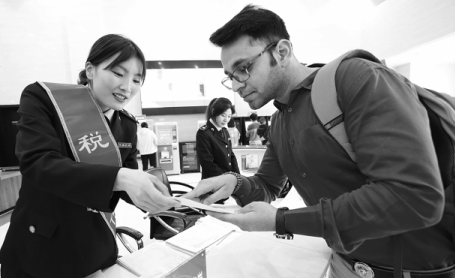
The State Taxation Administration, the country's tax authority, launched a system that facilitated e-filing of different stamp duty taxes. Additionally, China implemented a series of measures in the past two years, which simplified corporate income tax, labor taxes, value-added tax declarations, and e-delivery of invoices.
In 2014, China's integrated taxpayer services were launched on mobile tax apps and official accounts on the two main Chinese social media platforms-WeChat and Weibo. A year later, the "Internet+Taxation Initiative" unlocked the potential of big data for taxpayer services, such as data sharing among government bodies, online training, and e-invoices.


Today's Top News
- Stability, vitality and creativity appeal to all: China Daily editorial
- Xi attends Chinese New Year gathering with non-CPC personages
- Xi extends Spring Festival greetings to service personnel
- Nigeria and China at 55: a partnership for a new era
- 'Shopping in China' a broader economic repositioning
- China successfully conducts key flight test for manned lunar mission







