



Who is to blame for the surge in HK PTSD level?







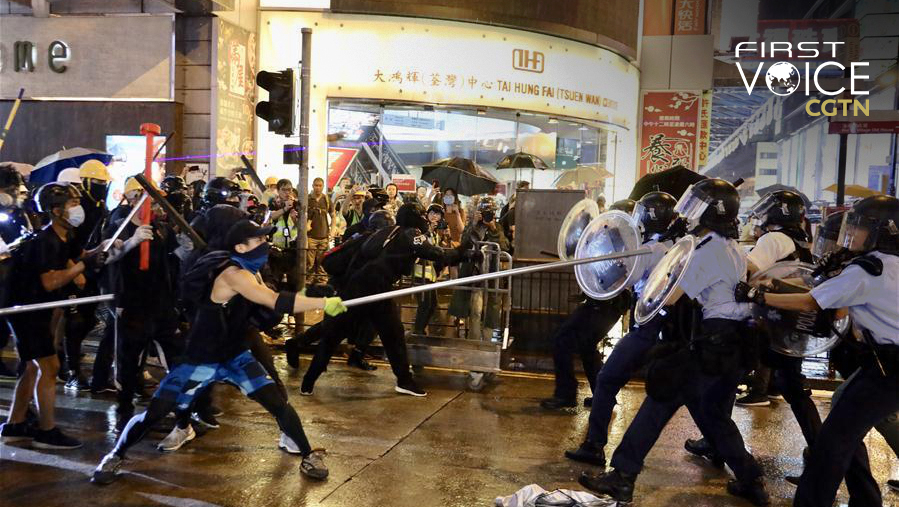
Editor's note: CGTN's First Voice goes beyond the headlines to dissect, examine and analyze hot-off-the-press issues and break down breaking news into simple parts. The daily column offers a Chinese perspective on global current events to help you shape your views on matters that shape your life.
Hong Kong is seeing a surge in depression and PTSD (post-traumatic stress disorder) levels after months of violent social unrest, according to findings by a study published in The Lancet medical journal this week.
Up to 11 percent of adults reported probable depression in 2019. That's compared to 1.9 percent before the Occupy Central Movement in 2014 and 6.5 percent in 2017. "One in five adults now reports probable depression or suspected PTSD, which is comparable to those experiencing armed conflicts, large-scale disasters, or terrorist attacks," the study concluded after research that involved more than 18,000 Hong Kong residents from 2009 to 2019.
As members of the police force were not sampled and under-18s – who make up a substantial proportion of protesters – not included in the study, the mental health problem in Hong Kong could be more severe than what the study has indicated.
Apart from the disruption to normal life with underground stations paralyzed, schools closed and children terrified, the long-term consequences of the violence have started to bite. Investors and tourists fled; the city's economy sank into recession for the first time in a decade; and now, its PTSD level is "comparable to conflict zones."
Since last July, "activists" in collusion with exterior forces, have been vigorously fighting for Hong Kong's "future" that, in their words, would be freer and more democratic. But despite their rosy portraits, facts indicate the opposite: "pro-democracy fighters" are stirring up trouble in Hong Kong under the guise of freedom and democracy. While the city had been known as an innovative and financial hub that could rival Silicon Valley, months of violence have dragged it into an abyss of misery.
It is worth noting that after The Lancet's study went viral, some netizens with ulterior motives started to blame Hong Kong authorities for "never responding to the demands of Hong Kong residents" and this, as they alleged, is the culprit behind the surge in depression and PTSD levels in the city. But, is it so?
Contrary to allegations, Hong Kong residents' right to peaceful demonstrations has been well-protected. Rallies were initially triggered by a now defunct fugitive bill. While authorities suspended and eventually withdrew the bill, demonstrations descended into violence that battered the city for seven months. Local authorities have responded to people's demands, but violence persists.
It is the forces behind the violence, rather than the Hong Kong government, that should be responsible for the rising PTSD level. "Spending two hours or more every day on sociopolitical news via social media was strongly associated with probable depression and suspected PTSD," The Lancet's study found.
"Activists" and exterior forces have wasted no opportunity in defaming the central government online. Fake news about police bullying "innocent citizens" has widely circulated on social media platforms. This, to some extent, may raise the public's anxiety level. While the Hong Kong government was busy restoring social order on the street, forces with ulterior motives were busy spreading rumors and fake videos about the central government's "suppression on dissidents."
"Heavy media use, particularly social media apps widely used by protesters, was associated with both probable depression and suspected PTSD," the study concluded. Fabricated news has intensified the public's hostile sentiments against local authorities, and hostility has, in turn, bred more fake news on social media. Hong Kong's PTSD level rose in this context.
Now, certain netizens have again pointed a finger at the authorities for the city's mental health burden, with an intention of driving a wedge between the government and residents in Hong Kong. Isn't it going to further raise Hong Kong's depression and PTSD levels?
Then, what's the solution? The Lancet's study advises "substantial increases in service surge capacity in both the health and social sectors, and in real time." Innocent residents have been verbally and physically attacked for voicing support for the police. Even passersby were randomly selected and assaulted. Physical injuries may recover in a few months, but mental burdens take longer. This requires long-term professional medical treatment.
Apart from after-event interventions, narrowing down the knowledge gap between people holding different views and soothing their hostile sentiments may carry more weight in protecting people from depression and PTSD. Malicious attempts to sow discords between the public and the government must end.





