



US democracy only for the rich







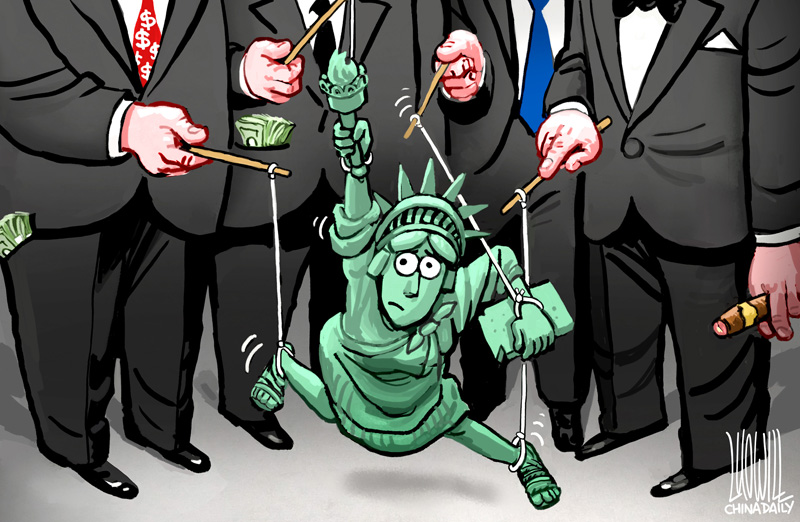
Editor's note: The China Society for Human Rights Studies published an article on Thursday titled "Money Politics Exposes the Hypocrisy of American Democracy". The following are some excerpts:
The United States has long prided itself on being a "beacon" of democracy, asserting that all Americans enjoy the rights to participate in public affairs, to vote, and to supervise the government. But the reality is that the US is bitterly divided politically and deeply divided socially, and large numbers of Americans are excluded from the political process. Money politics is the main reason for this. Money politics deprives American people of their democratic rights, suppresses the expression of the real wishes of voters and produces political inequality.
I. Money permeates American politics
Elections are meant to express the will of the electorate, set policy direction and select qualified leaders. But money politics distorts public opinion, making elections a show just for the rich. Fundraising is an entry requirement for candidates at all levels of elections. Between 2000 and 2012, the amount spent by the Republican and Democratic presidential candidates increased rapidly from $700 million in 2004 to $1 billion in 2008 and $2 billion in 2012. The 2016 elections in the US, including presidential and congressional elections, cost a total of $6.6 billion, the most expensive political elections in the US history. The cost of midterm elections has also been rising very fast. The four mid-term elections between 2002 and 2014 cost $2.18 billion, $2.85 billion, $3.63 billion and $3.84 billion respectively, and the cost further skyrocketed to $5.2 billion in 2018. In the 2018 midterm elections, the average cost of winning a Senate seat was $19.4 million, and the average cost of winning a House of Representatives seat was more than $1.5 million. The high cost greatly raises the threshold for running for a seat, ruling out the possibility for the vast majority of people. Only a few with the ability to raise large amounts of campaign funds can participate in the political races. This has certainly created a breeding ground for rich people and interest groups to cash in on candidates.
In addition to publicly registered election funds, large amounts of secret funds and "dark money" are also injected into American election campaigns. The NBC reported in 2018 that the US Treasury Department announced it would no longer require most nonprofit agencies to report the sources of their donations, significantly reducing the transparency of election funding. The amount of "dark money" in the 2010 mid-term elections was $16 million, and it had increased to $53 million in 2014. In 2018, the "dark money" spent by outside groups other than candidates ballooned to $98 million. More than 40 percent of the TV ads aired by outside groups to influence congressional elections were funded by secret donors.
II. Money politics is the inevitable outcome of American capitalism
The US has devised an elaborate political system and electoral system that screens candidates and voters to ensure that those who satisfy the rich are elected. While the wealthy can use campaign finance to select qualified political agents to become candidates and win elections, lacking money it is hard for representatives of the poor to become candidates. Under this system, the rich participate in politics through elections to guarantee their economic interests, while political figures get involved in elections with the help of money. In order to maintain their dominant positions in the allocation of national public resources, the rich have a strong incentive to actively get involved in politics, seeking spokesmen at all levels of government. The activities of interest groups vividly illustrate the connotations of money politics. The first amendment to the US Constitution is the supreme legal basis for the legitimate existence and activities of interest groups. The unique US political system, such as the separation of federal and state powers, and the separation of legislative, executive and judicial powers, provides a wide scope for interest groups to exert pressure on all levels of government and influence American politics. Interest groups have been deeply embedded in Congress and the judicial system, as well as political parties and government.
Lobbying is an important tool of money politics. As a unique political phenomenon, lobbying corruption is a chronic disease inherent in the American political system. According to several US laws, interest groups are allowed to be formed to compete to influence congressional legislation and government decisions. Interest groups hire lobbyists to lobby members of Congress and their aides to influence the enactment and amendment of bills, and pursue their own interests. Over the past more than 40 years, the American lobbying industry has grown at an explosive rate. In 1971, there were only 175 registered lobbyists in the US, but the figure increased to 2,500 in 1981 and 13,700 in 2009. That means there are more than two dozen lobbyists surrounding each member of the Senate and House of Representatives. According to incomplete statistics, there are more than 2,000 lobbying firms in Washington and interest groups' spending on lobbyists has soared from $1.44 billion in 1998 to $3.33 billion in 2011, a 131 percent increase over the past 14 years.
In the late 19th century, money politics in the US became a "pork-barrel" system, through which the winning party usually allocated official positions to those who contributed to the election, mainly the party's main figures and campaign funders. The "pork-barrel" system resulted in the spread of political corruption and low administrative efficiency. Since the beginning of the 20th century, the US has tried to impose some restrictions on political donations, but failed.
III. Consequences of money politics
Money politics deprives ordinary American people of their political rights. The US often boasts of its "one-man, one-vote" democracy, but the voting rights of low-income Americans are severely restricted. According to US News& World Report, from 2010 to 2015, 21 US states passed laws restricting voting rights, and 14 states implemented measures restricting the exercise of voting rights in the 2016 presidential election. These laws and measures have mainly prevented the poor from registering to vote. Newsweek reported on Nov 21, 2017, that hundreds of thousands of Americans were denied the right to vote because of poverty. Nine US states have passed legislation denying the right to vote to anyone who fails to pay attorney fees or court fines. In Alabama alone, more than 100,000 people, or about 3 percent of the state's electorate, have been removed from the voter list. That has led to lower voter turnout in US elections. In the 2014 mid-term election, the average voter turnout in the US was just 37 percent, the lowest since the 1940s.
Meanwhile, government positions are reserved for the rich and the upper class. According to American political practice, the candidate who wins the presidential election usually awards some government positions to those who have made contributions to the election victory. Every president appoints a number of donors as ambassadors. After the 2000 presidential election, a third of the new posts in the US government went to friends, relatives and donors of the victorious candidate. Of the 556"super fund-raisers" who supported the winning president in the 2008 presidential election, a third were given cabinet posts or became advisers, and nearly 80 percent of those who raised more than $500,000 were given key positions.
Money politics overtly channels interests to the rich. One consequence of political donations is that a few rich people have more influence than the vast majority of American people, causing the government to make policies that benefit the rich at the expense of the poor. The rich capture politicians with campaign contributions, making them legislate on their behalf.
It is known to all that the Republican administration that took office in 2017 was a government that represents the rich. The Tax Cuts and Jobs Act passed by the US Congress in 2017 is not a universal tax cut, but a tax cut for the rich and big businesses and a tax increase for the poor. On the one hand, the rate at which wealthy families pay income tax was slashed from 39.6 percent to 35 percent, a decline of 4.6 percentage points; on the other hand, the poorest families have seen their income tax rates rise from 10 percent to 12 percent. The act has caused the poorest families to suffer while the richest families have gained greatly. A Gallup poll at the end of 2017 showed that 56 percent of Americans opposed the tax reform bill, compared with 29 percent who supported it.
Money politics makes it harder to solve pressing political and social problems. In the US, the proliferation of guns and gun violence is a major political and social problem that has troubled society for many years. In 2017, the most recent year for which complete data is available, 39,773 people died from gun-related injuries in the US. This figure includes gun murders, misuse and gun suicides. Most of these casualties could have been avoided if guns had been strictly controlled. But anti-gun control interest groups have successfully disrupted gun control efforts by intervening in elections and lobbying. These interest groups make substantial political contributions to US presidential and congressional elections, donating $113 million through the Political Action Committee between 2010 and 2018 alone. Because of the huge amount of funds they have provided, anti-gun control interest groups in the US have achieved a great success.
The US has long touted itself as a "role model" for democracy and human rights that should be emulated by the whole world. But the pervasive, deep-rooted money politics has laid bare its lie once and for all.





