Inflammatory presentation of imagined foes







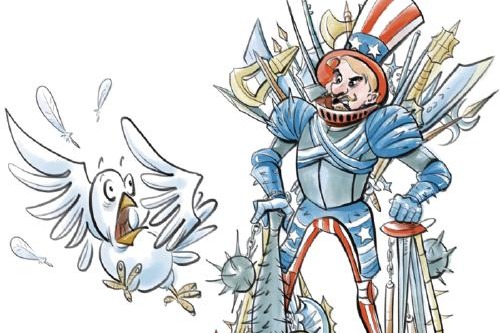
A more peaceful world-most people would agree-is a goal worth aspiring to. Creating enemies undermines attempts to realize that worthwhile objective. Yet 30 years after the end of the Cold War, in his speech at the North Atlantic Treaty Organization on Nov 20, United States Secretary of State Mike Pompeo reiterated that in his country's eyes, China, Russia and Iran are enemies.
What China, Russia and Iran have done merit being called "threats" to the West, beyond opting for a different system of governance, Pompeo did not say. This geopolitical name-calling mostly goes one way and the inflammatory narrative of a bipolar world pushed by high-ranking US representatives is further forcefully backed by a never-ending barrage of criticism from US mainstream media and NGOs chastising these manufactured adversaries for supposed societal and humanitarian shortcomings.
That it is system of governance or human rights records of China and Russia, which the US is now using to justify it elevating both countries to the level of main official threats and harsher line in diplomatic affairs, is difficult to stomach given the US' own human rights record, which includes its drone war, torture, mass incarceration and at times deadly migrant detention centers. The underlying concerns really appear to lie elsewhere.
A more likely explanation is that the US and China have found themselves on opposing sides on an international issue more than once in recent years.
And while most countries, exercising a degree of diplomatic sovereignty and independence, have been willing to observe the geopolitical line drawn in the sand by the US, China continues to assert itself on the world stage, despite the tariffs the US imposed on China as part of the US-initiated trade war, which were simply returned in kind.
So despite the publicly proclaimed concerns for human rights and the supposedly differing fundamental values of China, Russia and Iran-a questionable claim in itself-an observer of the world stage has to conclude that the only thing that really bothers the US is the exercise of diplomatic sovereignty potentially at odds with its geopolitical interests and which can resist US economic pressures to confirm.
The US could regard the shifting balance of power as, if not friendly, at least respectful competition among sovereign nations. Applying the logic of the Cold War to today's world and promoting a clash-of-systems narrative is falsely reductive and unhelpful. Real global threats such as climate change and the mass extinction of species mandate that the world's strongest nations put their differences aside, cooperate and face the challenges together. Here, the US has the opportunity to lead by example and not by means of economic sanctions or the threat of force.
Given the enormous challenges facing the US domestically-from the gun violence that kills almost 40,000 Americans a year, to its opiate epidemic and alarming suicide rate, along with the starkest levels of wealth inequality in the developed world, which sees 12 percent of adults and 16 percent of children in the richest country on Earth living in poverty-the energy the US government expends trying to shame other countries for their domestic issues seems ill-placed.
And let's not forget that the US and China are both nuclear powers. In an age where a military conflict between nations with nuclear weapons could have existential implications for humanity, there is nothing to be gained from the arbitrary vilification of another global power.
Yet the actions and statements of the current US administration make it abundantly clear that more than anything else China's decadelong rise to prominence is seen by the US purely as a threat to US hegemony. Sadly, it seems the nation that spends $700 billion annually on its military will always need enemies, real or perceived, to justify the investment. He who is adamant about looking for enemies will always find them. The US' attitude is not conducive to a peaceful world and maybe that is the fact its media should write about and not the domestic challenges of other nations.
The author is the director of Online Sales and Operations at Zimmerli in Switzerland. He got an MBA degree from the University of Oregon, US, and has been living and working in Shanghai, China, for 8 years.