



We are living in an era of ongoing globalisation







The markets of developing countries are crucial for global economic growth. According to an adjusted forecast by the IMF in July, emerging markets may display more than double the rate of growth in 2019 compared to developed countries: 4.1% versus 1.9%. That will result in global economic growth of 3.2%.
The IMF is expecting economic growth in developed countries to slow down to 1.7% next year, while in developing countries growth may reach 4.9% (which would lead to global GDP growth of 3.6%). These figures do not particularly capture the imagination – the IMF has very justifiably deemed this rate of growth to be sluggish. What is revealing is the trend.
It is by no means the case that this trend is viewed with universal approval. Some experts claim that developing countries have emerged as the main beneficiaries of globalism, and that their growth comes at the expense of advanced countries and their people. They state that globalism is in and of itself an ideology, rather than a global system which is economically viable and favourable to all.
Tangible benefits for all participants in globalisation
In practice, globalisation – that is to say, the removal of political barriers hindering the movement of capital, people, goods and services – has already resulted in tangible benefits for all participants in the process. I readily admit that Kazakhstan has undoubtedly benefitted from globalisation – the nation is growing at a greater rate than the global average. Last year, its economy grew by 4.1%, and this year is forecast to increase by 3.8%.
In the last few years there has been increasing talk of the regression of globalisation, of rising nationalism and protectionism, especially in developed countries. Nevertheless, it is gratifying to see that developing countries are continuing to remove barriers and are endeavouring to enter the global market.
When talking about global trade, sceptics like to claim that developing countries primarily export raw materials. However, this is only true up to a point. Aside from minerals, aside from goods produced by traditional manufacturing sectors, globalisation gives these countries the chance to diversify, to offer modern and sought-after services to regional and global markets.
Undoubtedly, the world needs regional platforms to facilitate the trade and investment flows in emerging markets. It is only natural that the map of international financial centres saw a new addition recently with the establishment of Astana International Financial Centre in the capital of Kazakhstan. It operates in its own jurisdiction, independently from the rest of the country. This jurisdiction is founded on international commercial law (based on common law), and has independent governing bodies and its own legal and arbitration system. The centre operates in full accordance with FATF principles. Participating companies enjoy numerous benefits, including with regards taxation.
We do not only expect the AIFC to provide a key to Kazakhstan’s market. The country is part of the Eurasian Economic Union (EAEU) together with Russia, Belarus, Armenia and Kyrgyzstan (in addition, free-trade agreements are in place with numerous other countries which are not part of the bloc). Today, the EAEU is a major global player. According to EAEU statistics, total annual foreign trade is worth more than $750 billion. In the first half of this year alone, EAEU nations exported $225.2 billion-worth of goods, with imports totalling $126.1 billion, thereby giving a surplus of almost $100 billion. This is a market with enormous potential, both in terms of trade and investment.
Modern economy is global in nature
In itself, the innovative nature of the modern global economy is global in every sense, and encompasses all countries, all industries, and all sectors of society. The fourth industrial revolution, of which much has been and continues to be said at international economic forums – including in Davos – actually has its roots going back as far as the end of the previous century. However, it is only recently that the term has caught on, now that wholesale changes in the way production and services are structured have become noticeable and exerted a cumulative effect. Indeed, even employment patterns have changed. The division between tradable and non-tradable sectors has become largely eroded. Forward-thinking stores are accessible 24 hours a day, seven days a week in any country, provided there’s internet access and the ability to use modern means of payment. Traditional service sectors, such as the postal service, initially appeared under threat of extinction from new forms of communication. However, the opposite has turned out to be the case – these sectors have become revitalised. Today, people don’t receive letters, but packages, and in much greater quantities than before.
Many of the standards which will determine the way we live tomorrow are being developed today. We are witnessing how fintech and green technologies aiming to save energy and effectively process waste are currently at the very forefront of progress. The companies addressing these issues are located in all kinds of countries – not only developed ones. In order to create a business climate which fosters innovation, there needs to be a favourable regulatory environment. And that is precisely why a regulatory sandbox has been created at Astana International Financial Centre, and opportunities to attract funding through issuing green bonds are welcomed.
We don’t know which of today’s technologies will take off and move into common usage (including as a result of globally adopted standards). However, one thing is clear: the market of ideas and technologies remains global, in spite of any trade wars. The payments system which uses a phone’s IMEI number as an identifier first appeared in Africa, while QR code payments were developed in China. Efficiency enables us to capitalise on the process of implementing any technology, and serves as the main argument in its favour, both for business, and society. Where this technology is first implemented – and by whom – is not so important.
‘The natural effect of commerce is to bring peace.’ This succinct statement was not taken from the latest IMF report. It is a quote from the French writer and philosopher Montesquieu, who wrote those words in the 18th century. It is a sentiment that remains pertinent to this day, in an era of ongoing globalisation.
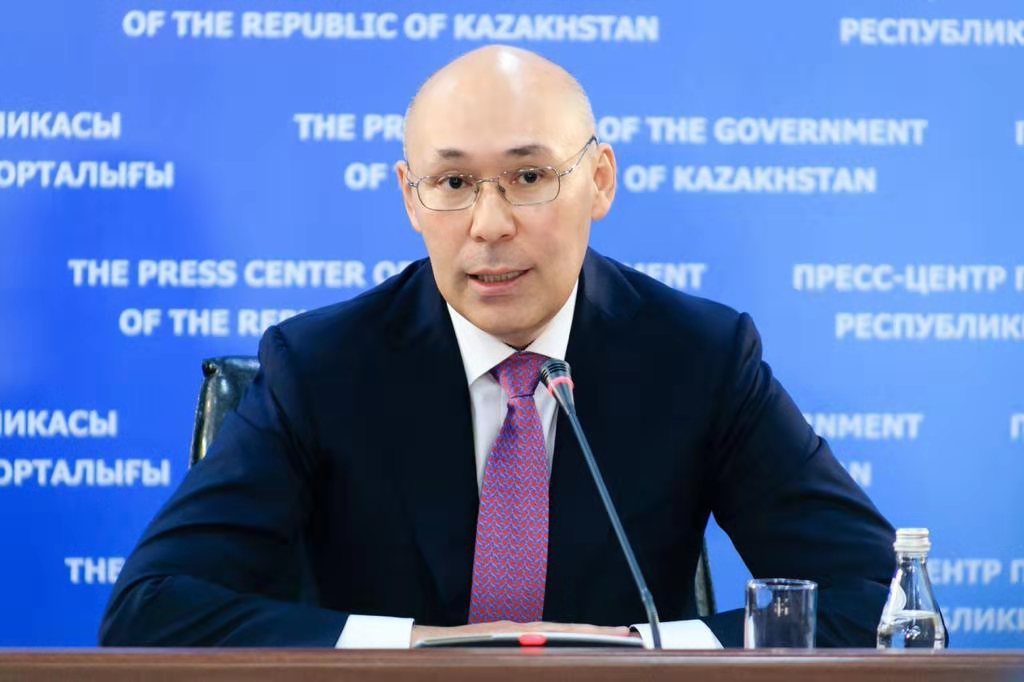
The author is governor of Astana International Finance Center, Kazakhstan.





