Volunteer medics a tonic for rural residents
Doctors from large hospitals across the country are offering free help to people in China's far west. Wang Xiaodong reports from Tacheng, Ili Kazakh autonomous prefecture, Xinjiang Uygur autonomous region.







Editor's note: This is the ninth in a series of stories focusing on the Xinjiang Uygur autonomous region, looking at developments in the local economy, the cultural and business sectors, and poverty alleviation measures.
Xiao Jie, a border control officer in Yumin county, Xinjiang Uygur autonomous region, has felt stomach discomfort occasionally in the past year. Although he has visited local hospitals and clinics, his condition has not improved.
So, when he heard that a group of volunteer medical professionals from Beijing would be providing free diagnoses and treatment at the health center in Chahantuohai, the township in which he lives, Xiao hurried to join the line of patients.
"I hope it will work this time. Doctors from big hospitals are definitely more skilled and may provide a better diagnosis," he said.
"I hope more similar voluntary services can be organized and more experts will come to the township to provide training for local doctors. Also, I hope local clinics can develop remote medical care services, so patients here can consult doctors at big hospitals via the internet, instead of having to travel long distances."
Expert advice
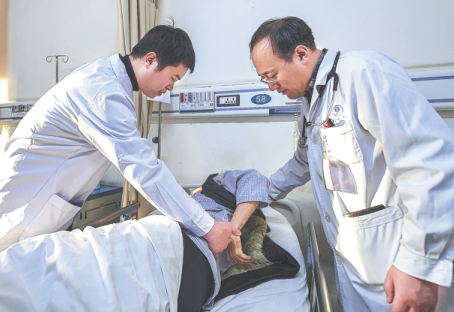
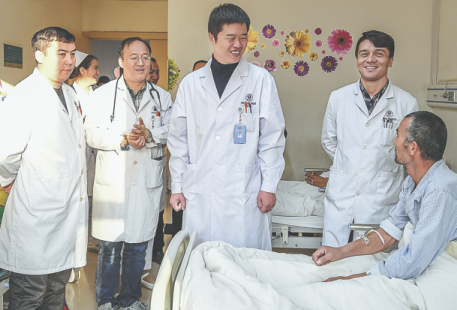
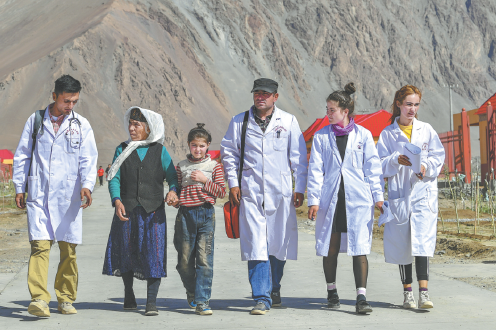
The visit, from Oct 21 to 27, was organized by the National Health Commission. The 18 doctors, all from major hospitals in cities such as Beijing and Shenzhen, Guangdong province, were experts in fields such as respiratory disease, eye surgery, gynecology and cardiovascular disease.
Seeing the long lines of patients, Chen Yao, an eye surgeon at Beijing Tiantan Hospital, said it was the first time he had visited Xinjiang and he was pleased to have the opportunity to provide medical services as a volunteer.
"Medical services here lag behind big cities like Beijing," he said. "Most of the patients I received were older than 50, and they had conditions such as dry eye and cataracts. However, some had never seen a doctor before."
A township health center he visited in Yumin county lacked basic equipment for eye diagnosis and treatment, he said.
During a weeklong tour of Tacheng prefecture-including the counties of Yumin, Emin and Tuoli, which are under its jurisdiction-the doctors provided about 2,000 diagnoses and treatments, according to the commission.
To improve services, the Third Affiliated Hospital of Beijing University of Chinese Medicine signed an agreement with the Tacheng health commission to provide three months' free training for 20 to 30 doctors from county-level hospitals in the prefecture. The Beijing hospital will also cooperate with some rural establishments to provide them with regular remote training and diagnostic services via the internet.
Qin Yong, director of the Yumin county health commission, said the group was the largest voluntary medical team to have visited from another part of China.
"Such assistance is badly needed here. We were really grateful to the doctors who came from so far away to offer voluntary services for local people," he said.
Zhu Hongming, deputy chief of grassroots health at the NHC, said the voluntary services are intended to promote better health and poverty alleviation for people in some of Tacheng's poorest areas.
"Due to the unbalanced distribution of resources, some counties, townships and villages in Tacheng lack medical talent and technologies. We hope the voluntary services will help relieve more people's problems," he said. "We would also like to see hospitals in Beijing and Tacheng establish relations so local hospitals can improve their ability to provide services."
Ning Dongsheng, deputy head of Tacheng prefecture, said he hopes long-term partnerships can be established to help local hospitals produce more talent and meet demand.
The assistance provided to Xinjiang was not an isolated effort. Since 2016, the NHC and several central government departments have undertaken a national program aimed at improving medical services in the region.
National program
Under the program, 43 major hospitals across China have established relations with 37 hospitals in 32 impoverished counties in Xinjiang. Each major hospital sends at least five leading medical professionals to its partner in Xinjiang for at least six months to help improve the quality of diagnosis and treatments offered by local staff members.
By August, 2,400 personnel had been dispatched, helping to provide 1.4 million diagnoses and treatments, and completing 32,000 inpatient surgeries, said Zhou Changqiang, deputy director of the commission's Medical Administration and Supervision Department.
Moreover, the experts conducted 900 rounds of voluntary diagnosis, benefiting nearly 100,000 locals, he added.
In addition, since 2016, the commission has arranged for seven provinces and municipalities to support eight hospitals in Xinjiang by providing equipment and helping to train medical talent.
In the past three years, all eight regional hospitals have been upgraded to tertiary status-the highest level in China's three-tier system. That has improved their ability to deal with severe illnesses.
As of August, the seven provinces and municipalities had organized more than 1,500 leading medical staff members to work at the hospitals temporarily, providing 112,000 training sessions for local practitioners, Zhou said.
Bao Baogen, deputy director of the Zhejiang Health Commission, said the province has invested nearly 400 million yuan ($57 million) in medical assistance that will allow Xinjiang's Aksu prefecture to undertake 44 programs, such as upgrading existing facilities and building new hospitals and clinics.
New clinic
Late October saw the opening of a new three-story building-the site of a new health center in Chahantuohai township-built with the assistance of the government of Panjin, Liaoning province.
The new facility is more than three times larger than the previous clinic-a 350-square-meter, one-story building-which allows it to provide more and better services, said Zhang Jinping, the center's president.
"Previously, the limited space meant we had to provide different services in the same room, which was inconvenient for the doctors, nurses and patients," she added.
Ma Leina, a nurse at the center, said: "We did not have independent treatment rooms, so many of us had to share one room to receive patients. We did not even have enough space for some of the medical equipment. For example, we did not have a special room for ultrasound examinations, so we had to move the machine from one room to another to test patients."
A surgical department will be established at the center so patients who need minor surgery will not have to travel to the county seat or nearby cities, she added.
Zhang said she hopes the improved facilities will attract more doctors and nurses to the rural clinic. One of her major concerns is that many graduates are unwilling to stay at township health centers for long, because most opt to work in big cities if given the chance.
Qin, from the Yumin health commission, said the county still has a severe shortage of skilled doctors. Of the 400 medical staff members, only about 110 hold accepted qualifications, while the rest are "barefoot doctors" (locals who have received a basic medical training that enables them to treat minor ailments), he said.
Although more talented people, including medical school graduates, have joined hospitals and clinics in the county, the number and quality still fail to satisfy demand, he said.
Qin suggested that new policies should be formulated to attract more qualified personnel to townships and villages, such as special programs to recruit medical graduates to township health centers. He also urged improvements to job security and salaries.
In recent years, improvements in health services and medical insurance policies in Xinjiang have seen a marked reduction in the number of people falling into poverty as a result of illness.
Ma Zhilan, a 44-year-old herder in Yumin, said government subsidies mean she only pays 290 yuan a year for medical insurance, and up to 80 percent of her medical bills are reimbursed.
"All the locals are covered by the program, including herders, which has greatly reduced our medical expenditure," she said.
"In the past, medical bills pushed people into poverty, but in recent years that has become rare. Now, most people even choose to go to bigger hospitals in nearby cities for diagnosis and treatment."







Today's Top News
- FM's Africa visit reaffirms commitment
- China widens net in battle against graft
- New US dietary guidelines trigger widespread concern
- China eyes space leap with record satellite filings
- Defiant Iran says it's 'ready' as Trump swings tariff stick
- Multiple satellite filings demonstrate transparency, responsibility and ambition