



How to protect the interests of signatories to the Paris Accord?







Editor's note: Huang Yongfu is a senior fellow at the International Cooperation Center of the National Development and Reform Commission of China. The article reflects the author's opinions and not necessarily the views of NDRC or CGTN.
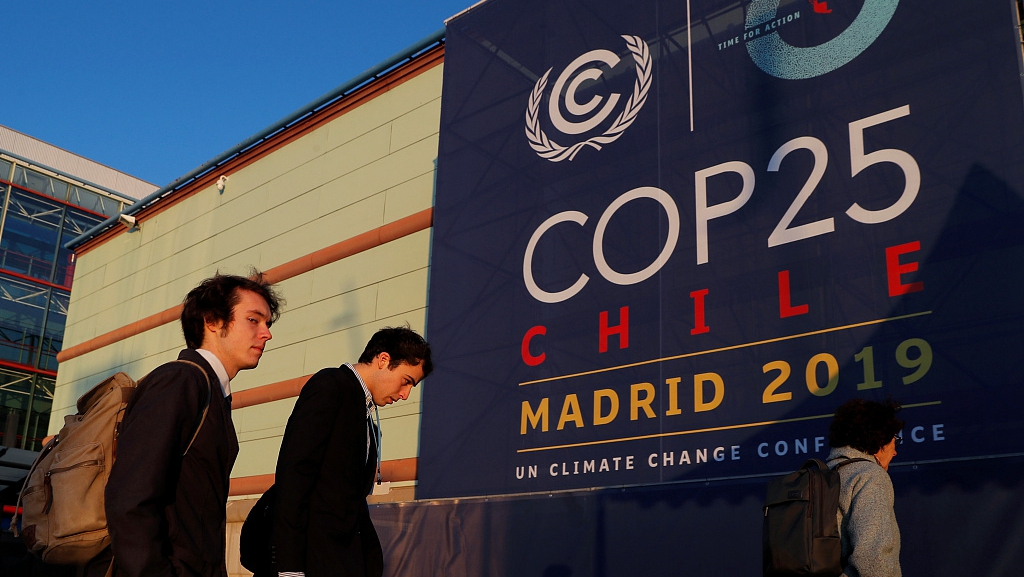
The annual UN climate change conference, so-called COP25, is taking place in Madrid from December 2 to 13, with the convergence of nearly 200 countries. Climate change is again taking a prominent place in the global and national public debates.
However, the negotiation to reboot a global system for tackling climate change has been unnerved and stymied by US' withdrawal from the Paris Accord on Climate Change, which is already the largest emitter in per capita in the world.
The US is starkly free-riding on the efforts of the rest of the world or taking advantage of them. How to protect the interests of signatories to the Paris Accord or prevent the Accord from being picked apart or the world from being tipped into fiery catastrophe?
What about the 'net zero' target?
Approved in 2015, the Paris Accord took effect on November 5, 2016, after being ratified and formally adopted by 197 parties. The Accord aims to limit global warming to "well below 2 degrees Celsius" above pre-industrial levels with an "aspiration" not to exceed 1.5 degrees this century given the increased scientific certainty on human-induced emissions.
However, over the years global carbon emissions have continued to rise nonetheless, with the average global temperature already being 1.1 degrees Celsius above pre-industrial levels, according to the World Meteorological Organization estimates.
As signatories to the Paris Accord are expected to announce bolder but voluntary emission-reduction targets by the end of 2020, many countries are locked in heated debates about setting up "net zero" targets and deadline within a defined geographical border, or whether a "net zero" goal might be right for them. The "net zero" target, means taking as much carbon dioxide out of the atmosphere as being put in.
The EU is setting a good example. The European Parliament declared a "climate emergency" to pressure for more ambitious green policies. So far, more than 60 countries have pledged to adopt or consider "net zero" targets, typically by around 2050, and dozens of countries have enshrined "net zero" targets into law this year, for example the UK and France. However, few have enacted specific pledges or policies to achieve such targets.
This momentum in the West heading towards the "net zero" is strong, but the gap between the countries committed to "net zero" targets and those that are not is getting much larger. The best case speaking to this is the US' withdrawal from the Paris Accord.
US under the Trump administration is the largest 'polluter'
The US House Speaker, Nancy Pelosi, brought a congressional delegation to COP 25 and proclaimed at a news conference that "we want to say to everyone: The United States is still in."
However, Pelosi's sojourn in Madrid was widely seen as an empty climate gesture, as the Trump administration gave the U.N. its formal notice to withdraw from the Paris Accord on November 4, citing "an unfair economic burden on American workers and businesses." The process is due to be completed on November 4 2020, meaning that COP25 could be the last one that the US delegation attends.
In fact, President Trump could have pledged reduced targets that could keep the US inside the Accord, as the Accord includes no legal binding and no enforcement mechanism as to pledges to cut emissions made by each government, even although it claims to stick to the principle of "common but differentiated responsibilities."
Trump's decision would result in increasing US emissions and put a brake on America's renewable-energy industries. It would undoubtedly bring risks for the rest of the world, i.e. emboldening fossil-fuel-rich countries, such as Saudi Arabia and Qatar, to delay their actions at least.
At present the US is already the second largest emitter in total and largest emitter in per capita in the world, while China is the largest emitter in total, according to current methodology to measure carbon emissions.
The emissions for the US was still underestimated due to the major defect of the current methodology, which ignores the impact of foreign trade, only calculating the carbon produced, not the carbon consumed (but produced in somewhere). As such, if consumption impact is taken into account, emissions for many developed countries will be scaled up and the US will transcend China to become the largest emitter in total in the world without much doubt.
Free trade policy could be incorporated
How to protect the interests of signatories to the Paris Accord? For the sake of long-run global sustainability, some mechanisms should be sought.
One is to incorporate the preferential policies of trade tariffs, even free trade policy, into the Paris Accord on Climate Change.
On December 11, the WTO's appellate body that hears appeals over trade disputes and authorizes sanctions against rule-breakers will cease to function due to the Trump administration's refusal to appoint new judges to replace the retired ones.
The WTO underpins 96 percent of global trade. Without a functioning appellate body, the multilateral trading system is about to freeze up, causing cross-border commerce unrulier.
This mechanism could be effective in upholding the ailing global trading system and seek ways to reform the WTO. It could decarbonize the trade sector involving production, consumption, delivery and a wider economic system. It could spur emission reductions once the levels of preferential trade tariffs being linked to the "net zero" targets pledged. It could fortify the Paris Accord by preventing those signed the Accord from using the Trump's opposition as an excuse to step back from their commitments.





