Anti-monopoly laws can bolster competitive, efficient markets







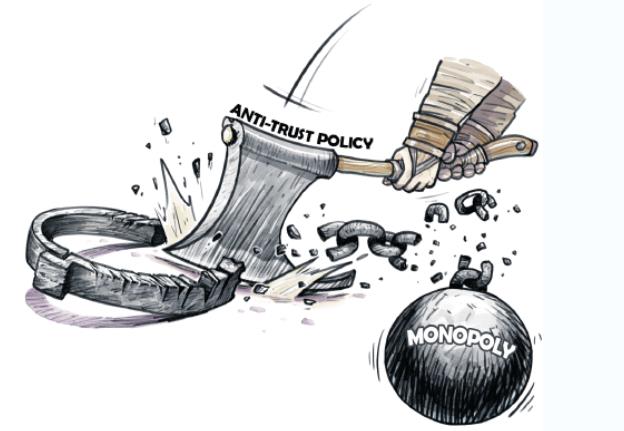
When I was studying economics 40 years ago, in the late 1970s, I was taught that monopolies are not a problem for a market economy. According to this doctrine, which was then just starting to become dominant, most monopolies are created by government fiat.
The few that arise naturally achieved their positions by developing new technologies or by providing cheaper or better products to consumers. Anyway, the argument continued, new competitors should enter the market to restore competition.
Starting with president Jimmy Carter (1977-81), these ideas have driven the policies of presidents of both parties, resulting in American economy that is much more highly concentrated with fewer opportunities for new entrepreneurs.
A new book by Matt Stoller, Goliath: The 100-Year War Between Monopoly Power and Democracy, provides a detailed history of the fights between those who believed that active government power is needed to break up the concentration of monopolistic business and finance versus those who argue an economy dominated by large monopolistic firms is either beneficial or unavoidable.
Anyone who wants to understand the economic and political history of the US of the entire twentieth century should read this book. I highly recommend it, with a few caveats discussed below.
An effective antitrust policy is especially crucial at a time that large online companies are coming to dominate many sectors of the economy. In the last 20 years, the rise of tech giants has further exacerbated the monopolistic nature of the American economy.
The importance for the Chinese economy of antitrust policy was stressed by the Oct 31 report of the Fourth Plenary Session of the 19th Central Committee of the Communist Party of China. The plenum concluded that the government should "strengthen the basic position of competition policy, implement a fair competition review system, and strengthen and improve anti-monopoly and anti-unfair competition law enforcement".
In 2018, multiple Chinese market regulators were consolidated into the State Administration for Market Regulation as part of an overall government overhaul which focused on eliminating duplication of work, streamlining regulation, and improving coordination between ministries. The new SAMR is responsible for market regulation, anti-monopoly enforcement, investigating price violations and unfair competition, management of intellectual property rights, and registration of small and medium enterprises.
In what may turn out to be a landmark case, JD, China's second-largest online retail platform, sued market leader Alibaba for antitrust violations in the Supreme People's Court in Beijing after 44 fashion apparel brands closed their JD online stores in 2017. JD claims that Alibaba required these brands to choose one platform or the other. Alibaba denies wrongdoing.
On Nov 5, the SAMR warned e-tailers that they cannot require such either-or contracts and that they could be fined 2 million yuan ($28,3990) for violations, Xinhua reported. This is a big step in stopping anticompetitive practices by the tech giants.
Stoller shows, in great but fascinating detail, how president Franklin Roosevelt was able to build up an anti-monopoly regime that allowed small businesses to flourish. Then, he shows the details of how this New Deal economy was dismantled step-by-step beginning in the 1970s. Banks were allowed to escape the regulations that had constrained them since the 1930s and, in many sectors, big companies were allowed to dominate, with little governmental control.
Stoller argues that this has led to corruption and inequality. He cites numerous examples of companies that gave large campaign contributions or speaking contracts to politicians just before a regulatory issue was settled in the company's favor. And, he says that the rise of big banks and monopolistic industry is a primary reason the wages of America's middle-and working-class people were stagnant for 40 years-just starting to rise a bit in the last three years.
On many points, Stoller is a polemicist-despite his detailed history, he does not mention counters to his arguments. For example, he abhors the rise of chain stores, which have killed local small businesses and made each American city look much like every other one. But, he ignores the equally well-researched work of economist Robert Gordon, whose The Rise and Fall of American Growth argued that chain stores were a key factor in raising American living standards by providing competition to stores which previously had a local monopoly. And Alfred Chandler, the famous historian at Harvard Business School, argued that anti-trust prosecutions of IBM and RCA destroyed America's position in electronics and enabled Japanese companies to become dominant.
But, Stoller's overall critique of government policies that allowed the growth of concentrated market power is damning.
For example, Amazon grew partly by its logistic and software expertise. But, it also did not pay state sales taxes for more than 15 years, thus getting an unfair big advantage over local stores. Stoller also discusses Amazon's use of predatory pricing to drive competitors out of business. For example, the company lost $100 million in three months selling diapers below cost to force Diapers.com out of the market.
Similarly, Walmart grew partly by having more efficient logistics and a competitive spirit. But, it also uses its size to pressure suppliers to lower prices to itself and deny those lower prices to competitors. This is just a transfer of wealth from producers to Walmart.
Google controls 90 percent of the online search advertisement market in the US, but the government did nothing to prevent its 2007 acquisition of DoubleClick, which had been its direct competitor in that market. And, its acquisition of YouTube in 2006 eliminated another major rival in the online advertisement market.
According to Stoller, Google has been allowed to acquire 145 companies. Plus, a European Union investigation of Google showed that the company was doctoring its search engine to move competitors off the first page of search results.
Similarly, Facebook used its acquisition of Instagram in 2012 and Whatsapp in 2014 to eliminate growing social media competitors.
Of course, it is important to protect intellectual property. But, the tech giants are filing such broad patents and have such large teams of high-priced lawyers that new entrants are stifled. At the same time, the tech giants can safely ignore the patent rights of small players who can't afford the huge legal expenditures needed to enforce them.
My impression as a wireless phone user in both countries is that China's telecom providers (China Mobile, China Telecom, and China Unicom) provide much lower prices and much better service even though (perhaps because) they are State-owned. They see their mission as making money, but also acknowledge their role in economic development and public service.
In many ways, Chinese markets are more highly competitive than any other. There are more car brands than anywhere else. Makers of appliances and other household durable products have been forced by competition to become highly efficient. In the computer and electronics sectors, competition is cut-throat-much tougher than in Silicon Valley.
Some big American internet companies, Amazon and eBay for example, have simply been unable to face the competition in China. Competition forces average profit margins to be much lower than in equivalent industries in the US.
When I was in economics graduate school, we learned none of the history Stoller discusses and our mathematical models did not reflect the real economic consequences of policies. Many of my fellow students specialized in antitrust and went on to become senior regulators. But, I'm sure they did not understand the negative consequences of dismantling Franklin Roosevelt's anti-monopoly laws and regulations. I hope that Chinese regulators become familiar with this history, so they don't make the same mistakes Americans did.