



Global implications of China's campaign to protect digital privacy







Editor's note: Huang Yongfu is a senior fellow at the International Cooperation Center of the National Development and Reform Commission of China. The article reflects the author's opinions and not necessarily the views of NDRC and CGTN.
On November 29, the Cyberspace Administration of China (CAC) announced a new rule banning fake pictures and videos using Deepfake technology. It will become effective from January 1, 2020.
Coincidentally, on December 2, the US Federal Bureau of Investigation (FBI) warned in a letter that the FaceApp, a face-transplant app that uses Deepfake technology, could pose national security and privacy risks.
Deepfake technology uses artificial intelligence (AI) to counterfeit photos, videos and audio recordings that look strikingly real.
Typically, netizens, with a single selfie of theirs, are able to seamlessly transpose their own faces onto actors or actresses in hit films, TV shows and video-games, for example, Leonardo DiCaprio in "Titanic."
The moves by the Chinese and US governments came amid rising concerns about privacy of personal data given the dissemination of AI-doctored pictures and videos. This has highlighted the potential for international cyberspace cooperation between China and the US as well as with a wider global community.
China's campaign to batter Deepfakes
As a timely legal action, the new rule issued by the Chinese government prohibits individual users or platforms from creating, distributing or broadcasting "fake content" by new Deepfake technologies, such as deep learning and virtual reality. In case of AI-altered videos and news, net users and platforms are required to mark them in a prominent manner.
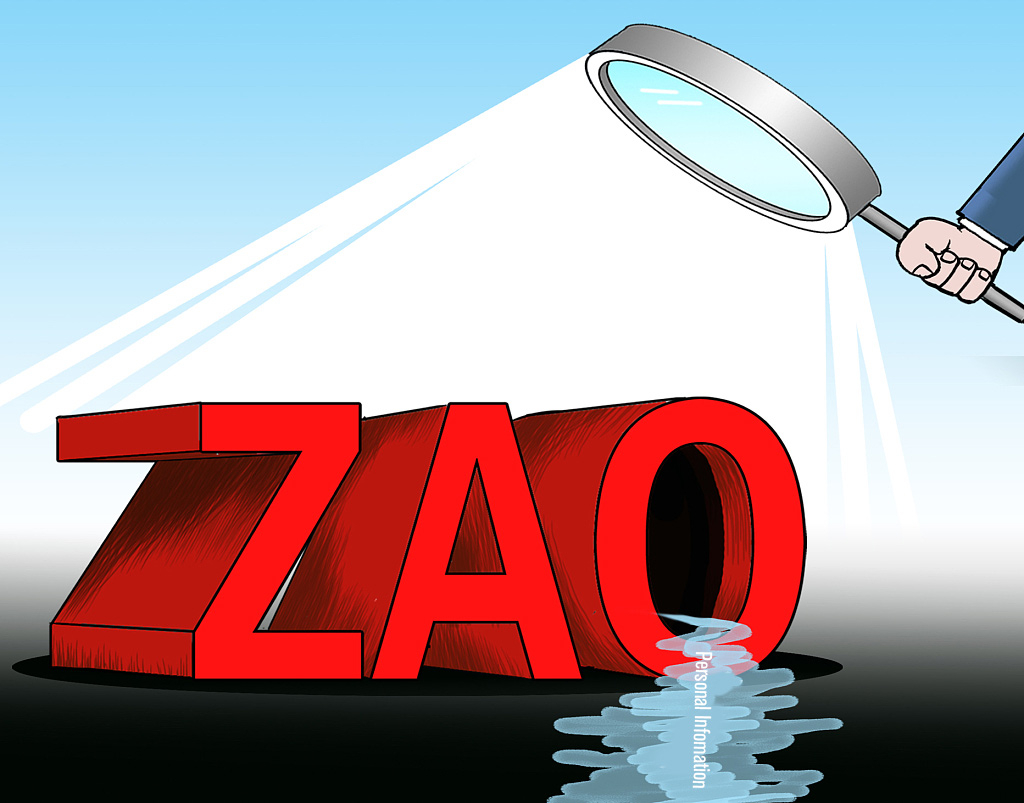
It reflects Chinese authorities' determination to protect digital privacy and address the challenges brought about by AI face-changing mobile apps, with the most hotly-debated one being ZAO, a Chinese app whose name means "to make."
After its launch on August 30, ZAO shot to the top of the list of the most-downloaded free apps in China. The fact that its servers have repeatedly been crashed shows its enormous popularity and Chinese users' tremendous enthusiasm about Deepfakes.
According to ZAO, it takes "just one photo for you to star in all the world's shows."
However, many netizens were alarmed that their biometric data might be stolen and misused when ZAO's expansive terms of service came to light: ZAO has "completely free, irrevocable, transferable and perpetual" rights to access all content uploaded for commercial use indefinitely and without users' consent.
What happened next is that the Chinese government took immediate action and initiated inquiries into ZAO's "non-standard user agreement, data leakage risks and other network data safety issues" as well as MOMO, a Chinese dating-app giant and ZAO's parent company.
Given the mounting public concerns over potential abuse of user privacy, ZAO issued a public apology in September and pledged to tweak its terms of services and attach more importance to the protection of personal information and data security.
Global concerns over Deepfakes
In recent years, Deepfakes have gone viral in the West; in particular, Deepfake pornography has even been a lucrative underground business.
As works produced by this technology become increasingly difficult to tell from the original, the threats posed by Deepfake have been noted by consumers, lawmakers and tech companies around the world.
US lawmakers and technology companies are currently grappling with how to detect and prevent Deepfakes from being used in next year's presidential election. A hearing was held by the US House Intelligence Committee aimed at countering the threat of Deepfakes this summer.
In July, the US Senate Minority Leader Chuck Schumer and Democratic National Committee urged the FBI and the Federal Trade Commission to conduct an investigation into the FaceApp for possible counter-intelligence and privacy violations due to its questionable terms of service, which grants the company the right to "use, reproduce, modify, adapt, publish, translate, create derivative works from, distribute, publicly perform and display User Content."
This has given rise to fears that users' privacy could potentially be at risk, although FaceApp insists it will stick to all data protection principles including not selling or sharing data with third parties and storing all user data in cloud servers outside Russia.
Common ground for international cyberspace cooperation
The threats posed by Deepfakes as well as other cyber crimes, involving Trojans, botnets and intellectual property theft, have highlighted the urgent need for international cyberspace cooperation between China, the US, the EU and the global community.
It is time for all parties to join hands to shape cyberspace, keep pace with the latest development of cyber technology and address relevant challenges in cyberspace.
The determination of Chinese authorities to protect digital privacy and clamp down on non-consensual harvesting of personal information has been consistent.
In addition to the legal actions taken against ZAO and MOMO, China's court ruled in the plaintiff's favor against Tencent in May, the internet giant behind WeChat, the widely used messaging app in China, for sharing personal data across its many services without users' approval.
The US has realized the national security threats involved, while European Commission President Ursula von der Leyen recently said that the protection of digital identity of European citizens was the overriding priority of her commission against the backdrop of increasing use of AI.
As facial recognition and verification become more and more ubiquitous on occasions such as registering for new mobile-phone services, making payments in supermarkets, gliding through various transportation gates and withdrawing cash, government actions are required to raise the awareness of netizens and firms about digital privacy and identity theft. This is especially important for people in the developing world as they tend to be more relaxed about digital privacy, in comparison to people in the West.





