China adjusts to the new world order







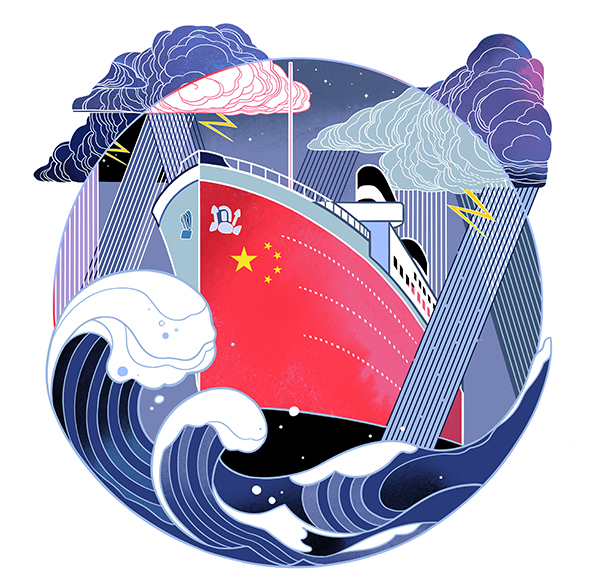
On Oct 1, the People's Republic of China celebrated the 70th anniversary of its founding with impressive military and civilian parades meant to showcase the extraordinary progress the country has made under the leadership of the Communist Party of China. Formidable challenges lie ahead. But China's record so far, and the resources it has at its disposal, indicate that it may well be up to the task.
China's achievements are undeniable. In the last 40 years, it has realized the fastest-ever sustained expansion by a major economy, enabling more than 800 million people to escape poverty. As investment in infrastructure, science and technology, education and healthcare has expanded, and living standards have improved drastically.
But in the third quarter of 2019, China recorded just 6 percent annual growth, the slowest since March 1992. And prospects for boosting that rate are limited, not least because the world is facing a synchronized slowdown. In its latest World Economic Outlook, the International Monetary Fund downgraded its 2019 global growth estimate to 3 percent, the lowest rate since the 2008 global financial crisis.
China has to deal with big geopolitical shifts
The outside world is also increasingly rejecting engagement, with the United States leading the way. That the US has launched a trade war against China has left no doubt that the US administration regards China as a strategic competitor, not a potential partner. Some in the US now advocate a complete decoupling of the world's two largest economies, unless China makes fundamental changes to its political system, economy, and foreign policy.
China has not been the only victim of US protectionism. The US administration has also targeted India, the European Union, and other economies. So, beyond direct animosity from the US, China must contend with profound and unpredictable geopolitical and economic shifts, driven partly by a backlash against globalization-the very process that enabled China's rise.
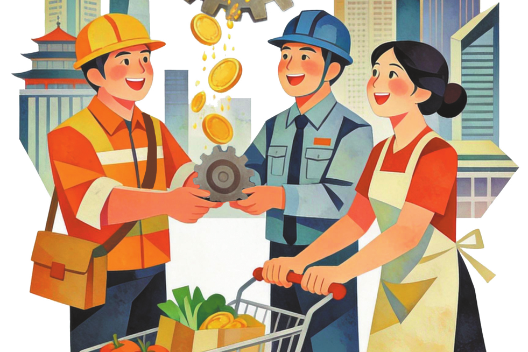
Chinese leaders have been working to counter that backlash by highlighting the benefits of international trade and cooperation. They have also reconfirmed their commitment to continued structural reform and opening-up.
Plenty of room for further progress
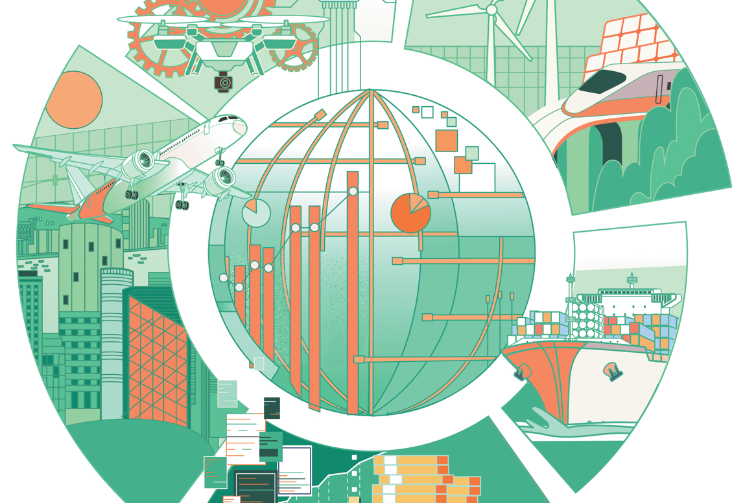
As a recent McKinsey Global Institute report showed, China has plenty of room for progress. The country accounts for 11 percent of global trade in goods, but only 6 percent in services, underscoring the growth opportunities that a more developed services sector would provide.
Moreover, foreign ownership in China's banking, securities, and bond markets remains below 6 percent. And while Chinese tourists made 150 million outbound trips in 2018, the country receives only 0.2 percent of global migrant inflows.
Increased Chinese engagement with the rest of the world could, McKinsey estimates, generate $22-$37 trillion of value for the global economy by 2040. In particular, China would benefit from import growth ($3-$6 trillion), liberalization of services ($3-$5 trillion), globalization of financial markets ($5-$8 trillion), collaboration on providing global public goods ($3-$6 trillion), and flows of technology and innovation ($8-$12 trillion).
Chinese economy's resilience highlighted
This is not to say, however, that China needs the world, at least not as desperately as the US administration seems to believe. While openness is in China's interest-and the interest of those with which it engages-recent trade hostilities have highlighted the Chinese economy's resilience.
In fact, given China's scale, there is enough domestic economic competition to continue driving progress, even without external engagement. Few economies are large enough to test different development models in parallel, without worrying about systemic shocks. But that is precisely what China is doing.
China has a long tradition of experimentation and adaptation, with competition among cities, in particular, bringing development breakthroughs. The central government is now cultivating much larger urban clusters-the Greater Bay Area (covering nine cities around the Pearl River Delta in Guangdong province and the Hong Kong and Macao special administrative regions); the Yangtze River Delta (centered on Shanghai); and the Beijing-Tianjin-Hebei cluster-to serve as platforms for further experimentation and competition.
Add to that significant scope for fiscal and monetary stimulus-thanks partly to a high domestic savings rate-and China's leaders are more confident than ever that they can resist outside pressure. The West should expect China to adhere to its policy of strategic patience, pursue further efficiency gains, and implement difficult but necessary reforms.
Emphasis on maintaining social, political stability
Throughout this process, China will continue placing the highest priority on maintaining social and political stability-a prerequisite for long-term economic development. For China, ensuring that greater openness does not bring problems like instability or corruption demands a strong state.
The US-led unipolar global order is disintegrating fast, not because the world wanted that outcome, but because the hegemonic US did. This is a tragedy. But all China-or any country-can do at this point is adapt to the new reality. For now, that means maintaining internal stability and advancing development, while resisting outside pressure to act against its own interests.
Andrew Sheng is a distinguished fellow at the Asia Global Institute at the University of Hong Kong and a member of the UNEP Advisory Council on Sustainable Finance. And Xiao Geng, president of the Hong Kong Institution for International Finance, is a professor at and director of the Research Institute of Maritime Silk-Road at Peking University HSBC Business School.
Project Syndicate
The views don't necessarily represent those of China Daily.