Belt and Road bolsters common development







Editor's Note: At the Third International Forum on Belt and Road Initiative and Global Governance co-hosted by Fudan University and the Silk Road Think Tank Association recently, scholars, entrepreneurs and officials shared their views on how to transform the Belt and Road from an initiative to a successful shared endeavor. Following are excerpts from the speeches delivered by three experts:
Belt and Road bolsters economic globalization
Economic globalization has mainly benefited coastal economies from the Atlantic to the Pacific. The Belt and Road Initiative, however, has prompted landlocked economies in Asia to further integrate into the world economy by connecting them to the coastal economies, and thus raised globalization to a new level.
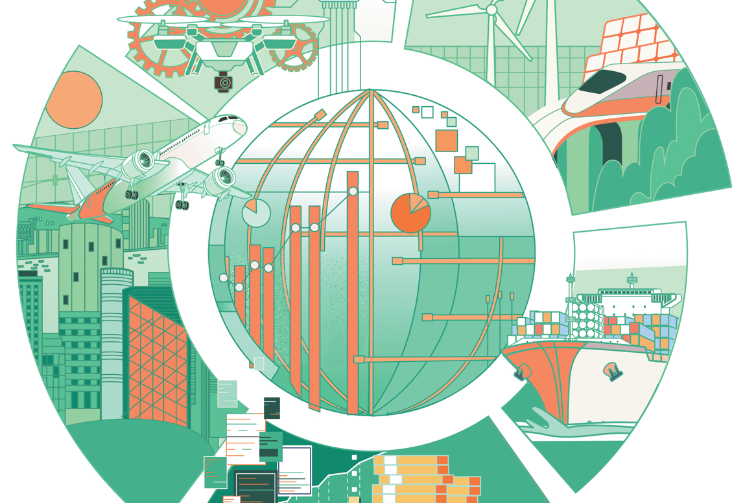
To be sure, the Belt and Road Initiative has helped boost landlocked economies' development and improved the welfare of the people there. For example, the development of container shipping, air transportation, highways, high-speed railways and online financial tools has connected the landlocked economies with the coastal economies.
Besides, the rapid progress of the digital economy, and the emergence of new forms of industries and business models have helped digitalize the Belt and Road Initiative, by integrating online and offline business activities.
The Belt and Road Initiative will further boost globalization, and inject new impetus into developing countries while helping them share the fruits of globalization with developed countries.
Li Junru, former vice-president of the Party School of the Central Committee of CPC
New Zealand the southern link in Belt and Road
The Belt and Road Initiative provides an opportunity for looking at the world differently. Or perhaps not so differently-after all it seeks to build on the Silk Road, the ancient trade route between China and Eurasia.
Another not-so-new idea which we believe the Belt and Road Initiative can help bring into reality is the "Southern Link". We have an opportunity before us to make New Zealand a major and natural connection or conduit for trade, travel and tourism between China and South America.
It's a simple fact: the quickest air route between Asia and South America is via New Zealand. This is a concept directly related to the Maritime Silk Road.
The Southern Link would involve routing passengers and multi-modal freight between China and South America via New Zealand, providing and facilitating a more seamless and convenient flow of goods and people compared with alternative hubs in the northern hemisphere.
The Belt and Road Initiative provides a new framework for future cooperation which will be enhanced through deeper understanding and improved governance. And the Southern Link is an idea whose time has come, but it is up to us to develop the partnership that can transform the route from vision to reality.
Visions are great, but turning them into reality requires hard work: we know that to build the Southern Link a number of changes will need to be made to both commercial strategy and public policy including transit visas, air service agreements and trade facilitation mechanisms.
But by being willing to work closely together, despite our differences and whether or not we might agree on all issues, China and New Zealand can demonstrate to the rest of the world that there is value to be created through openness and cooperation.
Don McKinnon, chairman of New Zealand China Council and former New Zealand foreign minister
A new style of global governance
Culture is destiny; this is the belief that led Asian countries to take the gradual community building process after World War II in their own way. They began by holding the first Asian-African Conference in Bandung, Indonesia, in 1955, two years after the Korean War (1950-53), followed by the establishment of the Association of South East Asian Nations in 1976, one year after the end of the Vietnam War, and the proposal of the Belt and Road Initiative in 2013, five years after the outbreak of the global financial crisis.
Like the Bandung Conference and ASEAN, the Belt and Road Initiative also is the result of the failure of the United States-style of global governance.
The Silk Road Economic Belt and the 21st Century Maritime Silk Road are rooted in the political experience of Asian countries being the victims of Western military expansionism and global governance.
The Belt and Road Initiative rejects Western-style global governance both in the political and economic spheres. In this sense, one could conclude that the Belt and Road Initiative signals the beginning of the end of modernity, as we know it. This process has four core components.
First, in its form, the Belt and Road Initiative aims to establish a partnership system based on socio-economic win-win relations rather than politico-military alliance, which is founded on politico-military win-lose relations.
Second, as part of its objective, the initiative covers multi-dimensional fields-from infrastructural investment and development, and trade and transportation to energy and ecology, and socio-cultural interactions.
Third, in its method, the initiative is aimed at creating and strengthening connectivity beyond the borders to maximize the "bonus" of a huge population, more than 4 billion in Eurasia, as well as the "bonus" of a huge expanse of space, more than half of the globe from the East coast of China through the Eurasian continent to West Africa and Latin America.
And fourth, as part of its goals, the Belt and Road Initiative intends to promote green and sustainable development to combat climate change, as well as to create inclusive growth in contrast to the neo-liberal "casino" financial capitalism, so as to alleviate poverty, fight terrorism and mitigate deprivation in developing countries.
Eiichi Shindo, professor emeritus of the University of Tsukuba and director general of Belt and Road Initiative Japan Research Center
The views don't necessarily represent those of China Daily.