



2020 marks end of support for fuel cell cars







Experts say it may take 10-20 years before their widespread use
Hydrogen fuel cell vehicles will no longer receive government subsidies when China withdraws its financial stimuli by the end of 2020, according to the country's Ministry of Finance.
The ministry made the statement in late September in response to SAIC Motor Chairman Chen Hong, a National People's Congress deputy, who proposed during this year's two sessions that the central government should continue its financial support.
It is the first time that the authorities have made it clear that fuel cell vehicles will not be an exception when China stops subsidies. They have been granted since 2009 to stimulate the development of new energy vehicles that include electric cars, plug-in hybrids and fuel cell vehicles.
Many had expected fuel cell vehicles to be exempt from the rule because the central government had not cut subsidies for them. Those for electric vehicles and plug-in hybrids have been slashed over the past few years.
"Some carmakers have become over-reliant on subsidies and thus find it difficult to compete in the global markets. And despite the financial support, China's fuel cell industry has not made breakthroughs and has not seen rapid development," said the ministry.
"So we think the subsidies should be withdrawn as planned while nonfinancial measures can be adopted to facilitate their purchase and use, and we think local authorities can promulgate measures to stimulate efforts to build and run hydrogen stations and other infrastructure," it said. Some companies including SAIC Motor, Great Wall Motors and BAIC Group have stepped up efforts to develop and produce fuel cell vehicles, which are believed to be the ultimate clean and emissions-free solution of the automotive industry.
South Korean and Japanese carmakers are taking the lead in developing and applying hydrogen technology.
Hyundai announced plans late last year to invest $6.75 billion in hydrogen fuel cell technology, allowing it to produce 500,000 fuel cell vehicles annually by 2030. It expects global fuel cell vehicles to grow to around two million vehicles a year within that timeframe.
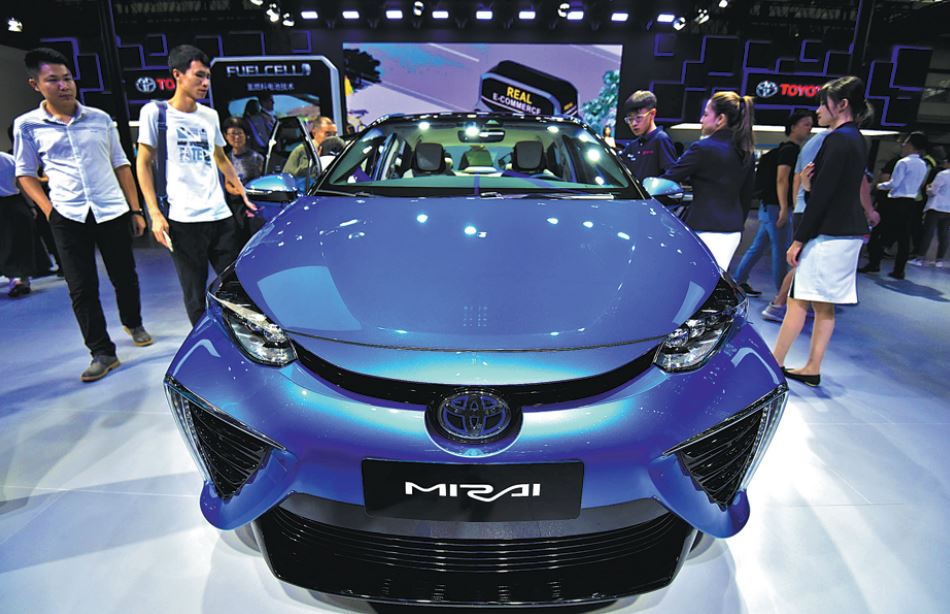
Toyota is a strong advocate of fuel cell vehicles as well and plans to follow up on its Mirai sedan with a range of SUVs, pickup trucks and commercial trucks beginning around 2025.
However, fuel cell vehicles are still at an early stage of development globally due to technical hurdles, high prices and a lack of infrastructure.
China had around 1,200 fuel cell vehicles on its roads and less than 20 hydrogen fuel stations at the end of 2017. It ranks behind the United States, Japan and South Korea, according to the International Hydrogen Fuel Cell Association.
The Chinese government has set a goal to have 5,000 fuel cell vehicles on its roads by 2020; 50,000 by 2025 and 1 million by 2030.
Yale Zhang, managing director of Shanghai-based consulting firm Automotive Foresight, said developing hydrogen fuel cell vehicles relies upon core technologies and supporting infrastructure. It will take China at least 10-20 years to realize the industrialization and commercialization of fuel cell vehicles.
Song Qiuling, a finance ministry official, said pure electric vehicles will remain the mainstay of China's new energy vehicle initiative as fuel cell vehicles still have a long way to go before widespread use.
"There is misunderstanding among the media and even carmakers that China will shift its focus from electric vehicles to fuel cell ones," said Song at the International Forum on Chinese Automotive Industry Development held last month in Tianjin.
"Fuel cell vehicles and electric cars have different technological features and they are to be used in different situations. They will complement each other instead of replacing one another," she said.




















