Amazon rainforest blazes raging out of control







Firefighters in Bolivia are losing their battle against fires that are burning huge tracts of the rainforest, as the international support they are receiving appears insufficient.
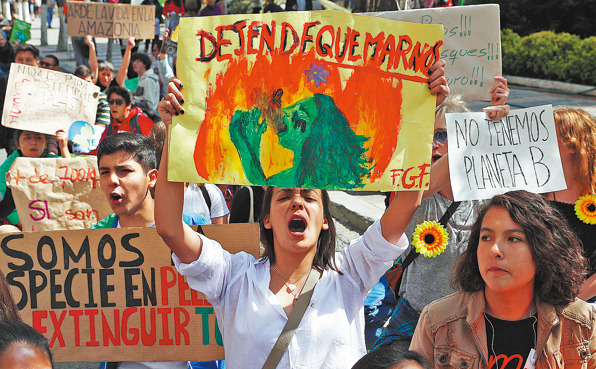
Volunteer firefighters from all over the country are trying to contain fires now raging out of control. China, France, Spain and Argentina have all deployed resources in Bolivia, whose army has also joined the effort.
The worst fires are in Chiquitania, a region of about 24 million hectares of savanna and transition forests connecting the Amazon basin with the rest of the country.
"This region is the largest dry rainforest in the world and is at risk of losing this title," said Ana Luiza Tunes, an environmental engineer and water management specialist at portal Tunes Ambiental.
"The impulse of the national government to (boost) livestock production in the lowlands of Bolivia has motivated the interest of local producers and agro-industrialists to invest in livestock production in Chiquitania," said Roberto Vides-Almonacid, executive director of the Foundation for the Conservation of the Chiquitano Forest in Santa Cruz de la Sierra, Bolivia's largest city.
"The country's institutions do not have sufficient personnel or financial resources to carry out the corresponding control of the burns," he said.
The government has hired a Boeing 747 equipped to fight fires and has welcomed international support in the form of personnel and resources. The government estimates there are between 5,500 and 6,000 people working to put out the blazes.
"Many outbreaks have been reduced, but there are still some in complex regions due to their geographical location," said Mirna Echave, president of the Bolivian chapter of United Firefighters Without Borders.
"The fires are quite strong. Despite the help and the work of many volunteers from the civil society, they have not been controlled, and every day that goes by takes a toll, not only on the wildlife and flora but also on human lives," she said.
Four firefighters have died trying to put out the fires.
"Many volunteer groups have decided to leave Chiquitania and return to their barracks," said Renan Paz, department coordinator of the Search and Rescue brigade at Oruro, a city west of Santa Cruz de la Sierra. They have supported operations on the ground in the Chiquitano Forest, which has been badly burned.
Paz said that the government response was slow, but there is now some movement.
"It was never thought that the fires were going to be out of control this way," he said. "But now the government has begun to act (and take control of the situation). It is currently doing a coordinated work with all the institutions in an effort to put out the fires."
Unfortunately, it may be too late. It may take some ecosystems decades or hundreds of years to recover, particularly those along the Amazon rainforest that were already damaged.
Rainer Antelo, an engineer and forest consultant based in Santa Cruz, said it may take 200 years "for the recovery of the ecosystem or for the landscape restoration".
"Fire not only impacts the ecosystem within the forest but also the entire productive system around," he said.
"To alleviate this disaster, both short-and long-term public policies are needed. Areas adjacent to the damaged areas that allow the restoration of the ecosystem, supported by sustainable management projects, must be immobilized."
According to the World Wide Fund for Nature in Bolivia, the total area burned along the Bolivian lowlands this year amounts to 26,354 square kilometers - significantly higher than in previous years.
The author is a freelance journalist based in Bogota, Colombia.