



Coding is new 'game' for Chinese kids







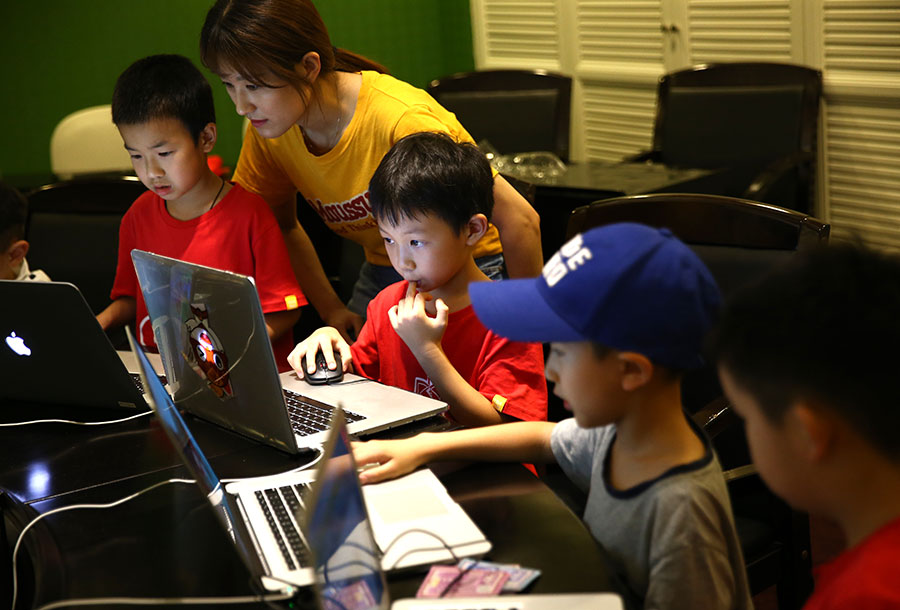
Chen Jiale's 10-year-old son, Zhixing, spends most of his free time on the weekends in front of his computer.
The fourth-grade pupil said he would rather stay indoors after a quick lunch, glued to the screen. But Zhixing is not just playing games or surfing the internet - the boy is immersed in a basic computer programming, or coding, lesson. It is an increasingly addictive hobby that his mother completely approves of.
"I signed him up for coding lessons at a private learning center about six months ago because I thought it might be an important skill that he would need. I'm glad he's enjoying it," said Chen, 36, who works in the catering industry like her husband in Beijing.
The mother is one of a growing number middle-class Chinese parents in major cities where the private education sector is racing to fill demand for coding lessons, which are seen as a crucial skill to adequately arm students for the digital age.
The coding industry for Chinese children is worth up to 4 billion yuan ($558 million) and that is forecast to increase about tenfold in the next five years, according to market research and consulting group iResearch.
Major coding training companies accounted for a large portion of Chinese education investment deals last year, raising more than 780 million yuan altogether, according to latest industry figures.
Makeblock, a global educational solutions provider for the Science, Technology, Engineering, Arts and Math fields and a major player in the intelligent hardware sector, is one of the Chinese companies looking to ride the coding wave. The company helps students build robots and carry out programming with self-developed software using tools and toys.
It boasts 8 million users at home and abroad, with more than 25,000 schools tapping its solutions, over 1,600 partners via its various channels and the overseas market forming a substantial part of its revenue.
The company, set up in 2013 and based in Shenzhen, Guangdong province, is focusing on schools, training institutions and families, continuing its involvement in STEAM education via schools through a comprehensive hardware and software combined learning ecosystem, according to its public relations manager Mason Zhong.
Makeblock has robotics products for the 4-to 8-year-old, and 8-to 16-year-old segments, geared toward maker communities and robotics competitions, and it has also rolled out kits targeting children's coding activities at home, Zhong said.
"The emergence of the Scratch graphical programming language has greatly reduced the coding threshold," Zhong said.
Scratch, developed by the Lifelong Kindergarten group at the Massachusetts Institute of Technology, helps children to drag and combine code blocks to make a range of programs, including animations, stories, musical instruments and games.
The international coding scene has expanded to cover the children and adolescent markets, Zhong said. Industry figures show that the current market penetration rate for those segments in China is 1 percent, compared with close to 45 percent in the United States and close to 10 percent in the United Kingdom, reflecting the great potential of the Chinese market, Zhong said.
The challenge now is to fully integrate coding into children's education and the latest policies pushing for that are positive signals, Zhong said. The breakthrough may come when STEAM and coding become part of college entrance examinations and related requirements, Zhong said.
More than half a million schools are now tapping advanced technology, including artificial intelligence and big data, to provide the latest teaching methods and curriculum for more than 270 million students across grades nationwide with practical lifelong skills for an increasingly digitized world, according to the Education Ministry.
Education guidelines for schools cover pilot programs to push ahead with classes focusing on major fields such as science, math, engineering and technology, including computer coding. A national plan to develop the AI sector also requires coding classes in elementary and secondary schools, with private sector involvement in designing games and the use of related software.
Education group Codemao, also based in technology hub Shenzhen, is another coding lessons provider for early learners, offering online platforms for children to design and program their work through animation and games. It boasts more than 10 million online users, including via mobile devices.
Tao Mingshun, whose 13-year-old son learns coding with the company on top of lessons in a private training center, said the boy and his peers find the games and other activities in the weekend classes "challenging but fun".
"The education sector is right to focus on these latest digital trends and the schools themselves need to speed up to meet these needs," said Tao, 45, who is also an educational consultant in a technology company.
"We're certainly glad and excited with the growing interest. But I guess parents must also not forget that learning also occurs outdoors, in the physical environment."






- China's Global Governance Initiative receives positive feedback at forum
- China's Xizang sees steady tourism growth in 2025
- First-of-its-kind pearl auction held utilizing Hainan FTP
- Agarwood exhibition steeps Shanghai museum in fragrance
- The Fujian Coast Guard conducts regular law enforcement patrol in the waters near Jinmen
- IP protection for new fields to improve














