Behind Hong Kong's chaos lie deep-seated social problems







CHANGING ECONOMIC STRUCTURE
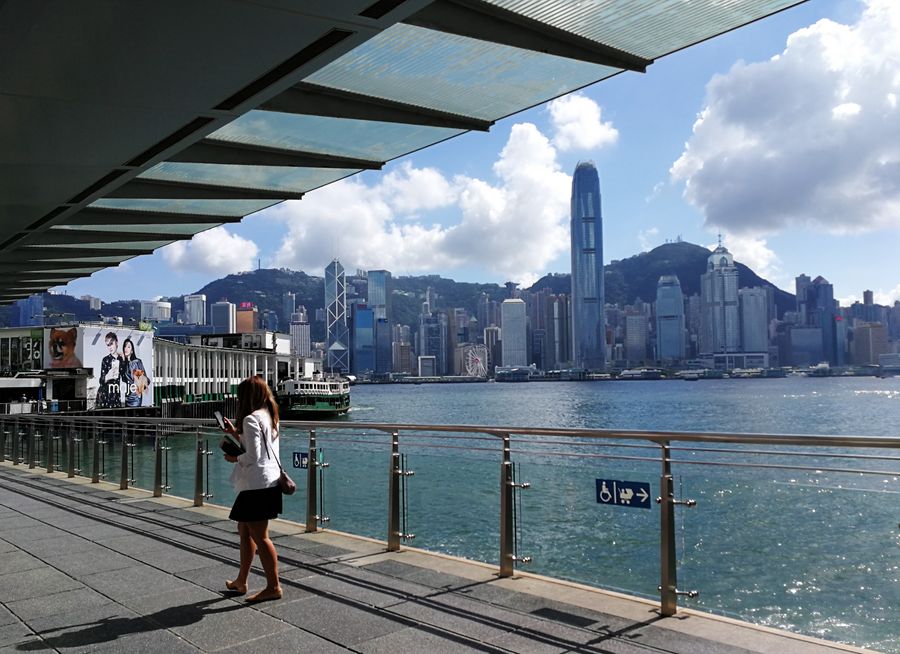
In the 1970s, nearly half of Hong Kong's labor force were industrial workers when manufacturing thrived in Hong Kong. During the 1980s, Hong Kong's finance, shipping, trade and logistics and service industries started to boom.
Since then, the economic landscape began to change amid subsequent industrial upgrading.
Due to the hollowing out of the manufacturing industry, the wealth gap in Hong Kong widened and the class division worsened. Despite the prosperity of finance, trade and tourism in recent years, more than 1.37 million people are living below the poverty line in Hong Kong, home to more than 7 million.
Working career options are now limited, leaving little hope for the youngsters to move up the social ranks.
As a result, Hong Kong's social class has largely been solidified in the 21st century, with the richest people dominated by property developers and their families.
The Gini coefficient, which measures the inequality of income distribution, reached a new high of 0.539 in 2016, far above the warning level of 0.4, according to data by the HKSAR government's Census and Statistics Department. The greater the number toward one, the more inequal in income distribution.
Though the HKSAR government tried to narrow the wealth gap, many people in Hong Kong said they are not sharing the fruits of economic prosperity, the young and those low-income groups in particular.
STAGNATING POLITICAL BARRIERS
What makes the deep-seated problems in Hong Kong such a hard nut to crack? The reason is complicated, according to observers, partly due to the containment in the current political structure that leads to governance difficulty, partly due to a doctrinaire implementation of the principle of "small government, big market," or laisser faire, and most importantly due to the opposition's "say no for none's sake" that stirs political confrontation and sends Hong Kong into a dilemma of discussions without decisions, or making decisions without execution.
Over the past 22 years, the successive HKSAR governments have tried many times to tackle these problems by rolling out affordable housing programs and narrowing the rich-poor gap.
For example, to make houses more affordable, Tung Chee-hwa, the first HKSAR chief executive, proposed in 1997 to build at least 85,000 flats every year in the public and private sectors, raise the homeownership rate to 70 percent in 10 years and reduce the average waiting time for public rental housing to three years.
Such plans, however, went aborted as home prices plunged in Hong Kong amid the Asian financial crisis in 1998.
"Since Hong Kong's return, many economic and livelihood issues would not be as politicized as they are now, should the HKSAR government have introduced more policies and better social security arrangements to address those problems," said Tian Feilong, a law expert of the "one country, two systems" center with the Beijing-based Beihang University.
To carry out major policies or push forward major bills, the HKSAR government needs to garner the support of two-thirds majority at the Legislative Council (LegCo).
The HKSAR government's previous motions, be it economic policies or fiscal appropriations, were impeded by the opposition time and again at the LegCo, regardless of the interests of the majority of Hong Kong residents and the long-term development of the society.
The HKSAR government sought in 2012 to establish the Innovation and Technology Bureau to ride the global wave of innovative startups, diversify its economic structure and bring more opportunities for young people. Such efforts, however, were obstructed by the opposition at the LegCo in defiance of repeated calls by the public. After three years, the proposal to create the bureau was finally passed by the LegCo.
In another case, a Hong Kong resident, incited by the opposition, appealed in 2010 for a judicial review of the construction plan of the Hong Kong-Zhuhai-Macao Bridge. Though the HKSAR government won the lawsuit after more than a year of court proceedings, 6.5 billion HK dollars of taxpayers' money had been wasted in the increased construction costs of the bridge's Hong Kong section due to the delay.
As time passed, problems remained unsolved, so did public discontent.
Repeated political bickering stalled Hong Kong's social progress amid the sparring, and the opposition created a false target and blamed the Chinese mainland for those deep-seated problems.
Lau Pui-King, an economist in Hong Kong, snubbed the opposition's resistance of or even antagonism to the Chinese mainland, saying such thinking of secluding Hong Kong from the entire country could end nowhere but push the city down an abyss.
"Seclusion brings no development opportunity for Hong Kong," Lau said. "Some youngsters don't understand that Hong Kong would be even worse if it is secluded from the Chinese mainland."
"To come out of the current economic difficulty, Hong Kong needs to be linked with the Chinese mainland much closer and more effectively," she said.




- Intl students showcasing global business acumen in Shanghai
- CPC expels former senior official of Guangxi
- Shanghai university unveils sustainable, efficient water treatment system
- Fire at auto business park in Jiangsu claims one life
- Magnitude 6.0 earthquake strikes Akqi county in Xinjiang
- Shenzhou XXI team to carry out first spacewalk