Minding brains







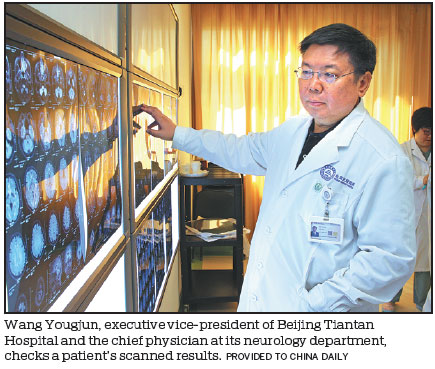
Leading neurologist Wang Yongjun has made it his life's work to tackle cerebrovascular disease - a common killer in China - head on.
Wang Yongjun knows a lot of trivia about the human brain. "An adult's brain weighs around 1,500 grams, and 78 percent of it is water. There are about 100 billion nerve cells in an adult brain, and if they became excited all at once, the power could light up a 25-watt bulb," Wang tells the audience during the filming of the TV show, Voice.
The 57-year-old executive vice-president of Beijing Tiantan Hospital and the chief physician at its neurology department is also a postgraduate supervisor of Capital Medical University. He is well experienced in the diagnosis and treatment of cerebrovascular disease, including stroke prevention, first aid and acute-stage treatment.
According to Wang, even though the brain accounts for just 2 percent of a person's weight, it consumes 20 percent of all the energy required by the entire body.
"To ensure the brain has enough energy to sustain it, it contains a total of 1.6 million kilometers of blood vessels," says Wang. "That's why strokes are so dangerous."
Wang concludes that strokes in China are distinct in several ways. The country has the highest global incidence rate, with around 2.5 million new cases every year. Patients in China also sustain a high disability rate, as two-thirds of the patients develop a sequela (a condition resulting from a previous disease), and the recurrence rate is also high.
"The last characteristic is that it has a high mortality rate - every 21 seconds, a Chinese person dies as the result of a stroke," says Wang. "It affects people of all ages, regardless of gender, ethnicity, skin color or social status.
"These days, we can ensure that most of our cerebrovascular-disease patients can return home and live normal lives."
After leaving medical school in 1982, Wang started to work at the neurology department of a hospital in Tangshan, Hebei province.
"Few wanted to study neurosurgery at that time because it's such a complex discipline. But once I started, I found it fascinating. I have been working in this field for the past 37 years," says Wang.
Wang recalls the first case report he wrote was thrown out of a window by his lecturer in front of a dozen other trainee doctors, because he said Wang did not know how to write a detailed clinical description.
"He told me that a single mistake in my case report could cost someone their life," Wang recalls, after he tearfully retrieved his report. But the teacher's words helped Wang forge his passion for neurosurgery as he soon realized its sole purpose was to save lives.
Wang published the first set of clinical guidelines for cerebrovascular disease in China in 1998 and went on to study vascular biology at the University of Arkansas in the United States from 1999 to 2000.
He returned to China to head up the neurology department of Beijing Tiantan Hospital in 2001. His team then only had one staff member holding a doctorate and one supervisor with a master's degree. He now has a dozen doctorate supervisors and 130 doctors in his department.
Leading stroke research
Wang spent Oct 29, 2006, waiting for a call from his colleagues in Cape Town to hear if Beijing had been selected as the host city for the 2012 World Stroke Congress. When the result finally came, Wang was disappointed to learn Beijing had not been chosen. He was aware how important it could have been for Chinese cerebrovascular patients.
He was later told by a German professor that even though Beijing had good facilities for hosting the congress, the world had not seen many breakthroughs in stroke research coming out of China.
Wang stayed up all night thinking about how the country could keep up with the rest of the world in terms of research.
Cerebrovascular disease is the most common cause of death and adult disability in China and a hot topic globally. Wang noticed that the recurrence rates in non-disabling strokes' patients was high - and relapses usually led to an increased risk of disability or death.
Wang and his team first began studying high-risk, non-disabling ischemic cerebrovascular events in 2008.
Five years later, his team published the Clopidogrel in High-risk Patients with Acute Non-disabling Cerebrovascular Events, or CHANCE, trial to the world. It proved that, for patients who can be treated within 24 hours after the onset of symptoms, the combination of clopidogrel and aspirin was superior to using aspirin alone in reducing the risk of a stroke in the first 90 days without increasing the risk of hemorrhaging.
The findings of CHANCE were included in the 2018 American Heart Association and American Stroke Association guidelines.
In February, during the 2019 International Stroke Conference held in Honolulu, Hawaii, Wang gave a 30-minute speech discussing the progress of CHANCE.
"When I announced the CHANCE trial six years ago, also in Hawaii, people thought it was just a research paper. But now it has become a treatment used all over the world," says Wang.
On June 30, at the Tiantan International Stroke Conference in Beijing, China's largest stroke summit, Wang gave a speech on the topic of anti-thrombotic therapy for acute strokes in the post-CHANCE era.
Solving the puzzle
Wang compares the process of a doctor giving a diagnosis to a writer who has to tell a story clearly with logic, or a director who rebuilds the scenes of how the patient developed the disease, or a detective who solves a mystery.
"It's like wearing virtual-reality glasses to watch a film. When we look at a CT scan, we need to turn the flat image into a three-dimensional image and try to work out what happened," says Wang.
Ten years ago, Wang met a young male patient who was suffering from a chronic headache. "He was diagnosed with an aneurysm at a local hospital, where he received surgery. But the headache returned a month later and five more aneurysms appeared," Wang recalls.
"That didn't make any sense to me, so I had to rewrite his story. I then found out that he had cut his arm two months previously, which changed the storyline of his disease. I realized he had picked up a bacterial infection that affected his heart and later moved to his brain, causing the aneurysm."
The patient was treated with anti-inflammatory drugs for three weeks and made a full recovery.
Li Zixiao, Wang's colleague and his former student, remembered how determined Wang was to solve the problem. "He kept researching documents and thinking it over until he finally figured out how the aneurysms developed," says Li.
"He is always expanding his knowledge of clinical diagnosis, treatment and research."
Li worked with Wang since 2006 and became Wang's doctoral student in 2010. "He shows me that he is not just thinking like a specialist when he treats patients, but he's always looking for new ways or solutions to help patients in China and around the world in every case," says Li.
Wang classifies doctors into four categories - unqualified, qualified, good and excellent.
"A good doctor can solve a patient's problem efficiently, but an excellent doctor can cure their patients and develop new theories and treatment methods to benefit more people," says Wang.
Wang believes China has many good doctors but needs more excellent ones.
"As science continues to develop, we doctors must use our knowledge to help people," says Wang.
"But if there are no new science or research breakthroughs, the prevention and control of cerebrovascular diseases will not progress."