Trade dispute could lead to global recession








Trade tensions are the single biggest factor weighing on global corporate confidence today. They also pose a significant and credible threat to the global business cycle, as policy-easing measures can only offset the negative impacts up to a point. Truth be told, the window for addressing trade tensions in a way that avoids significant additional damage to the global cycle is relatively short. Indeed, developments in recent weeks have increased the risk of an extended period of escalation, with attendant downside risks to global growth.
It seems investors are underestimating the impact of trade tensions. Our (Morgan Stanley's) concerns stem from the fact that we see the transmission channels as pervasive, the impact as non-linear and any policy easing as reactive, with lagged effects. If trade tensions escalate, with the US imposing 25 percent tariffs on the remaining $300 billion of products imported from China and China responds with countermeasures, we believe the global economy will end up in recession within two to three quarters.
Trade disputes will affect global growth
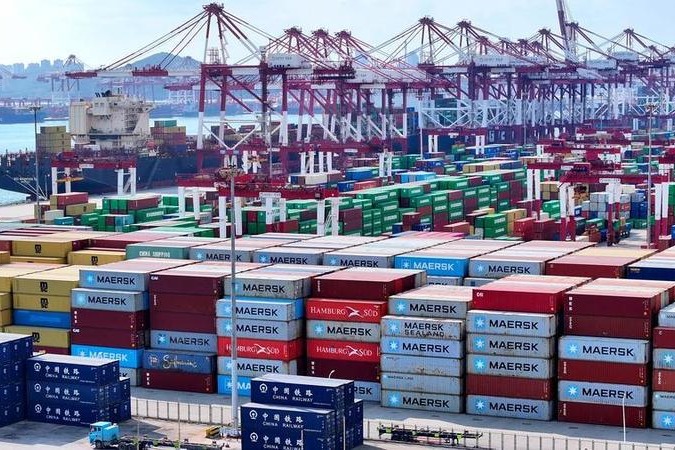
Five channels will transmit trade tensions to global growth. First, implementing the tariffs will increase costs-companies may not be able to fully pass along higher tariffs, which will erode profitability, and consumers, facing higher prices, may pull back on demand.
Second, the impact of the tariffs will spill over into the domestic and global supply chains and consequently global trade flows.
Third, over the medium term, multinational companies will incur additional costs as they develop alternative supply sources.
Fourth, global corporate confidence will take a hit, and companies will pull back on capital expenditure, which will weigh on aggregate global demand.
And fifth, corporations with global footprints will face additional downward pressure on growth and profitability from their international operations.
While the first three channels are probably well understood, the latter two seem under-appreciated. We think they will have a greater impact and that it will be non-linear in nature.
Policy easing can only have reactive effects
Can policy easing offset the harms caused by trade tensions? Investors are right to expect a stronger policy response in the event of continuing escalation. But the reality is that such policy easing will only be reactive, triggered by escalation and its effects on financial conditions and the growth outlook. What's more, given the customary lag before policy measures have an impact on real economic activity, a downdraft to global growth appears inevitable.
So how will the trade dispute evolve, and what are its implications for the global macro outlook? We offer three possible scenarios.
First, in a "temporary escalation" scenario, trade tensions continue to escalate for about four more weeks. We think the easing measures already under way-China's $250 billion in fiscal easing (1.75 percent of GDP) with the requisite monetary accommodation, and the US Federal Reserve's pivot, which has eased US financial conditions by an equivalent of 90 basis points in Fed funds rate terms relative to December 2018-should provide just enough support to lift global growth modestly, to 3.5 percent year-on-year by the end of 2019 from a weak starting point of 3.2 percent year-on-year in the first quarter of this year.
Global economy to suffer if dispute continues
Second, in an "extended escalation" scenario, the 25 percent tariffs on $200 billion of imports from China stay in place longer (three to four months). Even though talks may continue, global corporate confidence and consequently the global economy would take a hit.
As we learnt (rather painfully) in the second half of 2018, the indirect impact on financial conditions, corporate confidence and capital expenditure would flow through to global growth far more severely than the direct tariff impact and its spillover effects on the supply chain. The damage to private sector confidence would also dampen the effectiveness of China's stimulus. Tax cuts would not filter through to actual spending, as enterprises and households would be more likely to save than spend them.
Policymakers would activate tools to provide further support as the growth outlook deteriorates. For instance, the Fed will likely look through any rise in core personal consumption expenditure inflation from the tariffs, instead of focusing on tighter financial conditions and their impact on the growth outlook. Its response? A 50-basis-point initial rate cut around the third quarter of this year.
As for China, its policymakers would push for a larger stimulus package to mitigate the impact on the labor market-upping its total fiscal expansion to 2.25 percent of GDP($320 billion). We also think that such additional stimulus would focus more on direct public spending than on tax cuts. Net-net, however, these measures would not suffice to prevent a slowdown. We would expect global growth to decelerate by 50 basis points to 2.7 percent year-on-year over the next two quarters.
Global recession will follow in a 'no deal' scenario
Third, in a "no deal" scenario, talks stall, no agreement is reached and the US imposes 25 percent tariffs on the remaining $300 billion of imports from China. We then see the global economy heading toward recession. Under these circumstances, the Fed would cut rates all the way back to zero by spring 2020. China would again upsize its fiscal stimulus to 3.5 percent of GDP($500 billion) and raise its broad credit growth target to 14-15 percent a year. But with a sharp tightening in financial conditions and uncertainty damaging confidence so much that the corporate sector freezes or even cuts back on capital expenditure, growth could dip below the 2.5 percent year-on-year global recession threshold, notwithstanding the policy response.
To assess where things are headed, we are watching a number of key signposts and dates: Whether and when trade negotiations resume; the G20 Summit on June 28-29; and comments from the US administration confirming the imposition of a 25 percent tariff on the remaining $300 billion of imports from China (which could take effect on July 1 at the earliest).
Given the many twists and turns in the trade talks thus far, we admit that the outcome is highly uncertain. One thing is for sure, though, the window for resolving trade tensions and avoiding damage to the global cycle is narrowing.
The author is Morgan Stanley's chief economist and global head of Economics. The views don't necessarily represent those of China Daily.