US tariffs won't cause the sky to fall







While the impact of the Sino-US trade dispute on the Chinese economy will be negative, causing more damage to the Chinese economy than to the US economy, they will be manageable for China. I estimate the maximum possible damage, assuming that all Chinese exports of goods to the US are halted, at 2.4 percent of GDP. But the negative impact on China's real GDP and employment can be mitigated through an appropriate increase in domestic aggregate demand.
So there is no need to panic.
The Chinese stock markets have already taken a hit. As of the end of 2018, the shares on Shenzhen Stock Exchange had on average lost 30 percent, Shanghai 20 percent, and Hong Kong 10 percent. In contrast, the S&P 500 Index of US stocks did not suffer any loss on a whole-year (2018) basis.
Stock markets not good barometers of economy
Of course, the increase in the rates of interest in the US and elsewhere in 2018 also affected stock prices negatively. This year, the Chinese stock markets first fell and then began to rise, buoyed by hopes that the China-US trade talks would lead to an agreement. More recently, they have fallen again, reflecting the progress or lack thereof of the trade negotiations. The S&P 500 Index also experienced similar volatility.
But the Chinese stock market indexes are not good barometers of the state of China's real economy. There is essentially no correlation between the rate of growth of China's real GDP and the rate of growth of the Chinese stock market price indexes, because more than 80 percent of Chinese mainland investors are individual retail investors with an average holding period of less than 20 trading days.
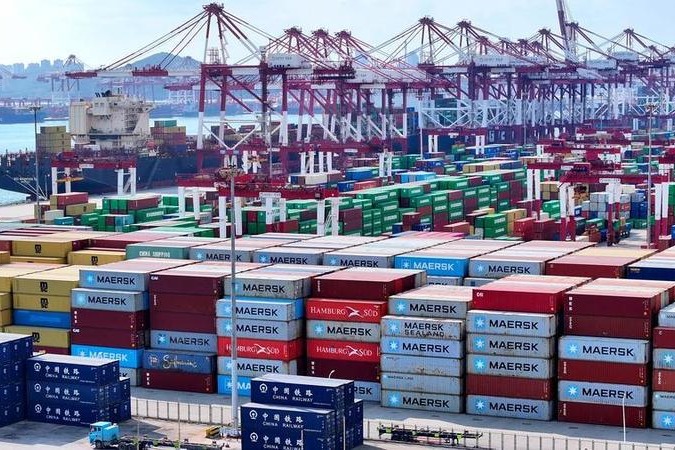
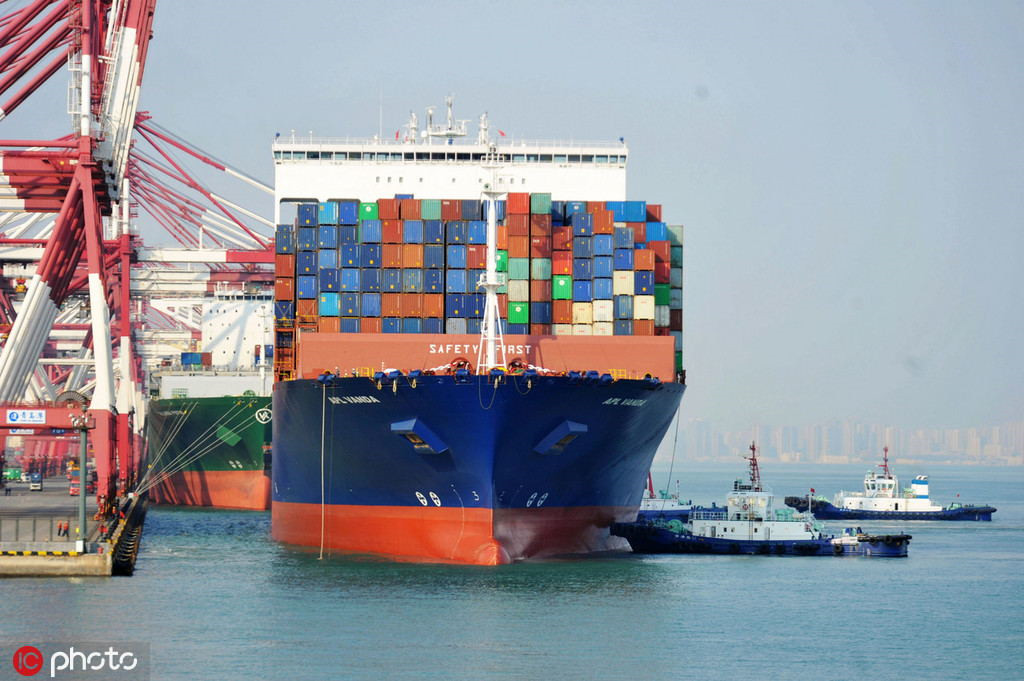
What is the damage to China's real economy? The exports of goods to the US in 2018 constituted 3.6 percent of China's GDP. The total value-added attributable to these exports would be about 66 percent, resulting in an estimated maximum loss of 2.4 percent (3.6 percent multiplied by 0.66) of GDP, assuming that all exports to the US are halted. If, as is more likely, half of Chinese exports of goods to the US is halted, the maximum loss would be 1.2 percent, which is quite manageable for China.
My calculation does not take into account the mitigating effects of any possible economic stimulus measures the Chinese government may take. Nor does it take into account the possibility of substitution of destinations for Chinese exports. For example, instead of shipping from a factory in China, a factory owner can ship goods to the US from another factory he or she owns, say, in Vietnam, and ship goods to Japan from his/her factory in China. Which means the factory owner's total exports from China will not decrease despite the US' higher tariffs.
China can manage decline in exports
It is instructive to recall what happened during the 2008-09 global financial crisis. Chinese exports of goods to the world and to the US declined by 16.0 percent and 12.5 percent in 2009, with a total reduction of Chinese exports of $230 billion (in 2009 prices), about the same real magnitude as half of China's total exports of goods to the US in 2018. Yet China's real GDP still managed to grow 9.4 percent in 2009. This shows that a decline in Chinese exports of this magnitude is quite manageable.
Hence, the trade dispute is unlikely to derail China's economic growth.
Over the past decade, China has become increasingly less dependent on exports as a driver of growth. But a reduction in net exports caused by the trade dispute implies a reduction in aggregate demand and employment, which have to be made up.
Still, the uncertainty caused by the lack of an agreement weighs heavily on the investment and consumption decisions of Chinese enterprises and households. China cannot and should not sit and wait for a trade agreement. The time for the launch of economic stimulus measures is now, even if the trade talks continue. A timely announcement of an increase in domestic demand will reduce uncertainty, revive public confidence and turn the expectations about the future from negative to positive.
To raise demand, enhance provision of public goods
Where can the additional aggregate demand come from? Not from fixed investment in traditional manufacturing industries or residential housing. Instead, China can increase domestic aggregate demand by mandating the enhanced provision of public goods such as environmental preservation, protection and restoration; education; healthcare and eldercare. However, the central and local governments must take the lead in increasing the demand for public goods. The Chinese economy still has significant excess production capacity so that as long as there is demand, there will be supply, without kindling inflation.
I am therefore quite confident that China's real GDP will grow at a minimum of 6 percent in 2019. There are no winners in a trade war. But to the extent that the Chinese economy can maintain its rate of growth at around 6 percent and its employment close to its existing level, China will not lose.
The latest failure in the trade negotiations is probably due to the White House's updated evaluation of the presidential campaign in view of the US president seeking re-election. With the US economy in good shape-for which the US president can and will take credit-he does not need an agreement with China, because it could provide an opening for his opponents to attack him. He can campaign much better by blaming China and claiming that he would always walk away from a bad deal.
Had the US been serious about seeking an agreement this time, it would not have openly warned China not to retaliate, which was in fact an invitation for retaliation, providing in turn a convenient excuse for imposing further tariffs and sanctions.
China is not unwilling to make concessions but is unwilling and unable to make concessions under duress, which would be not only humiliating but also prove threats work, and thereby encourage moral hazard and lead to the use of more threats and demands. It will not settle the trade dispute.
But a complete rupture of relations and a new Cold War between China and the US are not in the best interests of either country. China has no desire whatsoever of forcing or even proselytizing its political and socioeconomic system on the rest of the world.
Interim deal before US polls cannot be ruled
Perhaps even the US does not see advantage in a total breakdown in bilateral relations. So the trade negotiations are likely to drag on until after the US presidential election, although an interim agreement for both sides to rescind some of the tariffs and to defer additional tariffs cannot be ruled out.
Competition between China and the US for economic and technological dominance is likely to be the "new normal" in the coming decade. A real risk for China's economy is in being isolated from the rest of the world. China should continue opening up its economy to global trade and cross-border inbound and outbound direct investment, by reducing tariffs and non-tariff barriers and extending national treatment to foreign companies, on a reciprocal basis.
This should make the Chinese economy and its enterprises more efficient, and therefore stronger, and further improve the living standard of the Chinese people.
The author is Ralph and Claire Landau professor of Economics, Lau Chor Tak Institute of Global Economics and Finance, The Chinese University of Hong Kong, and the author of The China-U.S. Trade War and Future Economic Relations. The views don't necessarily represent those of China Daily.