New Indian govt needs inclusive policies to boost economy







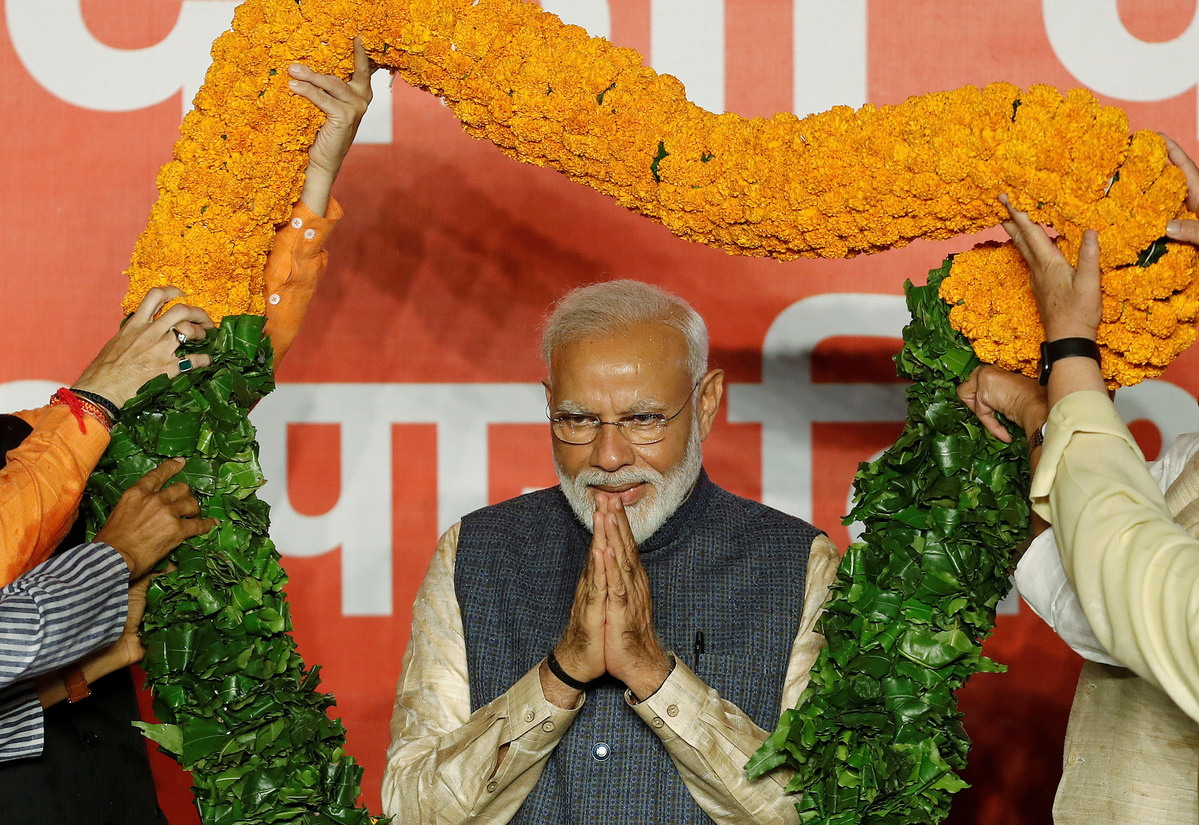
The campaign for the Indian national elections, whose results were declared on Thursday, took voters through bitter, unwanted political and sometimes dirty apolitical debates. The right-wing Bharatiya Janata Party-led National Democratic Alliance was re-elected to power, yet the BJP won just one of the four provincial elections which were held simultaneously. The fact that regional political parties held sway in three of the provinces is something unique about Indian elections, especially because their victories were against the national mandate.
If the BJP's victory in the 2014 national elections was a mandate for change, its second victory places much bigger responsibilities on the new government: to continue reforms, which the earlier government introduced, and develop non-partisan and inclusive political culture in the country.
Since national and local aspirations vary a lot, the new government needs to address all questions and doubts which were raised during the election campaign. If the NDA stands for inclusive growth for all sections and classes, as it claims, it has to prove that with its policies and performance.
The BJP succeeded in convincing the voters that it was the ideal party to lead the government for another five years, and the election results attest to that.
According to official statistics, the BJP secured about 39 percent of the votes and the NDA as a whole won more than 45 percent, which is about 7 percent more compared with 2014. This is the highest vote share the BJP has received in any general elections since its formation in 1980. The main opponent party, the Indian National Congress, too, raised its vote share by about 1 percent to secure a total of more than 27 percent of the votes. Which means the government led by Prime Minister Narendra Modi has more stringent tasks ahead.
The share markets, which are indicators of Indian elections, did outpour their emotions. Welcoming the prospects of a stable government for the next five years, the Bombay Stock Market sensitive index (known as Sensex) hit the 40,000 mark while the National Stock Exchange of India's benchmark broad-based stock market index for the equity market (better known as Nifty) crossed the 12,000 mark for the first time.
The Indian elections' results therefore can be seen as a vote for stability, which is precisely what the stock markets want.
The BJP leaders have already presented formative reform measures for India Inc. The BJP-led government in the past five years saw some shaky reforms-conceptualized in haste and not backed up properly. India needs to make further bold efforts if it wants to boost the economy. And this is also what those businesses "waiting in the queue to enter the Indian market" want.
Some of the top worries for the market leaders include creating more jobs, enacting more tax-friendly laws, helping local industries withstand the pressure of international trade and at the same time balancing it out by attracting more foreign direct investment in critical segments. More than being bold in nature, the reforms need to strike the right balance between innovation and transformational policies.
The new Indian government should therefore be more prudent in its policies than what it was during the past five years. Winning a higher percentage of votes this time means the new government will have to perform better.
The author is a senior research fellow at HSBC Business School, Peking University.
The views don't necessarily represent those of China Daily.