


New York exhibition highlights Jewish refugees' stories in China







NEW YORK - Eighty-nine-year-old Betty Grebenschikoff was born in Germany and spent most of her life in the United States, but she always tells people: "I grew up in Shanghai."
Two days before the Gestapo of Nazi Germany would approach her father, Grebenschikoff and her family boarded a ship in May 1939 heading to Shanghai, China, the only place in the world taking in Jewish refugees at that time. In the following 11 years, she lived in the Hongkou district, where a majority of over 18,000 European Jews settled through the 1930s-40s.
Despite hardships inflicted by World War II, local people still opened their arms to their new neighbors, helping them maintain the Jewish lifestyle and feel at home. Grebenschikoff attended Jewish schools, went to the synagogue, and even met the love of her life - a Russian who taught sports at her school, and married him in the late 1940s.
Earlier this month, Grebenschikoff shared her story at the Central Library of Brooklyn in New York as part of "Jewish Refugees in Shanghai", a project that tours the borough's public libraries from March through May, featuring old pictures, documentary-screenings and discussions to tell the little-known history.
"The Chinese people were always kind to us, accepted us without question," Grebenschikoff recalled of her years in Shanghai. She still remembers playing with local kids, though they didn't understand each other, and learning some Shanghai dialect for daily communications such as saying "Hello" or asking "How much is it?"
After the Pacific War broke out in 1941, the Japanese invaders took control of Shanghai and gradually segregated all Jews in the "Ghetto" of Hongkou, forcing them into a much harsher environment with limited living space, rationed food and medical supplies.
According to Grebenschikoff, life was also not easy for the Chinese, who suffered a lot from the Japanese brutality and oppression. "But I never heard of a word of anti-Semitism (from the Chinese). Never ever was I called the 'Dirty Jew' like I was in Germany," she said. "And I appreciate that a lot apart from the fact that we managed to find refuge there."
Jocelyn Wood, an early childhood educator in New York, was amazed to find her grandmother - then a teenage girl - in some old photos displayed at the library in Brooklyn.
"I'm so thankful to the people of Shanghai for taking my family in," said the 34-year-old Wood who celebrated Lunar New Year in Shanghai in February. "My grandmother always says Chinese people were very friendly to her."
Having heard all kinds of old-time stories from her grandmother, Wood is now considering compiling them into a book for today's children to make history better known and long remembered.
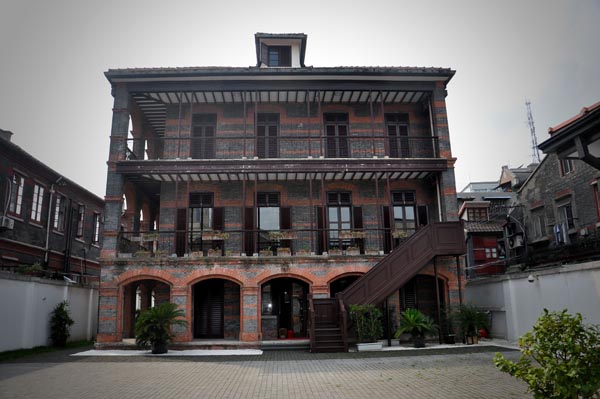
Chen Jian, curator of the Shanghai Jewish Refugees Museum, also wanted to spread these stories widely. Chen's museum, set up in 2007 in Hongkou's "Ghetto" area during World War II, co-organized the Brooklyn touring exhibition.
"We hope that Chinese people's generosity and kindness could be known by more people through the project," said Chen.
It is also of special significance to be able to bring these stories to New York, a major US city with a large Jewish community that consists of many former refugees or their descendants, he added.
After World War II ended, Jewish refugees gradually left China for Israel, the United States and other destinations, but many of them still visit Shanghai from time to time to relive their childhood memories. Grebenschikoff, who left China in 1950, has visited the Shanghai Jewish Refugees Museum quite a few times and even donated her wedding gown - a white, full-length satin dress - to the museum.
Having witnessed many vicissitudes of life, Grebenschikoff said she believes that people-to-people exchange is actually the most important thing for maintaining a peaceful world, as proved by her personal experience in Shanghai.
"We have to keep up the stories and tell the stories," she stressed. "If we can get along with one another, then nobody can hurt us."