Lofty goal draws elite satellite students to China







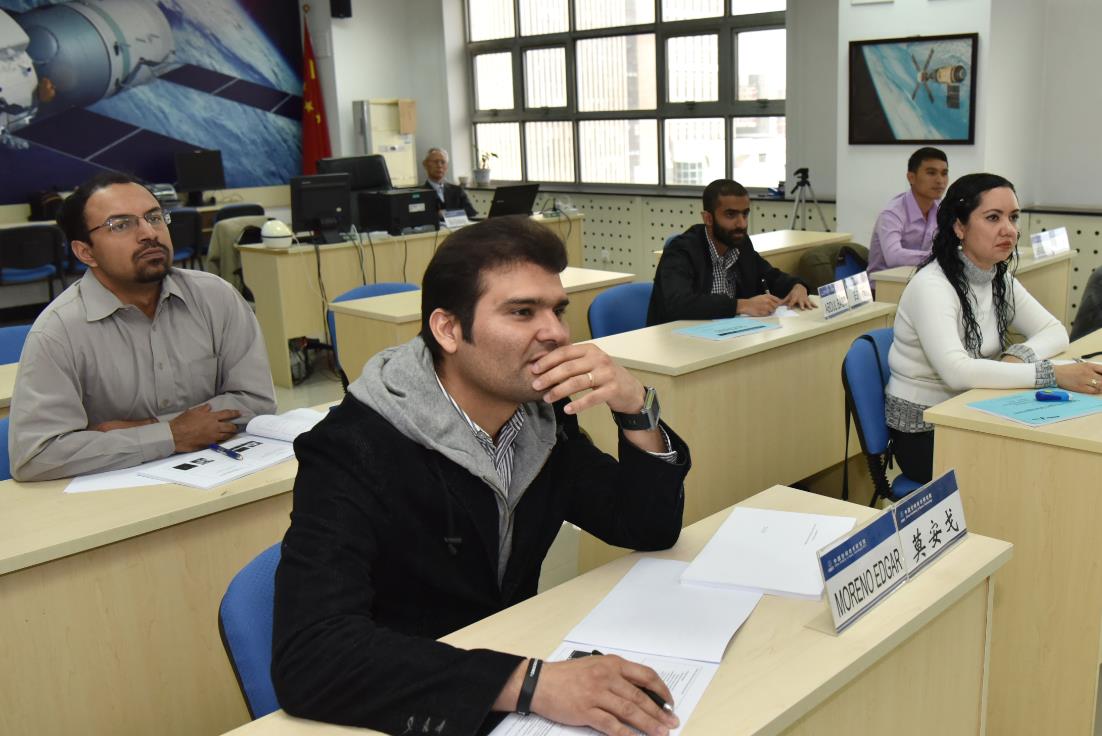
Socheat Chea, a Cambodian student with big dreams, wouldn't attract much attention if he walked down a street in his country since he doesn't talk a lot and is a bit shy around strangers.
His classmate, Edgar Moreno Pena, who is from Venezuela, is more adept at socializing. He has a vocabulary of more than 200 Chinese words, tells shopkeepers on Beijing streets pianyidian (give me a bigger discount) and uses Chinese-language food-delivery apps on his mobile phone.
"I often do shopping at Taobao and JD," he said, referring to China's two most popular online shopping websites.
Although the two foreign students have few similarities in their personal backgrounds, they share a common goal at the Shenzhou Institute in northern Beijing: They are trying to learn from Chinese teachers how to design, build, operate and maintain satellites.
Such a personal goal can be seen, to a certain extent, as a microcosm of the national aspirations of both of their countries to gain a place in the global space arena via the cooperation and assistance of China.
Chea and Moreno Pena are part of a training program hosted by the China Academy of Space Technology.
The idea is to train a small group of elite foreign students to become space industry engineers capable of developing and manufacturing satellites on their own, thus enabling their countries to build their respective space industries and explore space.
Eight people are taking part in the program, which began in March 2018-two Venezuelans, two Pakistanis, one Cambodian, one Russian, one Belarusian and one Kazakh.
"I am the first-ever Cambodian studying spacecraft knowledge," Chea told China Daily recently at the Shenzhou Institute, which is run by the academy.
"Cambodia is working with China to launch our first satellite in 2021, so the (Cambodian) government hoped that someone could learn something about spacecraft. But there is no school in Cambodia that teaches such a thing. So here I am," Chea said.
China has signed an agreement with Cambodia to develop, make and launch the Southeastern Asian nation's first satellite in the next few years. The satellite, Techo 1, will be used for communications.
Moreno Pena, on the other hand, has 11 years' experience at the Bolivarian Agency for Space Activities, Venezuela's space organization, as an electrical engineer and chief of the spacecraft operation unit.
This is the second time he has come to China as a student. The first time was in 2007, when he was selected to take part in satellite application training in Beijing.
He said he came to China this time hoping to expand his knowhow on spacecraft and learn how to design and build satellites.
"All of my knowledge and expertise in the space field was about ground operations, such as telemetry, tracking and command of spacecraft.
"I want to study satellites. I want to learn and work on communications satellites operating in low Earth orbit, because now we have a communications satellite in geosynchronous orbit, and remote-sensing satellites in low Earth orbit," he said.
"I want to learn how to combine these technologies and do some research here in Beijing, so when I come back to my country I can help to develop our own satellite technology," he added.
Each of Venezuela's three satellites-one communication and two remote-sensing satellites-was designed, built and launched by China.
The Beijing-based China Academy of Space Technology, a subsidiary of State-owned space giant China Aerospace Science and Technology Corp, is a major developer of satellites and spaceships in China.
Li Qiang, director of the Shenzhou Institute's postgraduate department, said China has trained hundreds of foreign space engineers since the mid-1990s.
However, those training sessions were mostly occasional, often accompanied a satellite export deal, and were mainly focused on ground-based control and applications of satellites rather than their design and production, the director said.
"However, in recent years, along with the expansion in our cooperation in the space industry with other countries, many of our foreign partners voiced their hopes that we could hold some sort of systematic training programs to help them create their own spacecraft designers and technicians," he said.
Therefore, he said, "We decided to open a two-year postgraduate program and then sent the message to countries having space cooperation with China."
Some of those countries selected and submitted their candidates to the space technology academy, which then reviewed their qualifications and selected who would be admitted.
"Whether the candidates can get this opportunity depends on two factors. First, their English proficiency is supposed to be good enough to handle our courses-all of them are taught in English," Li said. "And second, an ideal candidate should have at least a bachelor's degree as well as background in or some knowledge of the space industry."
Candidates who pass the qualification screening are also required to write a research proposal and provide an endorsement document signed by the space authority of their nation, he said.
Li said the program does not charge the students or their countries any fees. Instead, the Shenzhou Institute gives each student 3,000 yuan ($445) per month as a stipend.
Cui Yufu, a senior designer of small satellites at the academy and a professor at the institute, said the program has some advantages that other domestic and foreign space organizations don't offer.
"Our program features opportunities for students to experience what is it like in real satellite development projects," Cui said.
"We will ask the students to set up a project team to simulate research and development of an imaginary satellite, and each of them will be designated a role ranging from chief designer to subsystem manager," Cui added.
"We also offer opportunities to the students to visit satellite research-related institutes and satellite users to see satellites' assembly, testing and experiments," Cui said.
"They will be able to get personal understanding of spacecraft research and development and obtain some know-how."
He said space training providers in other countries will not take foreign students to design or production sites.
Cui said most of the lecturers in the program are senior researchers and chief designers at Chinese space institutes and provide the foreign students with the latest expertise.
In addition, the institute will invite foreign experts to give lectures to the students to provide access to new developments in the international space sector.
"We want to make sure that they will be able to design satellites when they complete their study here and go back to their countries," Cui said.
He added that compared with their Chinese peers, the foreign students are more active in class and are better at asking questions and sharing their thoughts.
The foreign students will choose either remote sensing or communications satellites as the topic for individual research at the Shenzhou Institute, Cui said, adding that their choice will depend on what they will do in their homeland after the program.
Wang Jie, the mentor of the eight-student class, said that in addition to professional knowledge and on-site tours, the institute also arranges lectures on Chinese language and culture for the foreign students and takes them to such historical sites as the Forbidden City and Summer Palace.
It also arranges for Chinese students at the institute to communicate with the foreigners to help them improve their ability to speak Chinese, he said.
For Chea, the student from Cambodia, studying at the institute has been difficult since the beginning.
"I majored in telecommunications in my university, so I knew nothing about spacecraft. For me, all the courses here are very difficult. At first I didn't understand anything of what our teachers were talking about in class," he said.
He said he feels lucky because the Chinese teachers are nice and considerate. They have been trying their best to make the lectures easier for him to comprehend, he said.
"Now I can understand much of the content in our courses," Chea said.
Moreno Pena, the Venezuela student, said he truly treasures the opportunity to learn from his Chinese teachers.
"All the professors here at the institute have not only theoretical knowledge, but also very good and deep experience in different types of satellites. For example, Professor Hu was part of China's own satellite program from the very beginning, and Professor Cui has taken part in both of my nation's remote-sensing satellite projects.
"All of them have at least 10 years of experience in satellite research and development. This is very important and very unique," he added.
Moreno Pena said China is special to him, professionally as well as personally.
"I met my wife during my first training in Beijing in 2007. She was also a Venezuelan studying spacecraft here at that time," he said.
"China is a very special nation to me. I've made a lot of Chinese friends. I love Chinese food in all flavors, especially Beijing roast duck, noodles and local Muslim food," he added.
Hu Qizheng, a professor at the institute who teaches fundamentals of the space industry, said Chinese teachers are exploring approaches that are appropriate for instructing foreign students.
"Some of the students have work experience in the space sector because their countries have satellites, while others don't have such experience and know virtually nothing about space activities," he said. "So we have been working to figure out an appropriate teaching schedule and to make sure everyone's individual needs can be taken care of."
The students' first year at the institute was focused on basic knowledge about space programs, while in the second year each of them will be given a detailed topic for research, Hu said.
Teaching materials given to the foreign trainees were modified from those prepared for Chinese students, while teachers are making textbooks specifically edited for foreign learners, the professor said.
Li said enrollment work has begun for the class of 2019. "So far, eight nations-Venezuela, Bolivia, Algeria, Egypt, Laos, Myanmar, Thailand and Cambodia-have applied for places for some 20 candidates."
Cui, meanwhile, said he looks forward to collaborating with his foreign students in the future.
"I am convinced that some of the students will become our partners in the future. Actually, the former director of the Venezuelan space agency was one of the trainees here at the institute.
"So by teaching them, we are promoting not only spacecraft knowledge, but also China's space industry standards."



- China's Global Governance Initiative receives positive feedback at forum
- China's Xizang sees steady tourism growth in 2025
- First-of-its-kind pearl auction held utilizing Hainan FTP
- Agarwood exhibition steeps Shanghai museum in fragrance
- The Fujian Coast Guard conducts regular law enforcement patrol in the waters near Jinmen
- IP protection for new fields to improve