



BRI poised to take greater shape







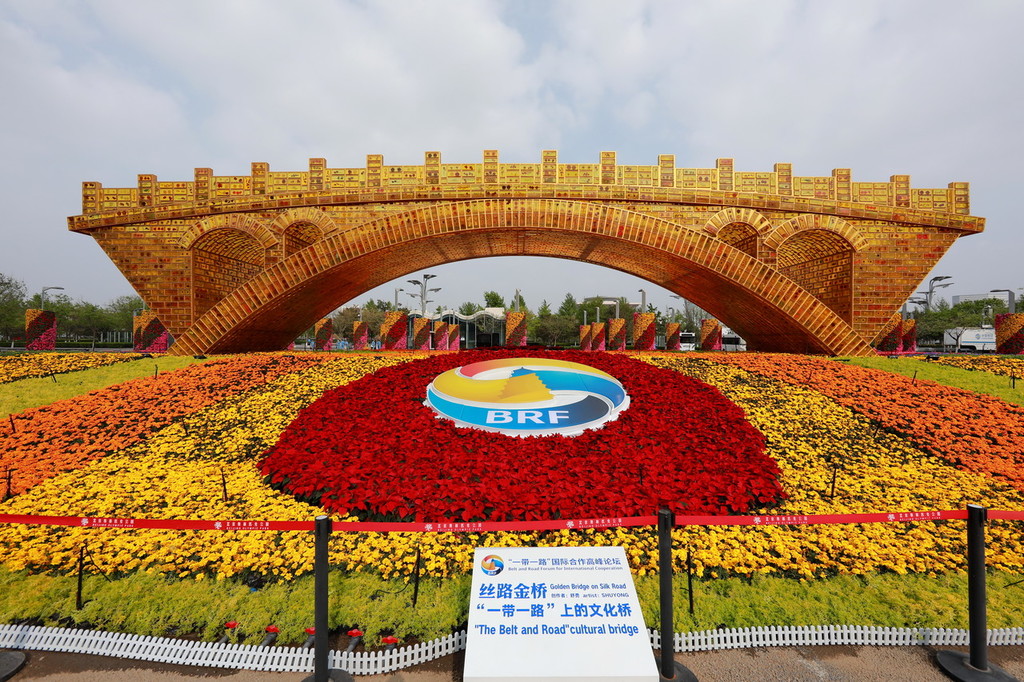
World leaders attending key gathering on initiative in Beijing
The future shape and direction of one of the world's most important initiatives is set to be decided in Beijing.
Some 37 heads of state or government, including Russian President Vladimir Putin, Italian Prime Minister Giuseppe Conte and Pakistani Prime Minister Imran Khan, will take part in the Second Belt and Road Forum for International Cooperation, which begins on Thursday.
Alongside them will be 5,000 participants from more than 150 countries.
All the participants will make their way to the China National Convention Center for the three-day event, which is themed "Belt and Road Cooperation: Shaping a Brighter Shared Future."
At the first forum two years ago, the initiative progressed to being one that all countries could take part in, not just those along the Silk Road Economic Belt, the land route taking in Central Asia and the 21st Century Maritime Silk Road, which winds its way through Southeast Asia to Africa and beyond.
To date, some 126 countries across the globe and 29 international organizations have signed 174 BRI cooperation documents.
Since the initiative was announced by President Xi Jinping in 2013, trade volumes between China and participating countries have exceeded $6 trillion, with investments of more than $80 billion. Some 300,000 jobs have been created.
Western countries, many of which will be represented at the forum by senior politicians, have increasingly embraced the initiative, with Italy in March becoming the first G7 nation to sign a memorandum of understanding.
Many experts believe this marked a turning point and that other Western countries will begin to give more support to the initiative.
Kishore Mahbubani, a former diploma and now an academic in Singapore, believes the forum could be a crossroads for this to happen.
"The fact that Italy has participated is a big deal. It is a real breakthrough, and now it is a question of getting another one or two G7 members to join," he said.
The initiative is also becoming increasingly popular with many in the business community in the United States.
David M. Rubenstein is co-founder and co-executive chairman of US global investment company, The Carlyle Group, one of the country's leading private equity investors.
"The Belt and Road has had a positive effect on China and I think it has been enormously positive on the countries in which they (China) have made investments," he said.
"Clearly, the US does not have anything comparable, and therefore we must recognize that we need to do more to be a visible force if we are going to have an impact on those countries (like China has had)."
Martin Sorrell, founder of WPP, the world's largest advertising and public relations company and now executive chairman of S4 Capital, a marketing services company, wants to see the United Kingdom become more involved. The UK is represented at the forum by Chancellor of the Exchequer Philip Hammond, who also attended in 2017.
"My view is that when the UK comes out of the European Union, if it does come out, it will have no choice. We will have to establish stronger relationships, both trading and political, with countries outside the EU, otherwise we will become increasingly marginalized," Sorrell said.
"I don't think we have yet put our best foot forward in China, and the question of whether we sign up to the BRI is just one of those decisions that has to be made."
Amitav Acharya, distinguished professor of international relations at the American University in Washington, said the challenge for the initiative at the forum will be to emerge as more multilateral.
"The initiative needs to have more collaboration with multilateral institutions. So if, for example, you have a project with country X and China provides funding but there is also additional money from the World Bank and the Asian Development Bank, it will become more integrated into the global governance system," he said.
Peter Frankopan, professor of global history at Oxford University, believes it is the scale of the investment that remains the most impressive aspect of the initiative, as more projects are set to be announced at the forum.
In his new book, The New Silk Roads: The Present and Future of the World, he quotes Cambodian Prime Minister Hun Sen, who said: "Other countries have lots of ideas but no money. But for China, when it comes with an idea, it also comes with the money."
Frankopan said: "I think he (Hun Sen) is right. These projects, for the large part, do have the ability to raise living standards and do the kind of things that large-scale international development does."
However, Frankopan said that although the forum will be a chance to reflect on what the BRI has achieved, it will take much longer to make a wider judgment on this.
"Five years is not a great period of time in historical terms to assess it. The key test will not be whether infrastructure projects look good, but whether they can actually significantly improve the GDP and productivity of China's neighbors," he said.
Daniel Ikenson, director of the Herbert A. Stiefel Center for Trade Policy Studies at United States think tank the Cato Institute, regrets that the US has not taken a more positive stance on the initiative.
"The US actively lobbied countries to eschew the initiative and not join. To me, that was showing a lack of confidence. The idea of bringing infrastructure to countries where it is lacking will benefit the global economy, including US companies," he said.
Terry Miller, director of the Center for International Trade and Economics at The Heritage Foundation, another US think tank, agrees that the initiative can deliver benefits, but said there is a need for more clarity.
"It can be positive for China and the recipient countries. There is not enough knowledge about the goals that China is trying to pursue, and transparency in terms of its motives. If this were better known, it would go a long way to improving the understanding and perhaps acceptance of the project," he said.
Justin Vaisse, director-general of the Paris Peace Forum, which held its first international summit last year, believes the BRI has to be seen as a step in the right direction.
"One's first reaction to the Belt and Road is that it is positive. It is an addition to connectivity, development and infrastructure, and not a subtraction," he said.
But he hopes the forum will give the initiative greater shape and form.
"At the moment, it is very plastic, very flexible. China has now grown in terms of being an economic power and is now a norm-setter. We want to see what sort of norms it wants to put in place and what mechanisms," he said.
Ian Goldin, professor of globalization and development at Oxford University who was economic adviser to late South African president Nelson Mandela, said the BRI is giving developing countries much more choice in terms of attracting finance.
"The only option for countries was to accept investment or aid from Europe, the US, or on the other side of the Cold War, the Soviet Union. Now, we are in an environment where countries have a choice because of the Belt and Road and they can decide for themselves what they do. This can only be a good thing," he said.
Mahbubani, the intellectual and author of Has the West Lost It? A Provocation, said the forum will also be an occasion to celebrate the initiative's successes.
He cited the 19.2-kilometer-long Kamchiq Tunnel through the Qurama Mountains in Uzbekistan, built by the China Railway Tunnel Group, now unites two regions of the country that had been historically separated. The project was completed in just 900 days.
"It is a wonderful initiative and has led to some significant success stories, which we don't hear enough of," he said.
"It should be remembered that no country is forced to join the Belt and Road, but it just so happens that the majority of countries in the world want to."
Wang Linyan contributed to this story.










