Think tanks essential for pragmatic dialogue







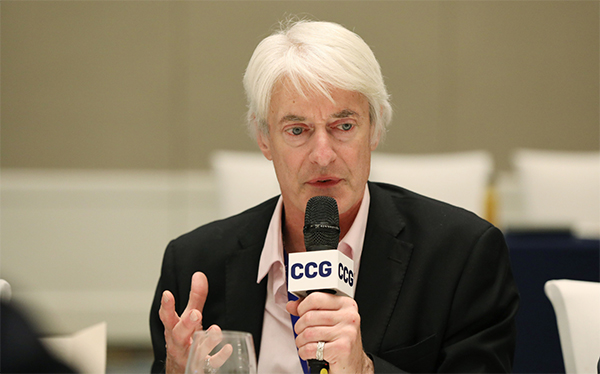
The author speaks at the fifth annual China and Globalization Forum which was held by the Center for China and Globalization, a Beijing-based non-governmental think tank on April 14, 2019. [Photo provided to chinadaily.com.cn]
We are living in an increasingly complicated world. The concepts of global governance and multilateralism that have been the foundations of our world order are quickly eroding. These foundations seem assaulted by a confluence of movements, including local populism, nationalism and protectionism, unseen in this degree of severity since the years leading up to World War II.
Some choose to ignore it. Others see a convergence of trends that could lead to further global destabilization. The right that once pushed for globalization is seeking isolationism. The left that once talked about localization now seems to lead on the concept of globalization. Do we have a world turned upside-down?
In the midst of these trends the question of global governance arises. What does it mean? Does it really exist? And if so, does it have any future in a world where rules are being quickly discarded in favor of national or even individual interests, at the cost of systems and normality of protocol?
The future of global governance and multilateralism was the subject of a private experts' roundtable held on the closing night of this year's China and Globalization Forum, that met on April 14, in Beijing. The annual event is convened by the Center for China and Globalization, an independent think tank that has emerged over recent years.
Because CCG draws experts from fields of business, finance, technology and government as well as academia, it is uniquely positioned to offer rational policy pathways. We are living in an interconnected world where politics, economics, finance and technology are increasingly entangled, requiring multi-disciplinary approaches to our world's challenges.
The idea of neutral think tanks is hard to imagine, as many Western think tanks have ideological leanings due to their funding sources. However, if we can draw upon multi-disciplinary expertise to solve problems, we will have a better chance of coming to solutions that work. Often government departments are narrowly focused on problems that affect them and produce policies that don't consider the effects on other sectors and social strata.
Certainly the world's two largest economies affect everyone, regardless of what happens. When their working relationship is positive it will have encouraging effects on nations large, medium and small. If relations are strained, the downside is felt by all as well. Despite a full spectrum of concerns over the future of globalization and global governance, the state of China-USA relations quickly dominated discussion at this year's forum.
Alongside China's own experts on trade, economics and diplomacy, American think tanks such as the Council on Foreign Relations, Asia Foundation, Cato Institute and even the very conservative Heritage Foundation were all present at the table. The conversation quickly focused on the current trade war disrupting not only China-US relations but the very structure of international trade and finance. Underscoring the discussion was concern over a seeming breakdown in our multilateral global system that has taken so many decades to build.
China's experts on trade expressed dismay at the increased shunning of multilateral frameworks such as the WTO by the current administration in Washington D.C. From their perspective, China's entry into the WTO represented a long struggle to become part of the international trading system.
Regardless of situations where the WTO rules against China on many disputes, the Chinese experts insisted on the importance of maintaining WTO as a rule-based multilateral framework, essential as a foundation for global governance in an increasingly unilateral world.
Another concern from China's trade and economy experts was the failure of Europe and the United States to recognize China as a market economy. The standard Western perception is that China's economy is dominated by state-owned enterprises. Statistically China's economy is driven by the private sector, of which foreign investment plays a substantial part.
The view from Washington was expressed in the room, as represented by the US Embassy in Beijing. China needs to open up its market faster, lower thresholds on foreign investment and allow liberalization of the financial sector. China's own experts focused more on the changes that China has already undergone, stressing that opening a once-closed economy takes time.
Clearly the areas of emphasis to both sides differed substantially, not unlike the current trade talks. However, the discussion occurred in an atmosphere of free expression, allowing for brainstorming to arrive at solutions. During formal government trade talks when positions are often carefully scripted, the open thrashing out of ideas is impossible.
There is a need for an independent think tank in China to serve as a counterpart to think tanks in Washington, whether they represent liberal or conservative interests. CCG is uniquely positioned to convene different voices together in constructive dialogue aimed at presenting solutions.
Despite differences at the formal negotiating table, there are people on both sides who see the benefits of collaboration over confrontation. Given the rather polarized politics in Washington at this time, those voices are not being heard. But the ideas are there.
Through more dialogue between think tanks, policymakers can be influenced. This takes time and a lot more dialogue between think tanks from both sides to achieve points of clear understanding. The role of think tanks in China has become more critical at this stage of the dialogue process than ever before. These are times when solutions are needed to resolve blockages. Ideology will not achieve this — but pragmatism can.
Laurence Brahm is the founding director of the Himalayan Consensus and a senior international fellow at the Center for China and Globalization.
The opinions expressed here are those of the writer and do not necessarily represent the views of China Daily and China Daily website.