


Thangka art: the tale of a Tibetan family








Norbu Sidar, a thangka master, spent his teenage days reciting vast sutras from Buddhist scriptures, and made sure that his nephews Konchoge and Tsering did the same.
Born into a family of thangka painters in Xigaze, they followed the steps of their ancestors to carry on the craft.
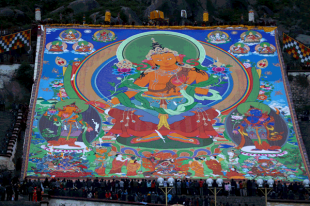
Thangka is a Tibetan Buddhist scroll painting on cotton or silk with mineral and organic pigments derived from coral, agate, sapphire, pearl, gold, and others so that the color stays for centuries. The paintings date back to the 10th century and typically depict Buddhist deities.
Norbu Sidar is a renowned master for the Mensar school in the Tibet autonomous region. Mensar is one of the four schools of thangka, placing focus on the elaborateness in Buddhist images, landscape, animals and garments.
He is the head of the Tibetan Thangka Academy in downtown Lhasa, offering free classes to interested applicants, particular those poor but talented apprentices from his hometown Xigaze.
Konchoge, a deputy to his uncle, is also a successful painter. He often sits for hours in front of a painter's rack for practice and wants to become a highly-acclaimed master.
"To draw a thangka, one needs to exert the power of the eyes, the hands and the heart, with the utmost purity in your heart and persistent attention to details," Konchoge said.
FAMILY ROOTS
Norbu Sidar and Konchoge are the fourth and fifth generations of painters from the family of Thutop, who lived about 100 years ago in Tashigang Village of Lhaze County in Xigaze. Thutop learned the basics of painting when he worked for a family in Lhasa.
After a few years, Thutop established his own style and began passing down the craft. His son Dawa Dondrup, the second generation painter of the family, was a gifted painter and was invited to repair ancient paintings in the main hall of the Sagya Monastery.
Dawa Dondrup, the grandfather of Sidar, inspired and trained the boy. "When I was young, my grandpa was painting most of the time," Norbu Sidar said.
At the age of 12, Norbu Sidar already knew the sutra on scales by heart. "I thought it was very boring to recite the books, but the elderly in my family kept checking my recitations. I would get scolded if I slacked," he said.
He uses burnt willow branches to draw on a board of white pigment before going on to practice coloring and completing lines for the thangka. He studied with his grandfather for six years.
Thangka paintings are highly geometric and leave little room to be creative, so practice is the only way to make them perfect, Norbu Sidar says.
YEARS OF PRACTICE
In the 1980s, Norbu Sidar participated in the repair and renovation project at the Tashilhunpo Monastery in Xigaze, where he honed his drawing techniques with seasoned painters.
He says the most difficult part is the eyes. "Even the thinnest line matters. Each pen stroke tells the level of mastery for thangka, which varies from one painter to another."
Norbu Sidar later repaired murals in the Sera Monastery and Drepung Monastery in Tibet and became a skilled conservator.
From 2005 to 2015, he worked independently in the Potala Palace to repair 18th-century paintings, a job only the best conservators can handle.
"Some of the lines disappeared, and images were hardly decipherable. I had to read books, make out what's missing, draw on my sketchbook before I laid my pen on the wall of paintings," he said.
ART AND LIVING
A two-story building lies on the Pargor street in downtown Lhasa where Norbu Sidar, Konchoge, and their students retreat to sharpen their skills.
Around 40 students are divided into the beginner, intermediate and high levels at the academy, and take the classes for free. Some leave to find jobs after they learned the basics of the painting, but students like Tenzin have their minds set on becoming masters.
Tenzin, a 24-year-old student from an impoverished family in Lhasa, has spent seven years taking classes with Norbu Sidar. The academy, supported by government funds, gives him 2,000 yuan (about 298 dollars) every month as an allowance. He keeps one-fifth and sends the rest to his parents.
"I want to use my pen to change my life and that of my family, but before I can do that, I have to be really good at the skills," he said.
Soft-speaking Norbu Sidar is uncompromising when it comes to training.
"A single thangka may have hundreds of images of deities, so the lines are crucial. The minimum practice each day is seven to eight hours, for two years. It takes that much effort to be able to work the lines right," Norbu Sidar said.
In 2006, thangka was listed as a national cultural heritage, a status that has since given the art a strong boost. Over 10,000 people now work in the thangka industry in Tibet.
Government funds for heritage protection and sales revenue of the paintings help cover the operational costs of the academy. Every year the academy hosts a seminar to carry out scholarly exchanges, research and training.
Over the years, more than 300 craftsmen have graduated from the academy.
INHERITANCE, INNOVATION
Though many shops in Lhasa sell inexpensive thangkas to undiscerning tourists and buyers for a quick profit, Norbu Sidar and Konchoge insist on the slow and traditional way, using expertly-made brushes from horse, goat and cat hairs.
"The value of thangka lies in the history and art it contains. You can never be hasty about it," said Konchoge, who started learning the art at the age of seven.
He has traveled extensively across China to give lectures on thangka. "I want to be a messenger of thangka. It is probably a good idea to live broadcast how we approach the art to a wider public online," he said.
"Thangka, as one of the pearls of Tibetan culture, must be passed on and relived in modern times. I hope my students will inherit the culture and pass on the persistent spirit the art embodies", said Norbu Sidar.