



New deposit insurance agency in works







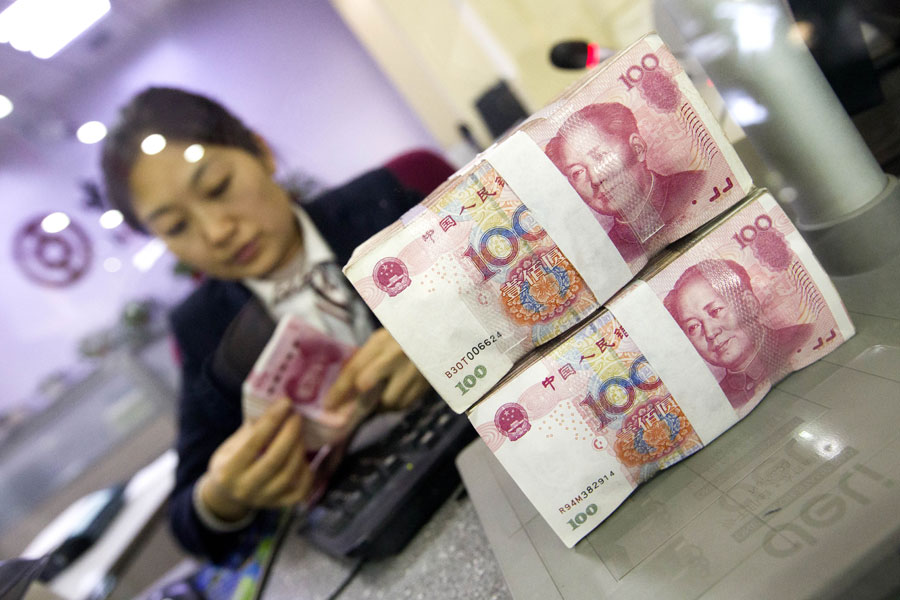
Central bank's financial stability bureau presents proposal to top legislature
China may soon establish an independent deposit insurance agency covering financial institutions that accept deposits from the public, according to some knowledgeable policy advisers.
The proposed agency will seek to protect depositors, they said.
Such cover will likely be up to the insured limits applicable to depositors, and will help maintain the stability of the financial services sector, they said.
More details, such as the functions of the agency, which is being envisaged as a separate legal entity, are being worked out.
The larger idea, designed and proposed to the country's top legislators during the ongoing two sessions, is that such a mechanism will be of great help in the event of a bank run or credit risks.
Based on the scheme, the proposed insurance fund manager will collect premiums from member financial institutions.
Such premiums will be differentiated based on risk levels applicable to each such member.
The institutions can make a claim for payment, or start the depositor reimbursement, under certain conditions, according to the proposals viewed by this reporter.
It will be the first such national agency to be created under the basic deposit insurance system established in May 2015.
The proposed agency could help failed banks exiting the market, limit depositors' losses, and prevent risk contagion from spreading to the whole financial system, the officials concerned said.
The central bank has already collected insurance premiums from depository financial institutions seven times. And the deposit insurance fund amounted to 81.5 billion yuan ($12.13 billion) by the end of September 2018, according to the financial stability bureau of the People's Bank of China.
According to a proposal presented to the National People's Congress by Wang Jingwu, head of the PBOC's financial stability bureau, when financial institutions' capital adequacy ratio-the adequacy of their capital keeping in view their risk exposures-drops below 2 percent, or when there are serious credit risks, the resolution process will get triggered. The insured institutions could then take self-rescue measures within 90 days.
"The deposit insurance fund management institution could use the fund to inject capital in Systemically Important Financial Institutions," said Wang.
China's four largest banks are in the SIFIs group, a term comparable to "too big to fail". Any improper disposal of their risks may lead to systemic shocks.
Bai Hexiang, head of the PBOC's Guangdong branch, said the fund management agency could be authorized with the right to access banks' information, in order to recognize potential risks at an early stage, and to reduce the possibility of bankruptcy.
The establishment of the agency is necessary, given the possibility of a further drop in real GDP growth this year from 6.6 percent in 2018, analysts said.
Economic headwinds may highlight the need for ensuring banks' asset quality, with nonperforming loan ratios and credit costs elevated but not deteriorating, said Nicholas Zhu, a Moody's vice-president and senior analyst.
China's monetary policy in 2019 will support system-wide liquidity and general repayment capacity among borrowers, but also slow the nascent decline in system-wide leverage over the past year, he said.
China's banking system risks are concentrated in rural and small banks, which account for 10 percent of total assets, and are usually in the form of non-performing loans higher than the system-wide average by about 2.5 percentage points at the end of 2018, according to the PBOC's financial stability report.
To enhance banking system stability, the China Banking and Insurance Regulatory Commission also strengthened regulations for rural commercial banks in January.
According to CBIRC data, the listed banks' capital adequacy ratios all stood above 10 percent by the end of last year. Most of the smaller rural banks' capital adequacy level has improved compared with that in 2017, on the back of increase in loans.
The proposed deposit insurance system was designed based on the practices in the United States, said Zhou Xuedong, the former head of the stability bureau.
The US was one of the earliest countries to establish the deposit insurance system in the 1930s.
In July 2008, the Basel Committee on Banking Supervision and the International Association of Deposit Insurers decided to collaborate to develop an internationally agreed set of core principles for deposit insurance.
In 2017, based on a scrutiny of China's financial sector, the International Monetary Fund said the deposit insurance scheme is "in compliance with international core principles".
The IMF wrote in its Financial System Stability Assessment Report that the system, which was put in place in 2015, is able to take care of any insolvency problem effectively.
"The implementation of a deposit insurance system will provide support for the orderly shutdown of financial institutions, and assistance for sorting out contingent liabilities," said the IMF.


Today's Top News
- China's import push offers opportunities
- Tomahawk rips off Tokyo's 'pacifist' mask: Editorial
- Sino-US talks enhance understanding, underline the value of dialogue
- China, US start economic, trade talks in Paris
- Trade talks seen key to sustaining China-US economic stability
- US-China trade talks not just about commerce





