Govt moves help eradicate poverty







Scholar says improvements in data collection added impetus to government's strategy
China has shown the world that it is possible to tackle poverty. The serious and sustained commitment made by the government, backed by tough anti-corruption policies, has given the strategy necessary momentum to achieve the current milestones, said David Monyae, director of the Centre for Africa-China Studies at the University of Johannesburg.
"China is dealing decisively with poverty," said the international relations and foreign policy expert.
He was commenting on China's success in moving 740 million people out of poverty in the past four decades. Monyae attributes this success to China's visionary leaders.

Tasks for this year as listed in the Government Work Report include making solid progress in poverty alleviation and rural revitalization, and moving closer to achieving the goal of building a moderately prosperous society in all respects.
With a fastgrowing population in decades past, Monyae said China had to confront the poverty problem. China initiated a strategic process that not only expanded the middle class, but also simultaneously started lifting people out of extreme poverty. "The results are commendable," he said.
Infrastructure expansion and nationwide access to basic education yielded immediate results. Farmers accessed markets, productivity was buoyed and factories filled up with semiskilled workers, who became the foot soldiers of the country's meteoric rise in industrialization.
"Expanded infrastructure also brought government services closer to the people," Monyae said.
A large talent pool was developed as funding of education rose. The largely youthful population accessed basic training and acquired skills, thus creating an inclusive and deepened economy.
As the strategy gained traction, Monyae said it was steadily fine-tuned.
China strengthened its data collection system. This ensured that interventions directly addressed household needs, with strengthened monitoring and evaluation systems.
"The approach was speaking of tangible results," he said. "I think this informed the whole strategy. This is indicative of the seriousness of these efforts."
Many people in rural parts of China live in mountainous and disaster-prone areas, making it hard for them to access to government services. Building infrastructure would be a costly and time-consuming affair, but to ensure that no one was left behind, the government embarked on a translocation exercise.
"The people were moved to favorable areas, where agriculture could thrive and the youth could easily access basic State services," Monyae said. "Those targeted interventions have started to reap fruits and have significantly helped in cutting down poverty levels."
Areas such as the mountains of the Tibet autonomous region have been conserved and become tourism hubs. Domestic tourism to such areas has thrived. Gender parity has been boosted by the sale of women's handiwork and cultural activities, creating a vibrant market. It has consequently kept the hospitality industry afloat, as well as secondary services that created employment.
"This has dealt a blow to poverty in a quicker and more sustainable way," Monyae said.
The UN strongly believes that the good practices from China can be replicated globally.
"The well-thought-out interventions, backed with incentives, infrastructure expansion and planting new socioeconomic programs in communities, ensured that it was hard for anyone to miss out on these benefits," Monyae said. "Africa can do the same."
Hard decisions need to be made. Policymaking should be backed by data, and serious monitoring and evaluation systems need to be implemented. "Africa is still largely an agrarian economy," he said. "This sets a firm foundation to launch well-thought-out value-addition programs. Corruption should also be dealt with decisively.
"All indications are positive that China is well on its way to eradicate poverty by 2020 and meet the first of its 'Two Centenary Goals'."





- Zimbabwe veterans hail historic bond
- Dazzling Guangzhou lantern display begins countdown to Spring Festival
- Huizhou takes major step forward as petrochemical hotspot
- Beijing's Shunyi district cracks down on crimes related to public welfare
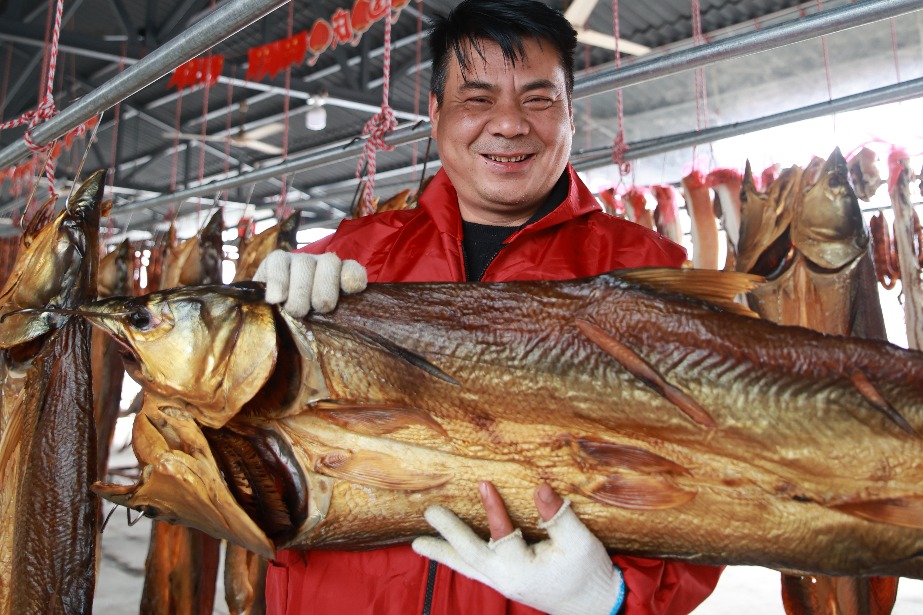
- Hunan's smoked fish and meat arrive in time for Spring Festival
- International arrivals to Guizhou skyrocket after visa-free policies