Beijing's on air quality sets international example: UN







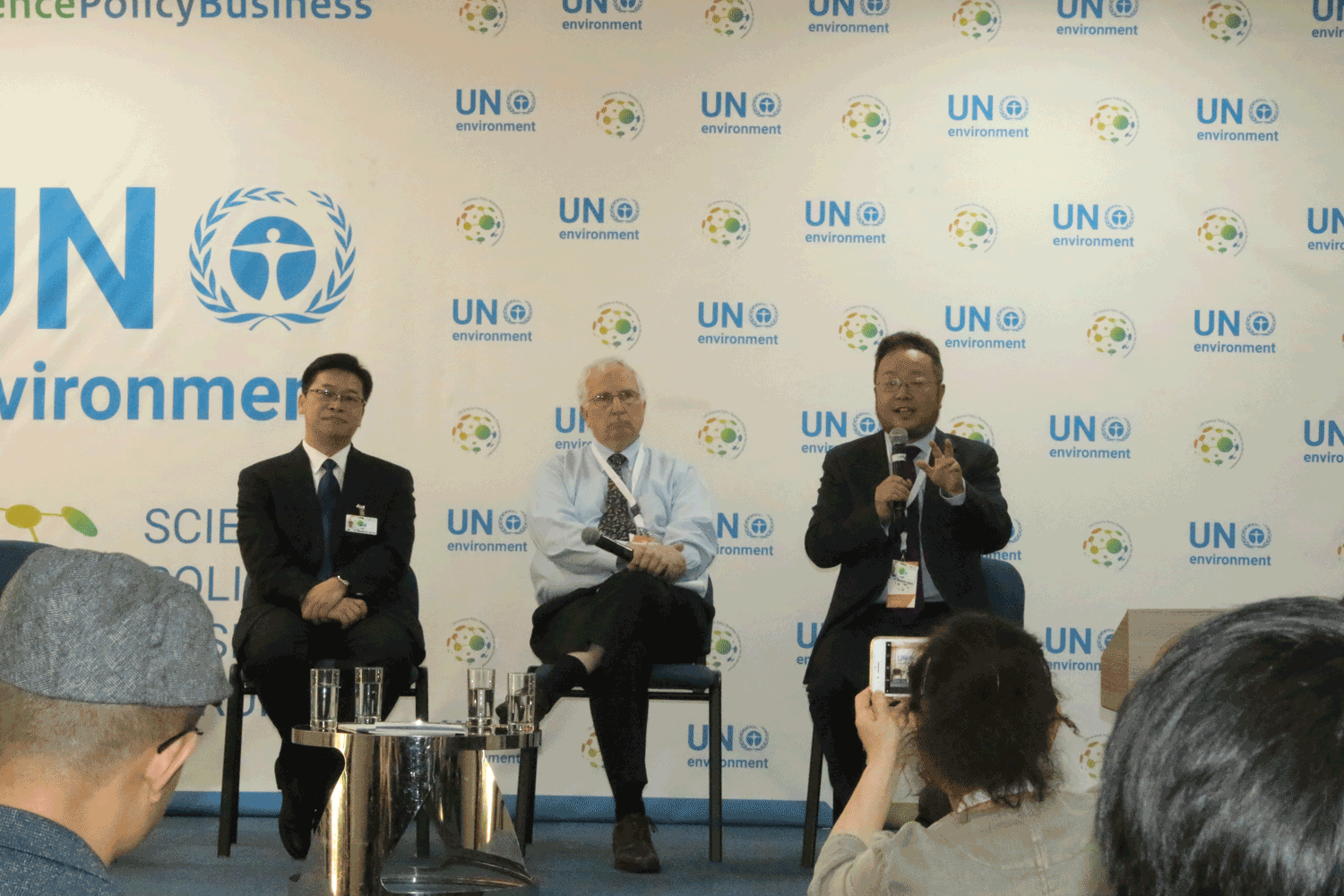
Over 20 years after Beijing began looking for ways to improve air quality in one of the largest and fastest growing cities in the developing world, it now provides a model for others to follow, according to a report released ahead of the UN Environment Assembly on Saturday.
Research by UN Environment and the Beijing Municipal Ecology and Environment Bureau (BEE) outlines how Beijing's air quality program has evolved, and makes recommendations for the near-, medium-, and long-term that Beijing can take to maintain its momentum toward clean air.
The report, A Review of 20 years' Air Pollution Control in Beijing, was compiled by a UN Environment-led team of international and Chinese experts over two years. It covers 1998 to the end of 2017.
"This improvement in air quality didn't happen by accident. It was the result of an enormous investment of time, resources and political will," said Joyce Msuya, UN Environment acting executive director. "Understanding Beijing's air pollution story is crucial for any nation, district or municipality that wishes to follow a similar path."
He Kebin, the report's principal author and dean of Tsinghua University's School of Environment, said Beijing progressed from 1998 to 2013, but that there were even more significant improvements under the city's Clean Air Action Plan 2013–2017.
In 1998 air pollution in Beijing was dominated by coal-combustion and motor vehicles. Major pollutants exceeded national limits. By 2013 levels had fallen and some pollutants, like carbon monoxide and sulfur dioxides, met national standards.
In 2013 Beijing adopted more systematic and intensive measures. By the end of 2017 fine particulate pollution (PM2.5) had fallen by 35 per cent and by 25 per cent in the surrounding Beijing-Tianjin-Hebei region. Much of this reduction came from measures controlling coal-fired boilers, providing cleaner domestic fuels, and on industrial restructuring.
Over this period annual emissions of sulfur dioxide, nitrogen oxides, particulate matter and volatile organic compounds in Beijing decreased by 83, 43, 55 and 42 per cent, respectively.
According to the report Beijing's air quality policy is supported by monitoring and evaluation, the identification of the sources of pollution, and emission inventories. It also contains comprehensive legal standards and provides for the strict enforcement of environmental law.
Work on improving air quality is further buttressed by economic policies, public participation, and coordination on air pollution prevention and control in the Beijing-Tianjin-Hebei region, said the report.
Yu Jianhua, deputy head of the Beijing Municipal Bureau of Ecology and Environment, said however that while much has been achieved, more can be done.
"At present, the PM2.5 concentration in Beijing still fails to meet national ambient air quality standards and far exceeds the levels recommended by the World Health Organization (WHO), and heavy pollution episodes still occur during autumn and winter," he said. "Solving all these air quality issues will be a long-term process. We are willing to share our long-accumulated knowledge and wealth of experience on air pollution with other cities in developing countries."
This is UN Environment's third independent assessment of Beijing's air quality, following the Independent Environmental Assessment: Beijing 2008 Olympic Games and A Review of Air Pollution Control in Beijing: 1998–2013, which were published in 2009 and 2016, respectively.
Dechen Tsering, director of UN Environment's Asia Pacific Regional Office, said UN Environment is committed to promoting sustainable development and best practices in countries and cities around the world.
"Beijing has achieved impressive air quality improvements in a short amount of time," Tsering said. "It is a good example of how a large city in a developing country can balance environmental protection and economic growth."




- Intl students showcasing global business acumen in Shanghai
- CPC expels former senior official of Guangxi
- Shanghai university unveils sustainable, efficient water treatment system
- Fire at auto business park in Jiangsu claims one life
- Magnitude 6.0 earthquake strikes Akqi county in Xinjiang
- Shenzhou XXI team to carry out first spacewalk