Flocking to 'swan lake'







City becomes hot destination for tourists, photographers thanks to conservation
On the brick wall at the gate of Qu Rongxue's house is a list, carved by Qu, of the dates in recent years of the annual arrival of "A97", which, though having wings, is not a plane. It's a whooper swan.

Qu, 74, has been tracking the appearance of A97, whose name comes from its tag number, since 2008, when the whooper swan came to the bay on the Yellow Sea for the first time.
"For several years, she has arrived in October," said Qu. "But last year, she showed up on Nov 25 - 21 days later than in 2017 and the latest during the past 10 years."
Once October arrives, Qu begins to watch for the arrival of his white swan friend. He will walk along the bay, which is around five meters away from his home in a coastal fishing village, and look for the swan every day until he finds it.

"If I don't see her, I will become worried about whether she got hurt or died on her way here. A97 will come as long as she is alive, because the living environment here is so good," said Qu, who believes that the swan, whose gender has not been determined, is a female.
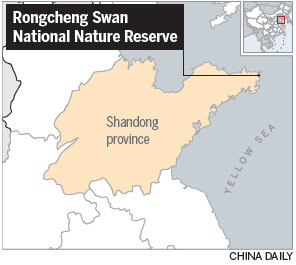
Located along the coastline of Rongcheng, a county-level city of Weihai in East China's Shandong province, the bay that A97 and thousands of other migrating whooper swans call home from November to April each year connects a wide estuary to the Yellow Sea.
Attracted by the abundant supply of fresh water, aquatic plants and fish, shrimp and seaweed, the whooper swans migrate from the Siberian region, the Inner Mongolia autonomous region and China's north-eastern regions to stay for the winter along the bay, making it China's largest winter habitat for whooper swans. As a result, the bay has become known as "Swan Lake".
For people driving along the coastline of Rongcheng, flocks of swans can be seen foraging for food, preening and flapping their wings.
Qu has been taking care of the swans since the late 1980s, when he spotted a couple of them along the bay. Amazed by the big white birds, he began feeding them corn. He also has taken injured swans to his home to treat them until they recover and can live on their own on the bay.

His efforts have earned Qu the nickname "Grandpa of the Swans".
Over the years, the number of whooper swans staying during the winter at Rongcheng has continued to increase as the quality of water has become better and better, he said.
"Some swans are even moving to lakes in the urban area as water quality there becomes very good," he added.
Overall water treatment and protection was launched in Rongcheng in 2000, when a nature reserve zone for the whooper swans was established to ensure a better living environment for the birds.
Since a campaign was launched in 2015 to improve sewage treatment and river water quality, the quality of offshore waters is now rated Grade II, the second-highest in China's five-level rating standard for water quality, which means the water is drinkable after treatment.
In addition, due to efforts to control emissions of factory pollutants, Weihai has seen its air quality take the lead among cities in the coastal province.
The city now has two national-level wetland parks and six provincial-level ones, all of which reflect China's efforts to emphasize sound ecological development as a basis for sustainable social and economic development.
Qu Xuejun, Party chief of Yandunjiao village, said: "Years ago, sewage from our village was discharged into rivers and the sea. But now we have 27 facilities to treat sewage, which has completely stopped sewage discharge."
With the improvement of the environment, the number of whooper swans has reached nearly 10,000, compared with fewer than 2,000 at the end of the 1990s, according to Sun Yang, head of the administration office of the national-level nature reserve zone for the whooper swans in Rongcheng.
Besides whooper swans, there are more than 150 species of birds living in the zone, mostly migratory birds including Oriental storks, he said.
The village of Yandunjiao, whose history dates back more than 400 years, has also benefited from the efforts. The village, whose seaweed-thatched houses have walls made of thick stone or earthen blocks, has drawn an increasing number of tourists.
Photographers and tourists from China and abroad flock there each winter to see the swans.
In the village, which has around 500 households, more than 50 families provide bed-and-breakfast services for tourists.
Yu Haiyang, a native of Yandunjiao, returned to the village in 2014 from Singapore to help his family run hostels for the tourists.
"The time-honored, seaweed-roofed houses, the elegant swans, the ocean and the good environment - all of these are what people dream of," said Yu, 30, who added that he can earn around 150,000 yuan ($22,370) each winter.
Statistics from the local government show that an average of 12,000 visitors came to the village each day during the annual seven-day Spring Festival holiday, which started on Feb 5, generating total revenue of 550,000 yuan.
"When the sun rises, casting golden glows, 'Swan Lake' is so beautiful," said Angeline Lew, a photographer from Singapore.
As it gets warmer, whooper swans begin preparing to leave the area, which makes Qu Rongxue a little sad.
"Years ago, I couldn't sleep because the swans' calls were so loud," he said. "But now that I am used to it, I can't sleep well without their calls."
zhaoruixue@chinadaily.com.cn






- Most parts of country were warmer than usual in 2025
- Poverty relief transitions to governance
- 'Micro sports areas' boost students' fitness, fun
- China tips scales toward healthier living trends
- Anti-corruption efforts focus more on work conduct issues
- Deeper reflections on 'cave-dwelling conversation'