Upgraded supervisory system hits the mark







Commissions have been in full swing since the country's top legislature adopted the Supervision Law and an amendment to the Constitution that defined their status. Zhang Yan reviews the reform's progress in the past year.
The Supervision Law and an amendment to the Constitution adopted by the first session of the 13th National People's Congress in March last year laid a solid legal foundation for an upgraded anti-graft task force, with the National Commission of Supervision and its local branches set up across the country in the past year.
Compared with the Communist Party of China's disciplinary authorities, which supervise Party members, supervisory commissions monitor all public officers, including civil servants, management at State-owned enterprises, and workers at public schools and medical institutes.
Establishing supervisory commissions at all levels is considered a major political reform. They are equal with the government, the prosecuting authorities and the courts.
"After a period of hard work, the reform of the country's supervisory system has made achievements in many aspects," President Xi Jinping said in an article published by Qiushi Journal on Friday.
Xi, also general secretary of the CPC Central Committee and chairman of the Central Military Commission, said the new commissions have integrated supervisory, corruption prevention and control functions that had been scattered across various departments, and optimized resources for fighting corruption.
The reform has brought all people who exercise public power under a unified supervision system, leaving no loopholes in power supervision and no dead ends in fighting corruption, he said.
The new mechanism, aiming to offer a fundamental solution for combating graft, has played a deterrent role in keeping people from wrongdoing and many corrupt officials have turned themselves in, Xi said.
Jiang Laiyong, a senior researcher with the Chinese Academy of Social Sciences, said the new supervisory system has extended inspection from Party members to all public officers."The new commissions have played a bigger role in fighting corruption and building a clean government," he said.
In one typical case, Li Sufei, former deputy manager of a State-owned investment company in Xiamen, Fujian province, was detained by the local commission of supervision in May last year. He was accused of making use of his job to help others with project bidding, and accepting up to 1 million yuan($150,000) in bribes. Li was sent to the local prosecuting department in July for the filing of charges.
Li is not a Party member, and so was not under the scrutiny of the discipline authorities of the CPC. However, as a senior executive of a State-owned company, he held public power, and so fell under the monitoring of the supervision commission.
"As a unified anti-graft system, the supervisory commission is an institutional invention incorporating China's reality and international practice," said Gao Bo, a political researcher at the Chinese Academy of Social Sciences.
He said the newly established National Commission of Supervision and those in provincial-, city- and county-level regions had helped the country's fight against corruption turn in a good report card last year.
'Tigers' and 'flies'
The National Commission of Supervision said anti-graft officers fought against both "tigers" and"flies" last year. They investigated corrupt officials who continued their crimes during the anti-graft campaign and ones who sparked strong public reactions.
They paid attention to investigating graft issues whose political and economic affairs were intertwined, and focused on probing abuse of power and bribery in some key areas, including personnel promotion, administrative approvals and resources development, bidding for projects and public expenditure.
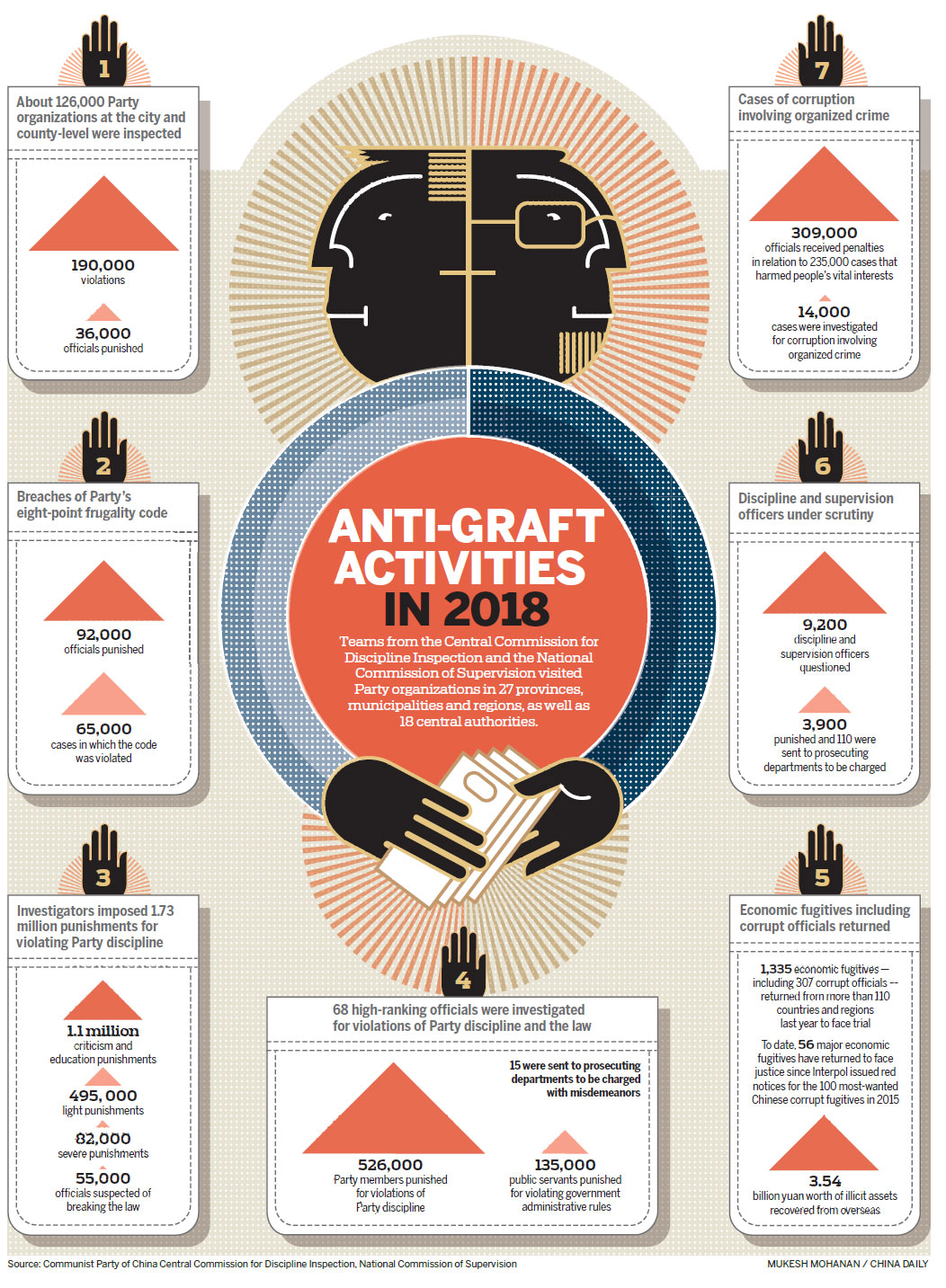
Figures released by the CPC's Central Commission for Discipline Inspection (CCDI) show 68 high-ranking officials at or above provincial or ministerial level were investigated for serious violations of Party discipline and the law last year, including Lai Xiaomin, former chairman of China Huarong Asset Management, and Li Yihuang, former vice-governor in Jiangxi province.
Of those 68, 15 were sent to prosecuting departments for the filing of criminal charges, including Lu Wei, former deputy head of the Publicity Department of the CPC Central Committee.
Last year, 526,000 Party officials were punished by the CCDI for violating Party discipline, and 135,000 public servants were punished by the National Commission of Supervision for violating administrative rules.
"Lots of corrupt officials being taken down on charges fully shows the new commissions have turned their institutional advantages into effective governance," said Guo Yong, director of the Center for Anti-Corruption and Governance at Tsinghua University.
"But we can't underestimate the seriousness and complexity of the anti-corruption campaign and will take a zero-tolerance attitude toward fighting such cases and curb new corruption."
Anti-graft officers investigated some high-profile corruption cases last year and punished many officials who neglected their duties and were involved in malfeasance. Cases included the illegal building of villas in Xi'an, Shaanxi province; the illegal erection of fencing at Dongting Lake, Hunan province; and the production of substandard rabies vaccine by a company in Changchun, Jilin province.
Inspection teams
The National Commission of Supervision said it and the CCDI stationed 46 inspection teams in various offices to supervise 129 central Party and government authorities last year. They also deployed inspection teams to provincial-level Party and government authorities to look for evidence of graft.
The central inspection teams probed Party organizations in 27 provinces, cities and regions and 18 central authorities.
During the inspections, they received 490,000 complaints from the public and investigated lots of corruption cases, including those involving Pu Bo, former vice-governor in Guizhou province, and Zeng Zhiquan, former head of the provincial United Front Work Department in Guangdong.
"Conducting routine and long-term supervision is considered a major task for anti-graft officers this year," said Mao Zhaohui, a law professor from Renmin University of China.
"Supervision is considered the first and basic duty of the anti-graft officers and establishing a perfect supervisory mechanism will tackle corruption at its source.
"Only if the supervision officers explore new supervision methods and take detailed monitoring steps, will they fundamentally prevent the occurrence of corruption."
Hunting fugitives
The National Commission of Supervision said China will deepen pragmatic judicial cooperation with other countries under the newly passed International Criminal Justice Assistance Law to extradite, repatriate and persuade more fugitives to face trial.
At international forums, Chinese leaders have repeatedly said China will strengthen law enforcement cooperation with other countries to combat cross-border corruption and dissuade other jurisdictions from offering "safe harbor" to fugitives.
Last year, China extradited 12 economic fugitives from six countries -including South Korea, Bulgaria, Spain and Portugal-to face justice.
In addition, judicial officers signed extradition treaties with five foreign countries, four judicial assistance agreements and four finance intelligence exchange agreements.
"The successful extradition and repatriation of the fugitives demonstrates the country's resolute determination to capture and bring them to justice, no matter where they flee," said La Yifan, director of the CCDI's International Cooperation Bureau.
Financial safety
The fight against corruption has become a top priority for the central leadership since November 2012 because it is key to China's future and the legitimacy of the government.
This year marks the 70th anniversary of the founding of the People's Republic of China and is key to realizing the country's centenary goal of building a moderately prosperous society in all respects by the time the CPC celebrates its centenary in 2021.
"We must adopt to the new situation, grasp the new opportunities and show our new performances," Zhao Leji, secretary of the CCDI, said when delivering a work report at the third plenary session of the 19th CCDI of the CPC on Jan 11.
The National Commission of Supervision said it and the CCDI will establish a sound supervisory system to tackle corruption in a highly efficient manner and ensure the central authority's major decisions are fully implemented.
This year, supervision officers will attach great importance to investigating graft issues involving the major projects, key positions and important areas, especially the financial sector. They will probe those offered bribes by businesses or special interest groups.
"Financial safety matters to national security. Such a measure is considered essential in defusing financial risks," said Zhuang Deshui, deputy director of the integrity-building research center at Peking University.
The National Commission of Supervision said anti-graft officers will focus on investigating corruption that harms people's vital interests in education, medical care, ecological protection, and food and drug safety. They will also investigate corrupt grassroots behavior, uprooting the"protective umbrellas" that facilitate and cover up the activities of organized crime gangs and "evil forces".
Xin Ming, a professor at the Party School of the CPC Central Committee, said, "The most important thing is to ask the public to enjoy the results of the strict administration of the Party, so that the masses will have a more real sense of achievement, happiness or security."