Education proves value of cooperation







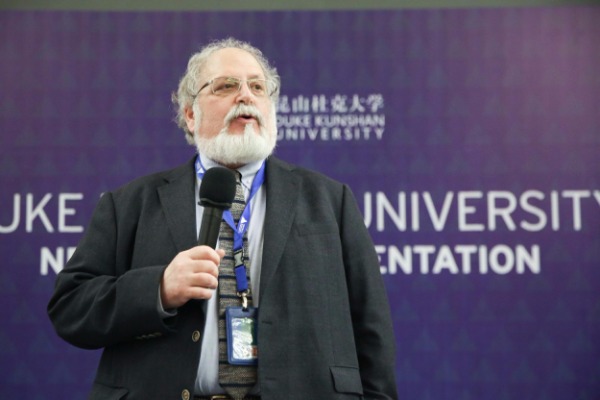
China-US university collaborations lay a solid foundation for win-win results
As the United States and China continued trade talks this week, companies and industries in both countries, including the education sector, will be hoping for a significant breakthrough that can lift Sino-US relations from the current morass and end the tit-for-tat trade war that has seriously affected exchanges of goods, technology and people between our nations.
For Sino-US joint-venture universities, such as Duke Kunshan University, in China's eastern province of Jiangsu, the ramifications of a further ramp-up in tensions would be felt acutely.
Fortunately, the impact of the trade dispute on these educational joint ventures has been minimal. But naturally there has been uncertainty surrounding the issuance of work and student visas (although the Chinese government has been quick to make assurances), and parents have raised questions about the sustainability of such projects should relations sour further.
More than ever before, it is important to remember that joint-venture educational projects highlight the importance and value of true mutually beneficial cooperation. Today, there is hardly a single major global problem for which the long-term solution does not depend on close collaboration between the US and China, respectively the largest and second-largest economies in the world.
While the US has long been an established powerhouse in multiple sectors, China is steadily transforming itself from a traditional manufacturing center into a technology-driven economy capable of delivering higher-value products and services to serve its increasingly affluent, middle-income consumer base.
Recognizing the pivotal role of colleges and universities in this process, China is making huge investments to strengthen its higher-education institutions, and is at the same time developing greater capabilities in science, technology and innovation. In the critical field of artificial intelligence, for example, Chinese President Xi Jinping has laid out an ambitious plan to make China a world leader over the next two decades.
Today, with rapidly improving academic systems, a clear focus on research, and a vast pool of high-caliber talent, Chinese universities are almost certainly at the forefront of defining the new and most innovative jobs of the 21st century.
This exciting trend, which will likely be unimpeded whatever the outcome of this week's trade talks, means there are tremendous opportunities for academics to work in China-and the appeal is much broader than just the likely increment in salary and research budget. Many individuals are attracted by the intriguing possibility of using the next stage of their academic career to take on a new adventure and explore a new culture.
One key attraction for many academics is the chance to fulfill their ambition in scientific research. And with China becoming a key driving force in so many key technology sectors, such as big data and AI, life sciences, clean energy and quantum computing, faculty members can quickly find themselves operating in a cutting-edge research environment, supported by a larger budget and more-skilled support team than might be possible elsewhere.
This trend reflects steps by the Chinese government to make working in the country more attractive to overseas academics, including the Thousand Talent Plan, which was initiated in 2008 and has already attracted more than 7,000 overseas Chinese and 300 to 500 foreign experts. While the FBI has raised some questions about the intentions of this program, it is clear that the vast majority of the participants are largely interested in nothing more than open, mutually beneficial, cross-border research collaboration.
At joint-venture universities, all full-time faculty members, irrespective of their nationality, are eligible to apply for domestic Chinese funding to support their research activities. With overall research and development expenditures in China growing at 15 to 20 percent annually over the past few years, this represents a major point of attraction for foreign scholars and faculty members.
While the experience of teaching on Chinese campuses is often different to that in the West due to the prevalence of a more traditional intellectual culture, the dedication of students and their zest for acquiring knowledge makes teaching a unique pleasure. Most faculty members find that their students are happy to adopt the Socratic methods favored in Western education, encouraging a rewarding level of debate in the classroom.
An important factor that makes the process of adaptation easier for faculty members is precisely the existence of joint-venture universities and other similar types of degree-granting collaborative projects, which allow them to remain within a Western-style administrative and academic structure while becoming embedded in a different culture and sociocultural living experience.
Having a highly networked knowledge platform in China also provides scholars from international universities a chance to build bridges with Chinese counterparts, and to tackle problems together in a more cohesive manner, which is essential for addressing today's pressing global problems.
So, while the governments of China and the US may exhibit discomfort with one another, it is clear that person-to-person education and research diplomacy will continue to provide a solid foundation for sustaining win-win academic projects. Any significant decoupling of the US and China in the education and research fields would prove detrimental to both countries.
In the globalized world of the 21st century, where international knowledge networks and crossborder collaborations have become the new norm, the US and China should be seeking to build more bridges, not dismantling them.
The author is executive vice-chancellor of Duke Kunshan University, a joint-venture university established by Duke University and China's Wuhan University, and professor of China Business and Technology at Duke University's Fuqua School of Business.