



GLP building up logistics ecosystem with lower costs, higher efficiency







How has the ongoing supply-side reform changed the nation's economic growth and your company's business in China?
As China's economy continues to grow, Chinese residents' per capita disposable income is increasing every year, reaching 28,228 yuan ($4,170) in 2018. This increasing income results in more demand for quality consumer goods and services, and boosts domestic consumption.
Today, China is the world's first trillion-dollar e-commerce market.
From the moment GLP entered the Chinese mainland, we positioned our logistics facilities network to serve the demands arising from the growth of domestic consumption, including online shopping.
We support our customers in consumption-related industries, such as retail, fast-moving consumer goods and third-party logistics services, to improve logistics efficiency, which will bring consumers better experience.
Now China has over 1 billion square meters of logistics space. However, only 20 percent of this space comprises modern, high-standard facilities. There is a critical shortage of modern logistics facilities to meet the growing market demand.
We believe supply-side reform will lead to an upgrading of China's logistics infrastructures.
What's your comment on China's policy on foreign enterprises and foreign investment? How can the country further improve its business environment for foreign investors?
The release of a new version of The Special Administrative Measures (Negative List) for Foreign Investment Access last year, involving sectors including finance, transportation, services, manufacturing, infrastructure, energy and agriculture, has eased limitations on market access and highlights China's determination to create a more open and flexible environment for foreign companies.
The policies are becoming more transparent and are enhancing our confidence in the Chinese market.
How has innovation changed China's economic development and your company's business in China?
Innovation is playing an increasingly significant role in driving China's economic development and improving people's quality of life.
The cost of automation, robotics, materials handling technology and autonomous vehicles is quickly declining to a point where they can be applied on a broad scale. Given China's record of technology adoption, this market will certainly be a leader in the next wave of smart logistics.
We expect that in the next five years, technology will change the logistics industry more and faster than the past 20 years. Based on our deep insights of the logistics industry, GLP is committed to building up a logistics ecosystem combining the resources and advantages of companies in the supply chain.
We have established a private equity investment division that will identify and incubate technologies that support and advance the expansion of our logistics ecosystem. This not only helps our customers to improve operational efficiency and reduce costs, but also drives the upgrading of the whole industry.
What's your suggestion for China to achieve more sufficient and sustainable economic development?
China is one of the largest energy consumers in the world. It is an enormous challenge for China to balance economic growth and environmental protection.
Besides technology innovation, the utilization of clean and renewable energy is key to sustainable economic development. For example, current rooftop resources can be leveraged to develop rooftop solar systems.
Given GLP's logistics facilities network of over 36 million square meters, we have pioneered solar systems on our rooftops.
Our joint venture with Brookfield intends to install up to 1 gigawatt of rooftop solar projects on logistics and commercial rooftops in China, which is equivalent to the annual power consumption of approximately 750,000 households.
This strategy can help our customers gain access to clean energy and lower operation costs.
What is your market development plan in the country over the next three years?
GLP entered the Chinese mainland in 2003 and we have had the privilege of being part of the transformation of China's logistics industry, driven by the growth of domestic consumption.
Operators in the logistics industry are seeking solutions that deliver lower costs and higher efficiency. Based on technology and big data, we will continue to pioneer an open logistics ecosystem, connecting capital, assets and equipment to provide one-stop solutions for our customers.
Our focus is continuing to invest in strategies and technologies to enhance logistics efficiency and capture opportunities across the logistics value chain, including express delivery, smart trucks, telematics and robotics, to help our customers become more efficient and competitive.
We have confidence in China's market and will continue to expand our investment in China.
How do you see China's role in promoting globalization and multilateral trade?
As one of the world's largest economies, China plays a key role in promoting economic globalization, which is an irreversible trend.
In the global supply chain, various categories of intermediate products are manufactured in China and exported to other countries for assembly. Meanwhile, China is a huge market for importing finished products from countries around the world.
Fast-growing e-commerce has shortened the distance between markets and consumers across borders. In 2017, the total amount of global online retail sales reached $2.03 trillion, and that number kept growing in 2018.
How do you see the power of digitalization in China and how will this improve your business in the country?
With digitalization, we see that the efficiency and cost of logistics services are relying more on technology and innovation. For instance, based on big data analysis of consumer demand, the last-mile express delivery is counting on minutes instead of hours.
For GLP, the opportunity is to provide technologically driven solution for customers to bridge that gap between logistics efficiency and costs.
We have invested in G7, one of China's leading fleet management platforms. There are almost 1 million trucks in China now utilizing G7's technology, which connects trucks, shippers, fleet managers and drivers to optimize the entire transportation ecosystem.
Transportation efficiency is advancing through the internet of things, the sensors equipped throughout the car, and artificial intelligence, as are improvements in all-around safety.
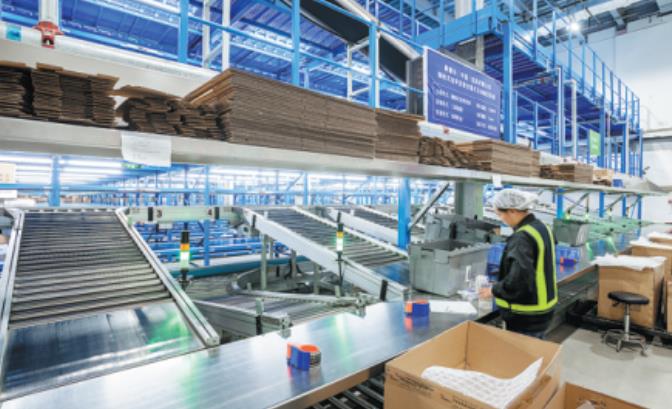
We have also been investing in robotics, on the picking and sorting side. Automating these processes improves speed, efficiency and accuracy and, with the use of sensors, enhances knowledge about inventory.
Which sectors in China do you think have more growth momentum and which sectors are declining?
China is one of the world's fastest-growing consumer markets, and it is perhaps growing faster than any other country in the world. Its consumption patterns are shaped by the digital world. There are 350 million millennials in China. In 2018, the total amount of online sales reached 9.01 trillion yuan, with a year-on-year increase of 23.9 percent.
As digital natives, this generation is used to getting their goods fast and also have higher requirements on the quality of goods and services. Such demands drive the increasing imports today in China.
We have seen domestic consumption gradually becoming a key driver for the logistics market.
As logistics facilities sit at the back end of the supply chain, versus the consumer-facing side at the front, this will boost demand for logistics services and facilities in China.




















