



Brawny robots for brainy tots







Educational toys, new-age learning tools spin big money for startups, giants alike
Fancy your child aged 6-12 building robots and programming them with self-written software using new-age tools and toys made by Chinese educational technology, or ed tech, firms?
Well, if he/she hasn't done that yet, it could mean he/she may want to catch up with over 5 million children around the world who have been using educational robots or intelligent hardware made by Chinese startup Makeblock (2017 sales: 203 million yuan or $29.6 million, 70 percent of which came from overseas).
Such startups are eyeing a potential multibillion-dollar global market for tech-powered learning tools for children.
Makeblock claims it has sold its robot kits in over 140 countries where over 5 million children in more than 20,000 schools use them.
In France, over 6,000 French primary and secondary schools are using Makeblock-based software and courses.
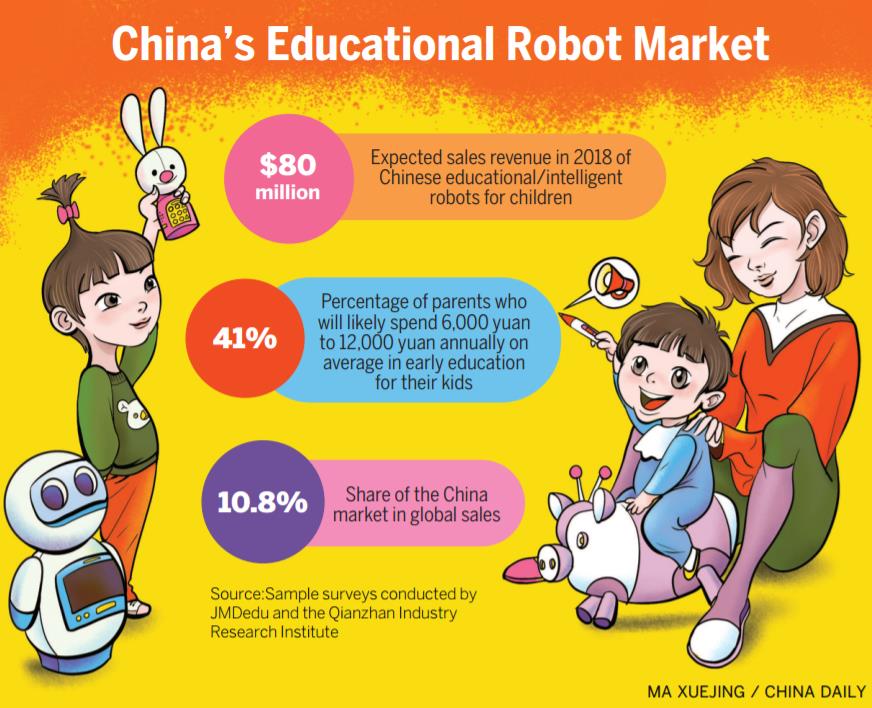
Industry sales in 2018 are estimated to reach $80 million in China alone, almost 10.8 percent of the global total, according to a report from Chinese ed tech firm JMDedu.
Such potential can be linked to Chinese kids such as Beijing's Chris Chen, 6, who can immerse themselves in cerebral tasks like robot-building and code-writing a whole afternoon.
Chen's mother Qin Liu, in her late 30s, an engineer with a Beijing-based internet company, said her son is still learning the English alphabet at the kindergarten, but can assemble Lego-like kits into a beetle, a cat and a frog in a jiffy.
Do-it-yourself or DIY block-building, or assembling stuff from kits comprising motors, wires, wheels, sensors and LED lights, is just the start.
Next is commanding the object, typically a robot, to perform or execute tasks-simple actions like moving back and forth-through self-developed code, using related mobile apps.

The level of skill required for DIY assembly and coding varies as per the user's age, said Wang Jianjun, founder and CEO of Makeblock.
Kids like Chen, for example, only need to assemble less than 10 components and write one sentence of code, to build a functional toy robot.
"Our business is to combine technology with education to teach kids how to build robots and how to code," said Wang.
Qin said she would like to invest more time and energy in educating her son at an early age. These days, early education cannot be considered complete without some training in skills that kids will likely use eventually as adults, she said.
"For me, building a toy robot is more meaningful than playing with a toy car. A kid can thus learn to develop his or her logical thinking and design skills while playing."
Agreed an analyst with research consultancy iiMedia. "Educational robots are gaining traction" thanks to modern-minded parents such as Qin who spend liberally on ed tech tools.
According to a survey report from the Qianzhan Industry Research Institute, more young parents would like to pay for early-age education.
Among parents surveyed, over 41 percent would like to spend 6,000 yuan to 12,000 yuan annually on early-education products and services.
No wonder, global sales of educational robots are expected to reach $11.1 billion by 2021 from around $3 billion in 2018.
"The market is going to take off very soon. Companies marching into the field early will benefit. We will embrace the opportunity to become an industry leader," said Wang.
His dash for early mover advantage comes from the realization that even tech giants such as Tencent Holdings Ltd and voice technology firm iFlytek Co are competing with startups in the emerging segment.
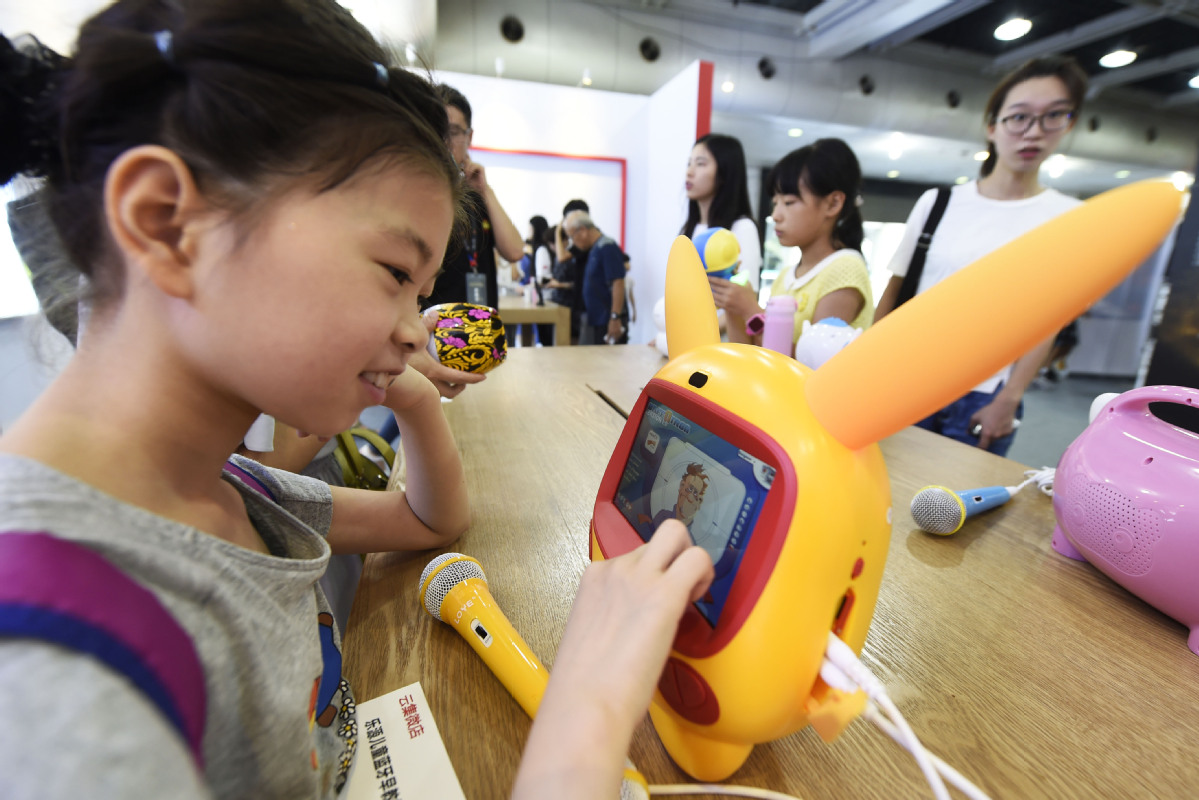
With strengths in voice recognition tech, Hefei, Anhui province-based iFlytek launched Alpha Egg, its latest educational robot, in September 2018. Alpha Egg helps parents by accompanying their children.

Hangzhou, Zhejiang province-based Cheng Quping, 43, father of two children, paid 2,900 yuan for the intelligent small-sized robot.
The doll-like robot can talk, tell stories and even run after his kids. When Cheng is away on business trips, he can view and chat with kids through the robot.
"Such robots play a key role in accompanying children. Especially for us parents who are really busy with our work, it's very helpful," said Cheng.
So impressed is Cheng with the little robot that he and his wife have set up a retail store for the product.
The birth of their second child two years ago turned out to be a turning point. All the kids-related tasks suddenly seem to have doubled for the parents.
"Now, when we help one child take a bath, the other baby sits quietly beside the robot and plays with it. What a relief!"
Guo Jia, founder and CEO of Turing, which mainly helps companies to develop robots, told a news outlet that compared with traditional robots, the latest products do much more than merely chat or answer simple questions.
When Turing designs a robot, it tries to ensure that the user can build some sort of relationship with the product. To illustrate this point, Guo has a dialogue with a robot.
"Sing a song," Guo commanded. The intelligent, almost intuitive robot retorted: "How did you know that I was about to sing?"
This kind of conversation lifts the interactivity element to a whole new level, he said. New-age robots display "moods", thus endearing themselves to the users (children) and extending stickiness-or the overall time spent by children with the smart toys.
In addition to robots, wearable devices like kids digital wrist watches are popular among parents in China. International Data Corp said there are at least 500 smart kids watch firms now in the country.
Hefei, Anhui province-based Ji Jing, 30, mother of Anchor Chang, 9, a second-grade student, bought a 700-yuan smart watch for him as he told her all his classmates wear similar intelligent watches, which do much more than display time.
"Unlike robots, smart watches are not expensive and they are worth their price," said Ji. Chang mainly uses his watch to communicate with his classmates and parents using audio and text.
Ji said smart watches are safer than smartphones insofar as protecting children from addictive or harmful content is concerned.
Lyu Senlin, founder and chief researcher at the Learneasy Times Online Education Research Institute, an industry research consultancy, said intelligent hardware such as educational robots has a long way to go in China, in terms of application of advanced technologies such as artificial intelligence.
"With the advancement of technologies, the intelligence level of such robots will be very high in some countries. For example, some robots can even blink their eyes," he said.
Lyu predicted that educational robots and companion robots will still act as digital assistants for a long time to come, and it remains to be seen whether the emerging market will spawn some iconic brands.




















