

<tt id="6hsgl"><pre id="6hsgl"><pre id="6hsgl"></pre></pre></tt>
          <nav id="6hsgl"><th id="6hsgl"></th></nav>
          国产免费网站看v片元遮挡,一亚洲一区二区中文字幕,波多野结衣一区二区免费视频,天天色综网,久久综合给合久久狠狠狠,男人的天堂av一二三区,午夜福利看片在线观看,亚洲中文字幕在线无码一区二区
          Colin Mackerras
          Australian Sinologist
          BORN:

          Aug 26, 1939, in Sydney, Australia

          EDUCATION:

          1961: Bachelor of Arts, Melbourne University

          1962: Bachelor of Arts, Honors, Australia National University

          1964: Master of Letters, Cambridge University

          1970: PhD, Australia National University

          CAREER:

          1974-2004: Foundation professor in the Department of International Business and Asian Studies, Griffith University

          1979-85: Chairman, School of Modern Asian Studies, Griffith University

          1988-89: Head, School of Modern Asian Studies

          1988-96: Co-director of the Key Centre for Asian Languages and Studies, Griffith University and University of Queensland

          1996-2000: Head of the School of Modern Asian Studies, later Asian and International Studies

          2004-13: Adjunct professor in the Department of International Business and Asian Studies, Griffith University

          2004-present: Professor emeritus in the Department of International Business and Asian Studies, Griffith University

          2007-present: Honorary professor at Beijing Foreign Studies University

          2011-13: Director, Tourism Confucius Institute, Griffith University

          2011-13: Chair professor, Renmin University of China

          2013-present: Honorary director, Tourism Confucius Institute, Griffith University

          HONORS:

          1981: Gold Citation for the Media Peace Prize, awarded by the United Nations Association of Australia

          1993: 20th Century Award for Achievement, International Biographical Centre, Cambridge, England

          2000: Millennium Medal of Honor, American Biographical Institute

          2007: Officer of the Order of Australia

          Veteran sinologist builds a bridge to Austrailia

          Colin Mackerras took a leap of faith by being the first Australian to live and work in China
          Yang Wanli

          Editor's note: Last year marked the 40th anniversary of the launch of China's reform and opening-up policy. China Daily profiles people who experienced or witnessed the important drive.
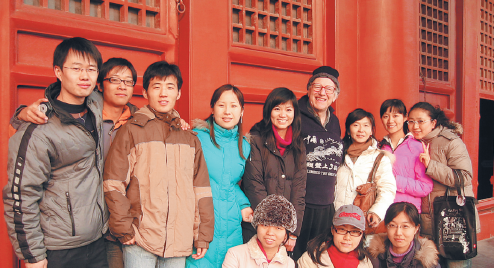
          Colin Mackerras poses for a picture with his students at the Beijing Foreign Studies University in Beijing. China Daily

          Sinologist Colin Mackerras said his children think he and his wife Alyce, were "incredibly brave" to be the first Australians to work and live in China in 1964, before the two countries had diplomatic relations.

          They even had a baby in the country, the first Australian born in the People's Republic.

          Mackerras was pursuing a master's degree at Cambridge University in the United Kingdom in the 1960s when he learned that foreign-language teachers were needed in China. He decided to give it a try despite the different geopolitical conditions back then.

          A fluent speaker of Mandarin, Mackerras said he has been to China about 70 times and taught over 500 Chinese students.

          "China has witnessed tremendous changes over the decades," he said. "When I first came to Beijing, few people could speak English and foreigners were also rare at that time.

          "Thanks to the country's reform and opening-up policy, now even taxi drivers can communicate with foreigners with some simple sentences in English."

          As a fan of traditional Chinese arts especially opera, Mackerras is also impressed by the diversity of art forms that have blossomed in China.

          "Different from the 1960s, when most art forms available to the public were those traditional ones, such as Peking Opera and Kunqu Opera, now lots of modern elements have been introduced into the traditional art forms, from the costumes to the performing style," he said.

          Mackerras said it has also been encouraging to see overseas art forms, such as Western opera, ballet, musical, modern dance and orchestral music find a growing number of Chinese fans.

          Once again teaching in Beijing, he visits the National Center for the Performing Arts nearly every week.

          "The center is always well attended," he said. "Thanks to the country's reform and opening-up, we can see more and more connections and shared interests between China and the world."

          Over the decades, Mackerras has visited all the country's provinces, municipalities and autonomous regions. He said the improvement in infrastructure, especially the railway system, is one of China's most outstanding achievements.

          "Not only metropolises, but those second-and third-tier cities are connected by high-speed trains," he said. "Within 18 hours, you can travel from the very north to the south. And the train is running superfast, almost without noise inside. Such a high-standard railway network is amazing."

          Mackerras said the rapid development of China had triggered worries in many countries about potential "threats" from a rising power in the international community.

          He said that "as a foreigner who has spent nearly half of my life in China", he thought such perceptions resulted from bias.

          "Some slanders we've heard are not what China really is," Mackerras said. "Taking the Belt and Road Initiative as an example. If we review the history, those 'explorations' conducted by Western people, including Cristopher Columbus, Ferdinand Magellan and Vasco da Gama, were all followed by invasion, without exception."

          However, he said, China's overseas voyages, from monk Jianzhen's journey to Japan and diplomatic envoy Zheng He's voyages to the South China Sea, the Indian Ocean and beyond in ancient times, to today's Belt and Road Initiative, have not been accompanied by invasion, but instead have been about trying to build closer ties with the rest of the world for joint development.

          "President Xi Jinping emphasized the importance of building a community of shared future for mankind and a win-win situation," he said. "He never mentioned 'China first' as the country's overseas strategy. I believe that is China's real attitude as a rising power."

          The academic papers and dozens of books about China that Mackerras has written over the years and his teaching of English in Chinese colleges have made him a bridge that has contributed to the China-Australia friendship.

          "Education plays a crucial role, not only for a country's future development but also for cross-border communication and a better understanding between different cultures," he said. "It is one of a country's most important investments."

          Over the decades, he has advocated exchange programs for teachers and students between China and Australia.

          "In future, global communities will be connected more closely," Mackerras said. "Only through learning from others can you think from the angle of the outside world and know the thinking of others, which is extremely valuable to both individuals and a country."


          Colin Mackerras
          Australian Sinologist
          BORN:

          Aug 26, 1939, in Sydney, Australia

          EDUCATION:

          1961: Bachelor of Arts, Melbourne University

          1962: Bachelor of Arts, Honors, Australia National University

          1964: Master of Letters, Cambridge University

          1970: PhD, Australia National University

          CAREER:

          1974-2004: Foundation professor in the Department of International Business and Asian Studies, Griffith University

          1979-85: Chairman, School of Modern Asian Studies, Griffith University

          1988-89: Head, School of Modern Asian Studies

          1988-96: Co-director of the Key Centre for Asian Languages and Studies, Griffith University and University of Queensland

          1996-2000: Head of the School of Modern Asian Studies, later Asian and International Studies

          2004-13: Adjunct professor in the Department of International Business and Asian Studies, Griffith University

          2004-present: Professor emeritus in the Department of International Business and Asian Studies, Griffith University

          2007-present: Honorary professor at Beijing Foreign Studies University

          2011-13: Director, Tourism Confucius Institute, Griffith University

          2011-13: Chair professor, Renmin University of China

          2013-present: Honorary director, Tourism Confucius Institute, Griffith University

          HONORS:

          1981: Gold Citation for the Media Peace Prize, awarded by the United Nations Association of Australia

          1993: 20th Century Award for Achievement, International Biographical Centre, Cambridge, England

          2000: Millennium Medal of Honor, American Biographical Institute

          2007: Officer of the Order of Australia

          Veteran sinologist builds a bridge to Austrailia

          Colin Mackerras took a leap of faith by being the first Australian to live and work in China
          Yang Wanli

          Editor's note: Last year marked the 40th anniversary of the launch of China's reform and opening-up policy. China Daily profiles people who experienced or witnessed the important drive.

          Colin Mackerras poses for a picture with his students at the Beijing Foreign Studies University in Beijing. China Daily

          Sinologist Colin Mackerras said his children think he and his wife Alyce, were "incredibly brave" to be the first Australians to work and live in China in 1964, before the two countries had diplomatic relations.

          They even had a baby in the country, the first Australian born in the People's Republic.

          Mackerras was pursuing a master's degree at Cambridge University in the United Kingdom in the 1960s when he learned that foreign-language teachers were needed in China. He decided to give it a try despite the different geopolitical conditions back then.

          A fluent speaker of Mandarin, Mackerras said he has been to China about 70 times and taught over 500 Chinese students.

          "China has witnessed tremendous changes over the decades," he said. "When I first came to Beijing, few people could speak English and foreigners were also rare at that time.

          "Thanks to the country's reform and opening-up policy, now even taxi drivers can communicate with foreigners with some simple sentences in English."

          As a fan of traditional Chinese arts especially opera, Mackerras is also impressed by the diversity of art forms that have blossomed in China.

          "Different from the 1960s, when most art forms available to the public were those traditional ones, such as Peking Opera and Kunqu Opera, now lots of modern elements have been introduced into the traditional art forms, from the costumes to the performing style," he said.

          Mackerras said it has also been encouraging to see overseas art forms, such as Western opera, ballet, musical, modern dance and orchestral music find a growing number of Chinese fans.

          Once again teaching in Beijing, he visits the National Center for the Performing Arts nearly every week.

          "The center is always well attended," he said. "Thanks to the country's reform and opening-up, we can see more and more connections and shared interests between China and the world."

          Over the decades, Mackerras has visited all the country's provinces, municipalities and autonomous regions. He said the improvement in infrastructure, especially the railway system, is one of China's most outstanding achievements.

          "Not only metropolises, but those second-and third-tier cities are connected by high-speed trains," he said. "Within 18 hours, you can travel from the very north to the south. And the train is running superfast, almost without noise inside. Such a high-standard railway network is amazing."

          Mackerras said the rapid development of China had triggered worries in many countries about potential "threats" from a rising power in the international community.

          He said that "as a foreigner who has spent nearly half of my life in China", he thought such perceptions resulted from bias.

          "Some slanders we've heard are not what China really is," Mackerras said. "Taking the Belt and Road Initiative as an example. If we review the history, those 'explorations' conducted by Western people, including Cristopher Columbus, Ferdinand Magellan and Vasco da Gama, were all followed by invasion, without exception."

          However, he said, China's overseas voyages, from monk Jianzhen's journey to Japan and diplomatic envoy Zheng He's voyages to the South China Sea, the Indian Ocean and beyond in ancient times, to today's Belt and Road Initiative, have not been accompanied by invasion, but instead have been about trying to build closer ties with the rest of the world for joint development.

          "President Xi Jinping emphasized the importance of building a community of shared future for mankind and a win-win situation," he said. "He never mentioned 'China first' as the country's overseas strategy. I believe that is China's real attitude as a rising power."

          The academic papers and dozens of books about China that Mackerras has written over the years and his teaching of English in Chinese colleges have made him a bridge that has contributed to the China-Australia friendship.

          "Education plays a crucial role, not only for a country's future development but also for cross-border communication and a better understanding between different cultures," he said. "It is one of a country's most important investments."

          Over the decades, he has advocated exchange programs for teachers and students between China and Australia.

          "In future, global communities will be connected more closely," Mackerras said. "Only through learning from others can you think from the angle of the outside world and know the thinking of others, which is extremely valuable to both individuals and a country."

          主站蜘蛛池模板: 精品无码久久久久成人漫画| 欧美一区二区三区成人久久片| 亚洲欧美在线观看品| 97成人碰碰久久人人超级碰oo| 亚洲男女羞羞无遮挡久久丫| 精品偷拍一区二区三区| 色偷偷www.8888在线观看| 国产成人精品一区二区| 免费无码观看的AV在线播放| 麻豆果冻传媒2021精品传媒一区| 成年黄页网站大全免费无码| 在线看片免费不卡人成视频| 亚洲人成网站在小说| 无码少妇一区二区三区浪潮av| A男人的天堂久久A毛片 | 国产黄色免费看| 国产超高清麻豆精品传媒麻豆精品 | 亚洲中文字幕国产精品| 国产小视频一区二区三区| L日韩欧美看国产日韩欧美| 国产18禁一区二区三区| 久久精品第九区免费观看| 韩国亚洲精品a在线无码| 亚洲国产一区二区三区,| 亚洲日产无码av| 亚洲色成人网站www永久四虎| 边添小泬边狠狠躁视频| 高颜值午夜福利在线观看| 国产精品人妻中文字幕| 久操线在视频在线观看| 国产影片AV级毛片特别刺激| 亚洲av久久精品狠狠爱av| 国产精品国产自线拍免费软件| 两个人的视频高清在线观看免费 | 国产成人精品午夜在线观看| 国产一区二区在线观看的| 办公室强奷漂亮少妇视频| 青青草国产线观看| 色噜噜狠狠成人综合| 偷拍亚洲一区二区三区| yy6080免费毛片一级|