An epic tale of two halves







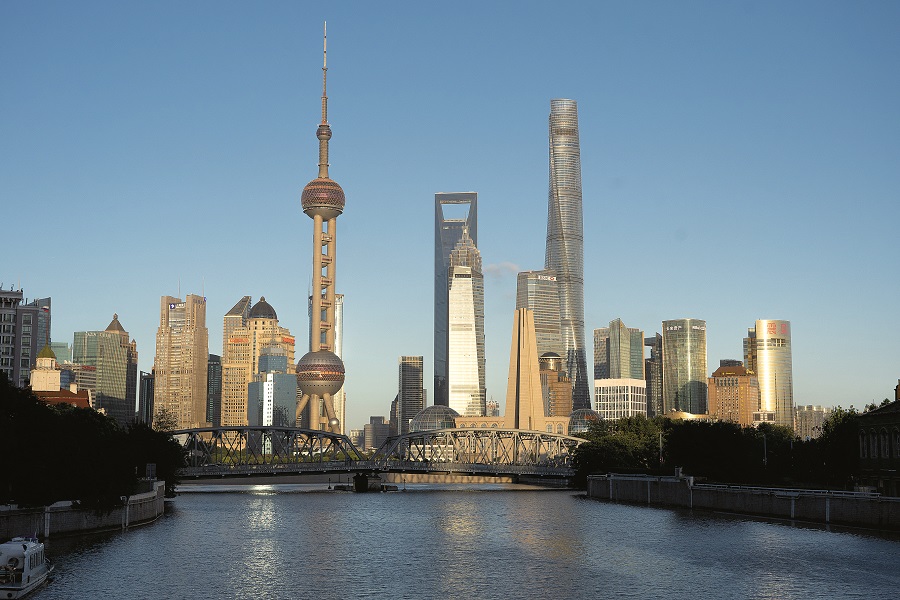
He Jianming’s first encounter with the Pudong area in Shanghai came courtesy of a blind date that took place 30 years ago.
Arranged by his friends, the date took place along the Bund, the western bank of the Huangpu River which was frequented by young love birds.
But He, who was then a young officer in the military, pointed out to his date that they should avoid the crowds along the waterfront and head across the river where it was quieter. He was promptly chided for his suggestion.
“Are you stupid? That’s Pudong, not Shanghai!” He recalled the girl saying.
It was then that he discovered the perception held by many of those who lived in Puxi, which literally means “river west”, that the zone across the river is considered backwater and not a part of the prosperous city of Shanghai. There was once even a local saying that “a bed in Puxi is better than a flat in Pudong”.
While Pudong was still defined by vast stretches of farmland and villages at the beginning of the 1990s, it is today home to the skyscrapers that define the Shanghai skyline, ports that handle millions of containers, industrial clusters for high-tech and medical industries, as well as thousands of professionals from across the world.
The rise of this zone from farmland to commercial powerhouse and how it reflects the success of China’s reform and opening-up is what He, who is presently the vice chairman of the China Writers Association, is aiming to show the world today through his new book Pudong Epic.

Launched in November, the 400-page book details the rapid growth and significant developments that took place in this part of Shanghai. To write the book, He interviewed more than 100 people, including locals, officials and businessmen who were involved in Pudong New Area’s development since the country’s central government announced the initiative in April 1990 to turn the area into an experimental zone for piloting opening-up policies.
He also examined a host of government files and meeting minutes to recount how China’s leaders such as Deng Xiaoping decided to single out Pudong as a special zone, how Shanghai’s mayors carried out the plan and how Pudong district officials bargained with international companies to attract investment without sacrificing the country’s interests.
Hu Wei, governor of the Pudong New Area from 2000 to 2003, praised the book for being so thorough in its research.
“In the early years of Pudong’s development, we said that there should be a book to document this progress. We even invited a writer to attend all our close-door meetings and write a book, but unfortunately that book project did not become a reality,” Hu said.
“There were books about Pudong afterward, but they don’t carry the same weight as He’s book. On behalf of all who contributed to the development of Pudong, I pay tribute to He for writing down their dreams and glories in Pudong Epic.”

The humble office
Amid the present-day landscape of the Lujiazui financial district, it is easy to overlook an innocuous-looking two-story building that sits on No 141 Pudong Avenue. Just a few blocks away are futuristic structures such as the Shanghai Tower and the Oriental Pearl TV Tower.
But a large billboard standing in front of the small building was what attracted He. It bears a portrait of Deng Xiaoping and his quote “Concentrate on the development of Pudong, do not waver until the job is completed.” This building is prominently mentioned in his book.
From 1990 to 2000, this humble building served as the government administrative office for the ambitious Pudong development project backed by Deng.
Ten years before the State Council announced its plans to develop Pudong, the central government had already established four special economic zones in 1980 — Shenzhen, Zhuhai, Shantou in South China’s Guangdong province and Xiamen in East China’s Fujian province — with more open policies and less market entry barriers for foreign investment.
Deng spent the Spring Festival in Shanghai every year from 1988 to 1994. During his visit, he listened to the plans regarding Pudong’s development and closely monitored its progress.
In order to differentiate Pudong with other special economic zones, the central government named it Pudong New Area, which became the first State-level “new area” that enjoyed more autonomy than special economic zones when it comes to designing local opening-up policies.
In the following years, Pudong achieved many national firsts — it had its first stock exchange, its first joint-venture retail company, its first bonded area, its first diamond exchange, and first free trade zone.

Notable developments
The news of the development and opening-up of Pudong New Area spread from the small office building to the world, luring investment and projects to land on the “new area” in the 1990s.
In his book, He profiled the most significant of these projects, which include the construction of the Nanpu Bridge that connects Pudong with Puxi.
The bridge, which prominent Chinese American engineer Tung-Yen Lin helped to design, was pivotal in solving the transportation bottleneck that affected the city at that time. He also wrote about the construction of the cable-stayed Yangpu Bridge which was the longest of its kind in the world when it was completed in 1993.
Another project that is mentioned in the book is the construction of the Oriental Pearl TV Tower. He wrote that the idea behind this structure came from Zou Fanyang, the previous director of the Shanghai Radio and Television Bureau who was inspired by the CN Tower in Toronto during a visit in the early 1980s.
He also documents the building of the 492-meter Shanghai World Financial Center which was beset with many delays — the 1997 Asian financial crisis, the Sept 11 terror attack in New York and the 2003 SARS epidemic in China.
The Shanghai Disneyland project is also mentioned. He reveals that though the idea of the theme park was brought up in 1990 by the then Shanghai mayor Zhu Rongji, real negotiations did not start until 2001. It was only in 2016 that the park finally opened.
“There is no project more difficult than the Disneyland development,” said Cheng Fang, a former official with Pudong district government who participated in the whole negotiation.
“It was the success of the Shanghai World Expo that helped us secure the deal, and the strong development of our country gave us confidence in negotiating with Disney,” Cheng added.
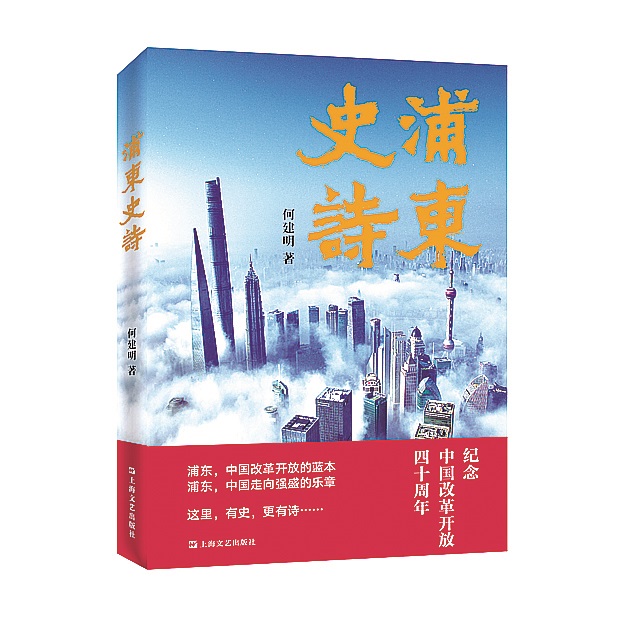
Reliving memories
Many of He’s interviewees attended the launch on Pudong Epic on Nov 26 and shared their thoughts of the book.
Sha Lin was among the first officials to work in the Pudong development office in the small building in Lujiazui.
Although Sha, who was then the deputy director of the office, has close knowledge of Pudong’s development, he said that reading He’s book allowed him to view that moment in history from a much wider perspective. He also enjoyed reliving those times through He’s words.
“The book is like a biography of dream chasers who contributed to building Pudong while chasing their dreams, and we should always remember these individuals,” he added.
Wang Ande, the first general manager of the Lujiazui Financial and Trade Development Co, said that reading the book reminded him of the days when he worked in the No 141 building.
“Everyone came to the office full of energy,” Wang recalled. “But the book is not just about us — it also tells the stories of the indigenous residents in Pudong who made sacrifices to support the government initiative for relocation, and the business elites who came from home and abroad. The development of Pudong would not have been so successful without their contributions.”
He said that in hindsight, his book can be considered a love novel of sorts.
“Come think of it, this is a story about a couple was divided by the river that gets reunited in the end,” he quipped.




- China, Algeria expand space cooperation with new satellite launch
- Cross-Strait Chinese New Year bazaar unites cultures in Fuzhou
- Emergency Management Minister Wang Xiangxi under investigation
- Overseas-Chinese group tours Xinjiang as special guests
- China launches satellite for Algeria
- Capital accelerates humanoid robot mass production