


Historic Centre of Macao








Category of site: Cultural site
Brief introduction
The Historic Center of Macao includes the oldest Western architectural heritage on Chinese soil today. Together with Macao's traditional Chinese design, it stands witness to successful East-West cultural pluralism and architectural traditions.
The center is a solid testimony of the city's missionary role in the Far East while also reflecting the dissemination of Chinese folk beliefs to the Western world.
It is the product of East-West cultural exchanges, forming the most unique blend of cultural heritage existing in China's historic cities.
The center presents a complete social infrastructure that has encompassed and sustained the living traditions of different cultures.
Macao was added to the list on July 15, 2005.
History
Macao, a bustling port of strategic importance in the development of international trade, was under Portuguese administration from the mid-16th century until 1999 when it came under Chinese sovereignty.
The emergence of Macao with its dual function as a gateway into China, and as a window to the world of Ming Dynasty, reflected a relaxation of certain restrictions combined with a degree of open-mindedness that offered a creative way to supplement China's vassal-state trading system and marked a turning point in the history of both China and Europe.
The settlement of Macao by Portuguese navigators in the mid-16th century laid the basis for nearly five centuries of uninterrupted contact between East and West. The origins of Macao's development into an international trading port make it the single most consistent example of cultural interchange between Europe and Asia.
For almost three centuries, until the colonization of Hong Kong in 1842, Macao's strategic location at the mouth of the Pearl River meant that it retained a unique position in the South China Sea, serving as the hub in a complex network of maritime trade that brought tremendous wealth and a constant flow of people into the enclave.
Cultural pluralism
Macao, as the West's first established gateway into China, was remarkable in establishing a succession of connections and contacts that progressively enriched both civilizations across a huge range of human endeavor, both tangible and intangible.
People of different nationalities came, bringing their own cultural traditions and professions, permeating the life of the city as can been seen in both intangible and tangible influences. This is evident in the introduction of foreign building typologies such as Western-style fortresses and architecture.
Macao also inherited various cultural experiences and regional influences, further developing these in conjunction with the local Chinese culture and blending them to produce the rich texture seen in the city's exceptional heritage.
The Historic Center of Macao is the beating heart of the Western settlement, also known as the "Christian City" in the past. Exposure to diverse cultures in this lasting encounter between the Eastern and Western worlds has therefore benefited Macao in assimilating a rich array of cultural heritage.
"Firsts" for China in Macao
During the late Ming (1368-1644) and early Qing (1644-1911) dynasties, missionaries from different European religious orders, such as the Jesuits, the Dominicans, the Augustinians, and the Franciscans, entered China through Macao. They made efforts to engage in missionary work and brought with them a certain cultural influence.
The missionaries introduced Western concepts of social welfare and founded the first Western-style hospitals, dispensaries, orphanages, and charitable organizations. Besides, they brought in the first movable-type printing press to be used on Chinese soil, and published the first paper in a foreign language.
As Macao was the base for the Jesuit mission in China and other parts of East Asia, the priests entering into China service would always come first to Macao where, at St. Paul's College, they would be trained in the Chinese language together with other areas of Chinese knowledge, including philosophy and comparative religion. Macao was thus the training ground for the Jesuit's mission to China and other parts of Asia.
St. Paul's College was the largest seminary in the Far East at the time, acclaimed as the first Western-style university in the region.
Other achievements of Christian missionaries in Macao include the production of the first English-Chinese Dictionary and the first Chinese translation of the Bible by Robert Morrison.
The worship of A-Ma in Macao originated with the folk beliefs of fishermen living along the coast of South China. Due to Macao's special position in channeling cultural exchanges between East and West, the A-Ma Temple has played a prominent role as the earliest reference to A-Ma worship abroad.
Strolling through the Historic Center of Macao
The A-Ma Temple is located on the southwestern tip of the Macao Peninsula overlooking Barra Square and the seashore. Around the corner of the A-Ma Temple is the Moorish Barracks situated on Barra Street. Further up the road, the narrow street suddenly opens onto Lilau Square, the first residential district of the Portuguese settlers in history where the Mandarin's House is just tucked behind the pastel facades across the street.
Further up the road, Barra Street runs into Padre António Street and Lourenco Street where St. Lawrence's Church stands. Behind the church, Prata Street leads to the junction of S?o José Street where the grand entrance to St. Joseph's Seminary and Church is located.
Walking alongside the granite wall on Prata Street and the adjoining Seminário Street, one arrives at the junction of Gamboa Lane. Climbing up the hill from there, the path leads to St. Augustine's Square enclosed by a cluster of monuments - St. Augustine's Church, the Sir Robert Ho Tung Library, and the Dom Pedro V Theatre.
Moving down Tronco Velho Lane to Almeida Ribeiro Avenue, the narrow streetscape opens onto the main city square - Senado Square. Situated at one end, the "Leal Senado" Building has a commanding view overlooking the entire square, flanked on both sides by South European-style buildings with the glimmering white facade of the Holy House of Mercy standing in its midst.
Tucked behind the commercial shop fronts to the left of the Leal Senado Building is the Sam Kai Vui Kun Temple. Climbing up the slope alongside the Holy House of Mercy, one eventually lands at Cathedral Square on the hilltop where the Cathedral is located. Turning back down to St. Dominic's Square, one passes a typical Chinese courtyard house compound - the Lou Kau Mansion.
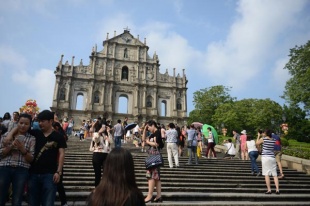
St. Dominic's Church is located at the junction of Senado Square and Dominic's Square. Ascending from the base of Mount Hill from this urban piazza along Palha Street, the bluestone cobbled road leads to the grand facade of the Ruins of St. Paul's, with Mount Fortress to the side of it.
Behind the majestic church front is the miniature Na Tcha Temple and Section of the Old City Walls. Further down the hill, the linear route ends at St. Anthony's Church, the Casa Garden and the Protestant Cemetery. Standing on the highest hill of Macao Guia Hill, Guia Fortress, Chapel and Lighthouse are visible along the skyline of the peninsula.